Key Takeaways
- Augmented sixth chords are chromatic predominants built on ♭6̂ in the bass + ♯4̂ in an upper voice — these two notes form an augmented sixth interval that resolves outward by half-step to an octave on 5̂
- Three types (Italian, French, German) differ only in their fourth note (1̂, 2̂, or ♭3̂); German aug6 risks parallel 5ths and often resolves via cadential 6-4 or drops ♭3̂ before V
- Aug6 chords have no root, no inversions (in practice), and are spelled identically in major and minor — easier to spot in major (more accidentals), but far more common in minor
What Is an Augmented Sixth Chord? ▶ 1:53
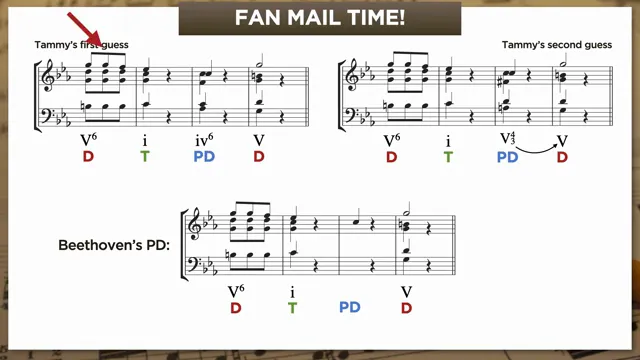
- Derived by combining ♭VI6 (bass + third) and vii°/V (tritone ♯4̂–1̂) — each "half-right" guess yields the full chord
- Sound-alike warning: out of context, aug6 chords sound like root-position V7; in context, they function as crunchy predominants
- Always appear before a cadential dominant (or cad. 6-4), near phrase endings
Spelling & Structure ▶ 4:28
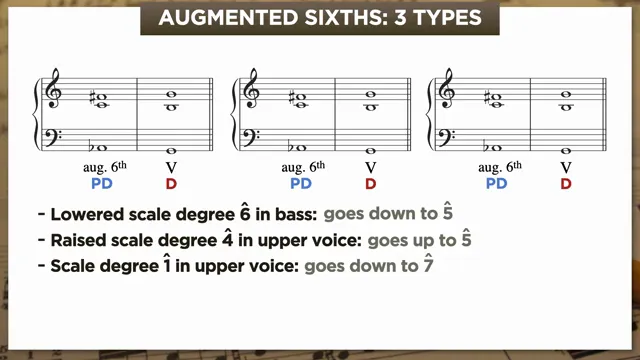
All three types share:
| Element | Note (C major) | Resolves to |
|---|---|---|
| Bass: ♭6̂ | A♭ | G (↓ half-step) |
| Upper voice: ♯4̂ | F♯ | G (↑ half-step) |
| Upper voice: 1̂ | C | B (↓ to leading tone) |
Fourth note distinguishes the types:
| Type | 4th Note | Behavior on resolution |
|---|---|---|
| Italian | 1̂ (doubled) | → 2̂ |
| French | 2̂ | common tone → 2̂ |
| German | ♭3̂ (P5 above bass) | → 2̂, but risks parallel 5ths |
Parallel 5ths & the German +6
The German aug6 contains ♭3̂ a perfect fifth above the bass (♭6̂). When both voices resolve by step — ♭6̂ → 5̂ in the bass and ♭3̂ → 2̂ in an upper voice — the result is parallel perfect fifths. Textbooks often insist the German +6 must resolve through a cadential 6-4 to avoid this, but as Monahan points out, "that's not true at all." Composers handle it in three different ways:
| Solution | Method | Used by |
|---|---|---|
| Cad. 6-4 first | Ger+6 → cad. ⁶₄ → V | Most common |
| Accept parallels | Ger+6 → V directly | Beethoven, some Romantics |
| Drop ♭3̂ | Change Ger to It+6 before resolution | Bach, careful voice-leaders |
-
Cad. 6-4: the intervening ⁶₄ chord breaks the voice-leading so ♭3̂ moves to 3̂ first, then 2̂ — no direct 5th-to-5th motion
-
Accept parallels: many real pieces just go Ger+6 → V; the parallel 5ths exist on paper but are masked by texture, register, or sheer dramatic momentum
-
Drop ♭3̂: the "sneaky" solution — the offending note (♭3̂, the P5 above the bass) disappears right before V arrives, effectively converting the German to an Italian +6 at the last instant; "Boom. No parallel fifths."
-
Spelled same in major/minor; in minor, only giveaway is ♯4̂ — check the bass for ♭6̂
Approaching Aug6 Chords ▶ 9:09
- Direct from tonic: most common; outer voices wedge apart by half-step into V (Mozart piano concerto examples — ▶ 9:17, ▶ 11:37)
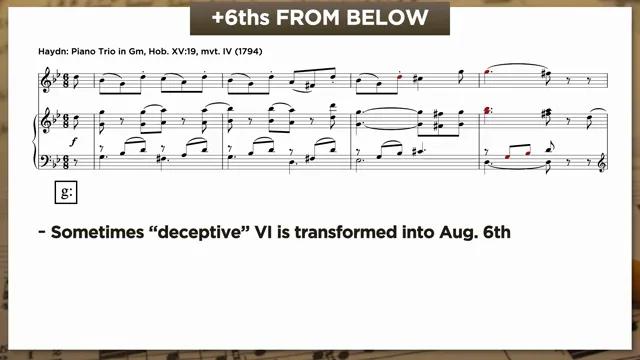
- From deceptive VI: V → VI, then add ♯4̂ to transform VI into German aug6 (Haydn piano trio — ▶ 13:30)
- Bass walk up from iv: bass line 4̂–5̂–♭6̂ (passing chord), top voice moves contrary: 6̂–5̂–♯4̂ (Haydn sentence — ▶ 14:50)
Hearing Aug6 vs. Other Predominants ▶ 16:42
All three share scale degrees 1̂, 4̂, 6̂ — difference is which versions (low/natural vs. raised):
| Chord | 4̂ | 6̂ | Sound quality |
|---|---|---|---|
| iv6 | natural | ♭ | soft, subdued |
| vii°6/V | ♯ | ♮ (raised) | bright, major-ish |
| Italian/German aug6 | ♯ | ♭ | tangy, most dissonant |
Aug6 in Lament Basses ▶ 19:41
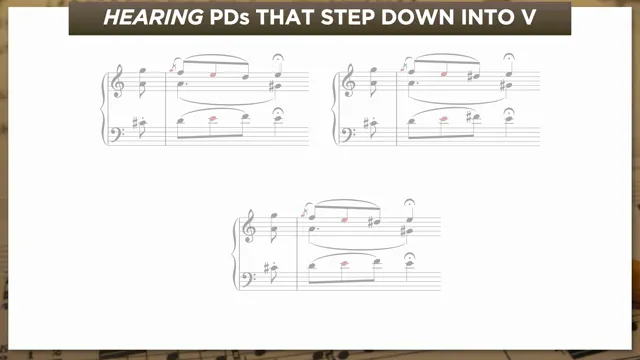
- Aug6 is a common 1-note substitution for iv6 as the penultimate chord before V in both diatonic and chromatic laments
- Chromatic lament variant: swap minor v6 for V4-2/iv → major IV6 → aug6 → V, producing a rising chromatic line in contrary motion to the bass
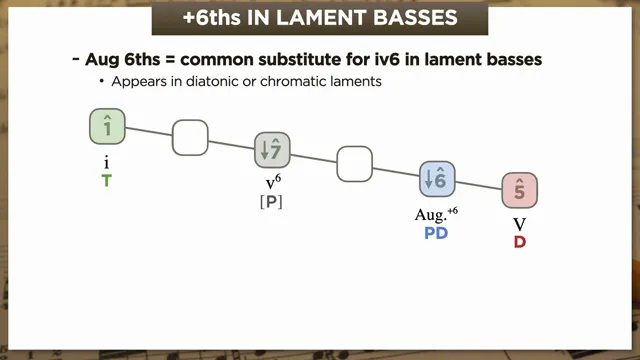
- Beethoven Coriolan Overture and Piano Concerto No. 3 use fully chromatic laments with aug6; harmonic rhythm accelerates through the lament to drive toward the half cadence (▶ 22:43, ▶ 26:46)
- Aug6 can also point to a non-tonic key: identify what ♭6̂ and ♯4̂ converge on — that's the local V (Mozart sonata modulation example — ▶ 24:32)
Aug6 → V7 (Special Case) ▶ 30:24
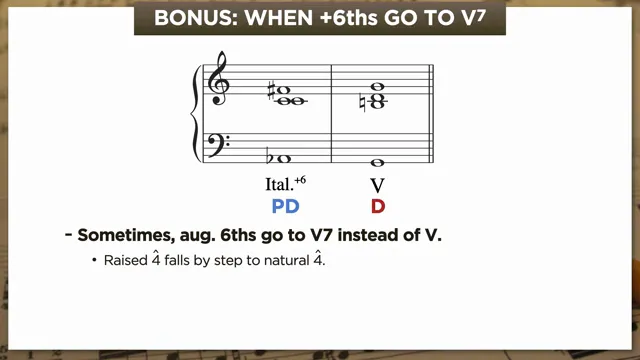
- When aug6 resolves to V7 instead of V, ♯4̂ falls a half-step to ♮4̂ (rather than rising to 5̂)
- Beethoven Appassionata slow movement example; also features enharmonic respelling of the German aug6 (F♭ → E♮) to avoid parallel 5ths on paper while keeping the sound — ▶ 30:56
Supplementary context from Kostka & Payne, Tonal Harmony (8th ed.), Ch. 22.