Key Takeaways
- Modulation = an actual change of tonic (not just a borrowed/applied chord); in the style studied here, the dominant of the new key is the clearest confirmation
- Pivot chords create smooth modulations via overlap; breakaway chords are the first chords that flatly contradict the old key — analysis requires listening, not just labeling
- Baroque/Classical defaults: major keys → dominant (V); minor keys → relative major (III) and/or minor dominant (v)
Core Concepts ▶ 2:00
- Modulation ≠ applied/borrowed chord — borrowing a chord doesn't change the tonic
- Smooth modulation: uses a pivot chord — a chord that functions in both the old and new key simultaneously (heard with "double meaning")
- Abrupt modulation: no pivot chord; composer simply swerves into the new key, often at a cadence boundary
- Breakaway chord: first chord that contradicts the old key (can't be plausibly labeled there) — signals the new key has taken hold
- Modulation strength varies: strong = extended time + cadential reinforcement in new key; weak = brief stay, little/no cadential support (debatable whether key change occurred at all)
Quick Reference: Identifying Pivot Chords
- Find the new dominant — locate where the dominant (V or V⁷) of the new key first appears convincingly
- Work backwards — from that dominant, step back through the preceding chords
- Test dual citizenship — find the last chord before the dominant that can be labeled in both the old key and the new key
- That's the pivot — label it with both functions (old key / new key); the next chord that only makes sense in the new key is the breakaway
- No overlap? — if no chord works in both keys, it's an abrupt modulation (no pivot chord)
Modulations & Cadences ▶ 6:49
- Most modulations involve cadences — either followed by an AC to cement the new tonic, or preceded by a cadence that creates a break opening space for a new key
- In this repertoire, a convincing dominant of the new key is the clearest way to confirm that the tonic has changed rather than merely been tonicized
Default Modulation Destinations ▶ 13:00
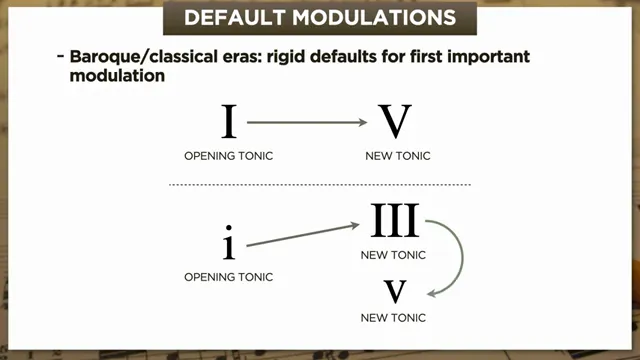
| Starting Mode | Primary Destination(s) |
|---|---|
| Major | V (dominant) |
| Minor | III (relative major) and/or v (minor dominant) |
Worked Examples
Beethoven op. 28 — D minor, 4 key changes in 8 bars ▶ 0:36
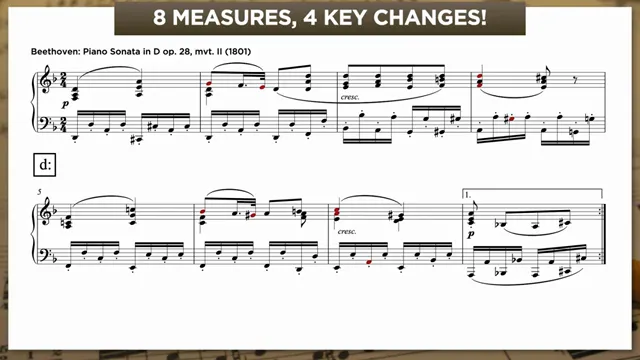
- D minor → F major (abrupt, after HC) → A minor (smooth, pivot = F major chord = I in F / VI in A minor) → D minor (abrupt, after PAC)
- Demonstrates both abrupt and pivot-chord modulations in a single theme
Mozart K. 284 — modulation to V (A major) ▶ 14:03
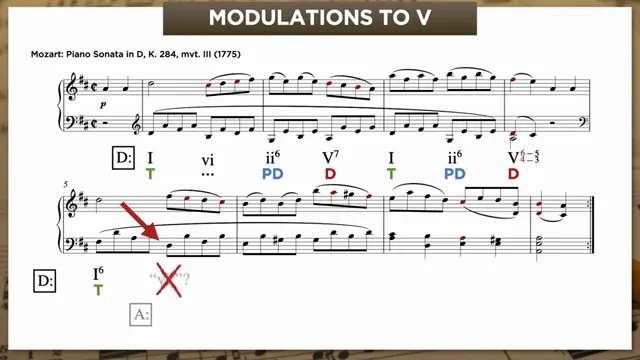
- Pivot: I⁶ in D = IV⁶ in A; breakaway: B minor triad (vi⁶ in D = ii⁶ in A) — ▶ full walkthrough 14:03
Haydn Symphony No. 104 — abrupt modulation to D major ▶ 15:47
- Deceptive resolution of V⁷ yanks directly into D major — no convincing pivot chord; C♯ heard immediately as new leading tone — ▶ 15:47
Haydn op. 55 no. 2 — F minor → A♭ major ▶ 20:34
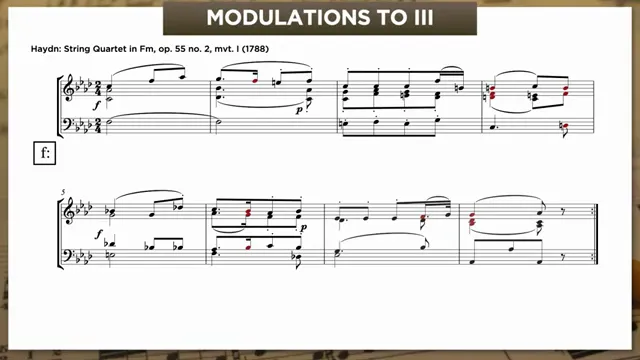
- Pivot: B♭ minor triad = iv⁶ in F minor / ii⁶ in A♭ major (same function in both keys) — ▶ full walkthrough 20:34
Haydn op. 20 — D minor → F major ▶ 23:00
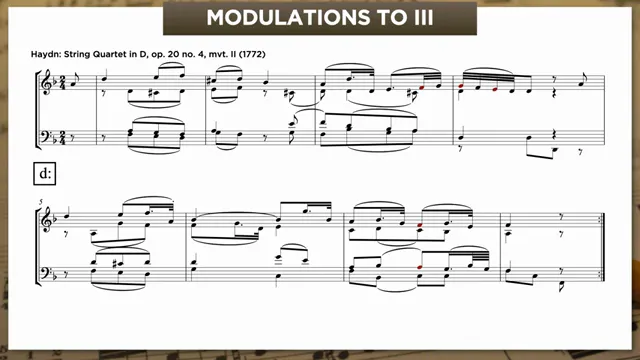
- Instructor hears last D minor triad (bar 5) as pivot (i in D / vi in F); Gm⁷ points forward, not backward — ▶ 23:00
Mendelssohn Songs Without Words no. 1 — G minor → D minor ▶ 25:26
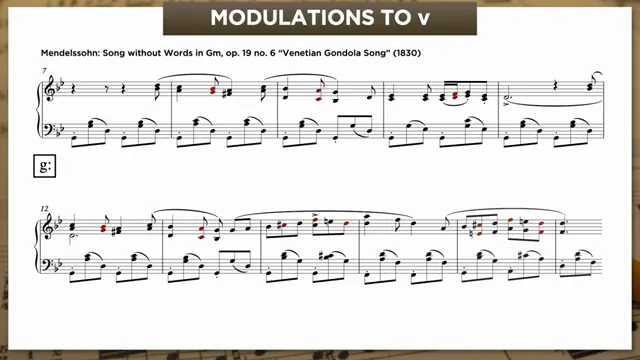
- Modulation to minor dominant (v); C♯/E♮ in melody and hypermetric stress on bar 15 signal D minor arrives as an arrival, not a passing chord — pivot heard at bar 14 beat 1 — ▶ 25:26
Supplementary context from Kostka & Payne, Tonal Harmony (8th ed.), Ch. 18.