Key Takeaways
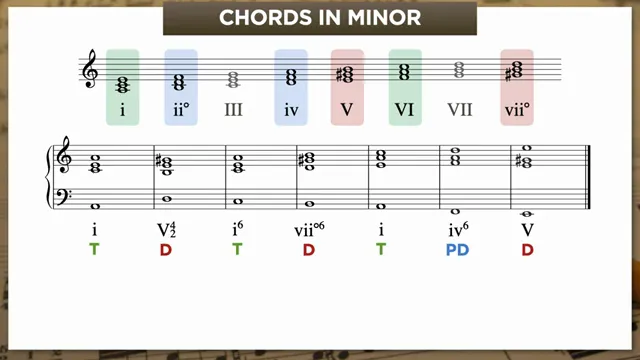
- III and VII in minor contain the subtonic (lowered scale degree 7̂), which displaces the leading tone and weakens dominant function—making the music sound as if it is drifting toward the relative major
- VII naturally acts as V of III; III sounds like a temporary tonic — giving both chords "scare-quote" functions: "D" and "T"
- When III/VII appear, it's usually a sign of modulation to the relative major; the rarer case (today's focus) is when they create a brief major-mode color shift without a full key change
Why III and VII Are Avoided ▶ 1:28
- Subtonic (♭7̂) = chord tone in VII and III; its presence forces out the leading tone (♯7̂)
- No leading tone → no dominant function → tonal center becomes ambiguous
- VII = V of III: subtonic seventh chord sounds like V7/I in the relative major
The "Color Shift" Use (No Modulation) ▶ 5:01
- III and VII can briefly evoke a major-mode aura without destabilizing the home key
- Signature gesture: melody rises by step as music moves toward III
- III receives function label "T" (tonic-like, restful but not true tonic); VII/V of III gets "D" (dominant-like)
La Folia Progression ▶ 5:28
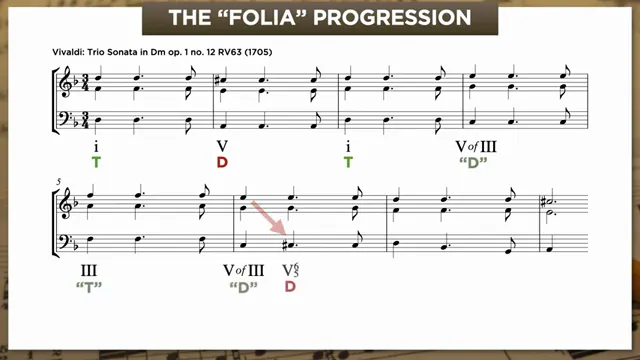
- La Folia: named Baroque progression in minor featuring a brief swing through III and VII; used by Vivaldi, Corelli, Handel, Scarlatti, Purcell
- Core structure: i → V | VII → III → ... → V (HC); leading tone reintroduced mid-phrase to pull back to minor tonic
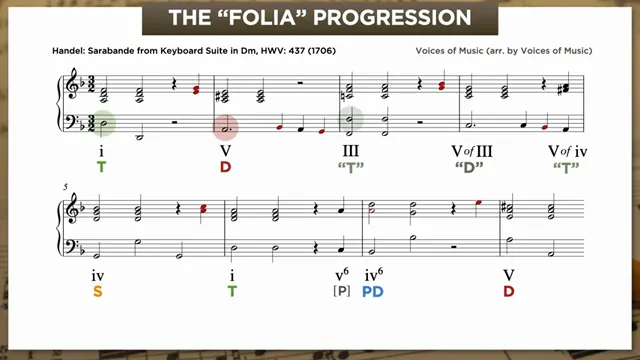
- Handel's variant ▶ 8:45: root-position chords in pairs, bass leaps up by 5th each pair: i–V, III–VII, IV–i, then lament bass to HC
Worked Examples ▶ 10:54
| Composer | Work | Key Feature |
|---|---|---|
| Beethoven | Symphony No. 5, mvt. 2 | Folia in A♭ minor; skips leading-tone re-entry (modal flavor) ▶ 10:54 |
| Beethoven | Bagatelle Op. 33 No. 2 | I–II–III bass; V6/III → III; melody rises into III ▶ 13:28 |
| Beethoven | Piano Concerto No. 4, mvt. 2 | Weak tonic opening; strong II–V7–I arrival on III ▶ 16:04 |
| Mendelssohn | Venetian Gondola Song Op. 19/6 | Bold III used for Mediterranean "exotic" color ▶ 18:20 |
| Schubert | Symphony No. 9, Andante | 9-bar phrase: i → III (melody rises) → i reset via leading tone in bass ▶ 19:39 |
| Chopin | Mazurka Op. 67 No. 2 | Parallel phrases in i then III; ♭VI chord reread as iv6 of relative major ▶ 21:50 |
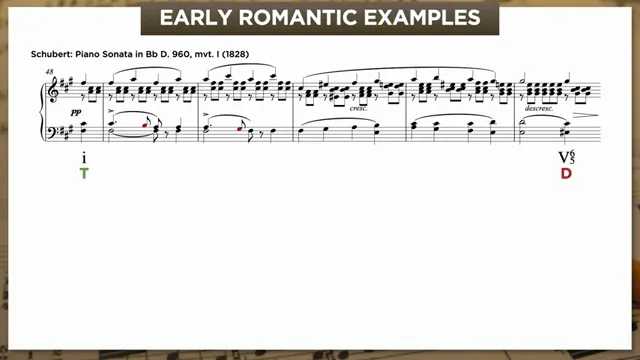
| Schubert | Piano Sonata D. 960 | ♯7̂/♭7̂ alternates 5 times; V7/III resolves deceptively in antecedent; consequent lets it resolve to PAC → full modulation ▶ 23:33 |
Key Pattern to Hear
- Melody rises + subtonic in bass = approaching III
- Leading tone returns in bass = snapping back to minor tonic
- Sustained III or full II–V–I into III = borderline/full modulation (→ Video 34)