Key Takeaways
- A common-tone diminished seventh (CT°7) retains a common tone—usually the target chord's root—into its resolution; a leading-tone diminished seventh normally resolves with no common chord tones
- CT°7 has no true root and no Roman numeral — spelling is irrelevant; leading-tone °7 spelling is destiny (root = leading tone, must resolve up by half-step)
- When vii°7/V resolves to a cadential 6-4, the apparent common tone (scale degree 1̂) is a suspension, not a chord tone—this is still a leading-tone °7, not a CT°7
Two Types of Diminished Seventh Chords ▶ 3:00
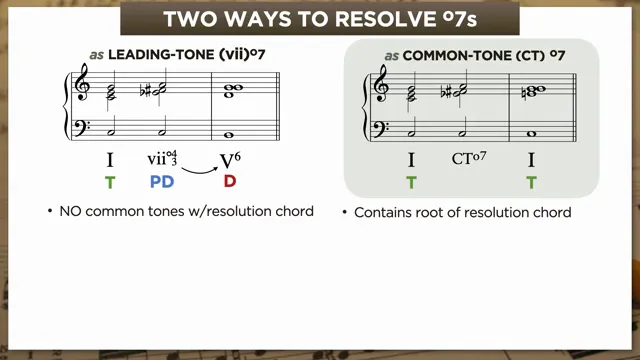
| Feature | Leading-Tone °7 | Common-Tone °7 |
|---|---|---|
| Label | vii°7 (or applied) | CT°7 |
| Root | Leading tone | None (no RN) |
| Common tones with resolution | None | 1 (the root of target chord) |
| Spelling | Matters — determines root | Irrelevant |
| Frequency | Very common | Rare, esp. before 1825 |
| Typical resolution | Any consonant chord | Root-position tonic |
| Function | Dominant | ~Subdominant |
- CT°7 is named for the common tone it shares with its resolution chord—usually the target chord's root and often placed in the bass—not for a functional root of its own
- CT°7 sounds subdominant-like: scale degree 1̂ is held in the bass while 6̂ resolves down to 5̂ (the same tendency found in IV)
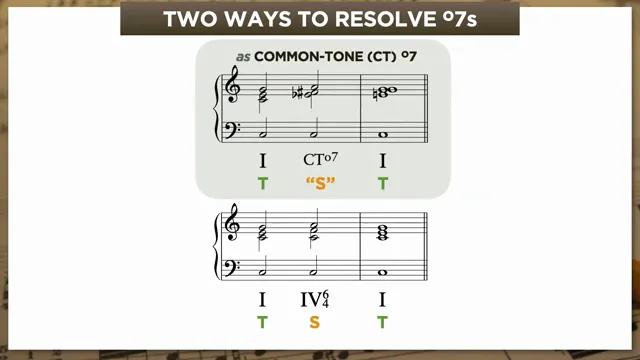
Identifying CT°7 vs. Leading-Tone °7 by Ear ▶ 14:53
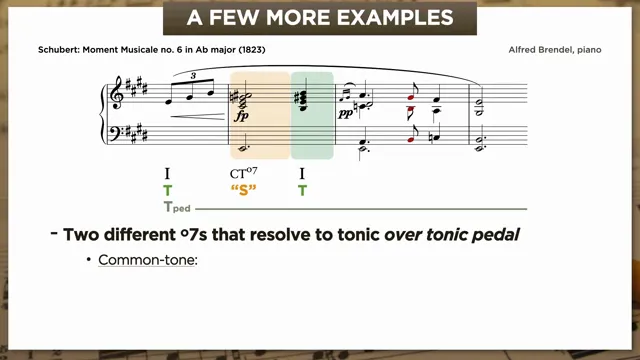
- CT°7: scale degrees 3̂ and 5̂ in the tonic chord are approached from below by half-step
- Leading-tone °7 (over tonic pedal): scale degrees 3̂ and 5̂ are approached from above by half-step
Less Common CT°7 Situations ▶ 16:02
- CT°7 can resolve to an inverted triad (not just root-position tonic) — the common tone is still the root of the target chord; see Das sieht' so aus analysis ▶ 17:00
- CT°7 can resolve to V7: all upper voices move up by half-step; best analyzed as lower neighbors (B, D, G#) to V7 chord tones — CT°7 label optional since figured bass covers it
The "Apparent Exception" Rule ▶ 21:03
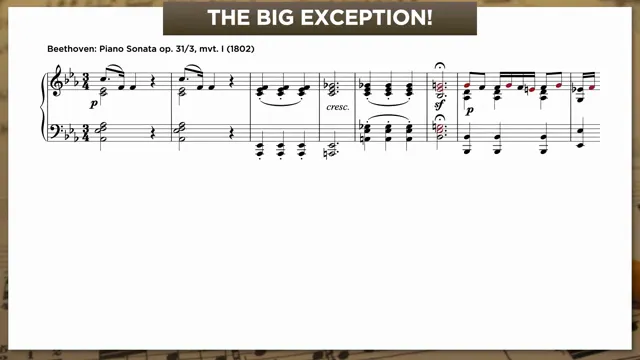
- vii°7/V → cadential 6-4: scale degree 1̂ appears as a common tone, but cadential 6-4 tones are non-chord tones—the 1̂ is a suspension that resolves to the leading tone
- Rule stands: leading-tone °7 never resolves with a common chord tone
CT°7 vs. Other Diminished 7ths
| CT°7 | Applied °7 (vii°7/x) | Diatonic vii°7 | |
|---|---|---|---|
| Function | Prolongation / embellishment (~subdominant color) | Dominant of a secondary key | Dominant of the home key |
| Resolution | Resolves to the chord whose root it shares (usually root-position I) | Resolves to its tonicized chord (e.g., vii°7/V → V) | Resolves to I |
| Common tone? | Yes — one note (usually the bass) is retained in the resolution chord | No — all voices move by step | No — all voices move by step |
| How to identify | Look for a bass pedal or held note that belongs to both the °7 and its resolution; no Roman numeral | Root is a half-step below the tonicized chord's root; labeled vii°7/x | Root is the leading tone of the home key; labeled vii°7 |
- If a fully diminished 7th chord shares a note with its resolution chord, it is almost certainly a CT°7
- If every voice moves (especially the root resolving up by half-step), it is a leading-tone type — determine diatonic vs. applied by checking whether the target chord is tonic or a secondary harmony
Worked Examples
- Schubert, String Quintet in C major — same °7 chord used first as CT°7 (→ I), then as vii°7/V (→ V): ▶ 0:12
- Brahms, Symphony No. 3 — most famous CT°7 in the canon, bass pedal on F throughout: ▶ 8:32
- Delibes choral piece — CT°7 with accented NCTs creating a complete dominant 7th over tonic pedal: ▶ 12:09
- Tchaikovsky, Symphony No. 6 — CT°7 in basic idea + vii°7/V → cadential 6-4 exception: ▶ 23:41
Supplementary context from Kostka & Payne, Tonal Harmony (8th ed.), Ch. 24.