Key Takeaways
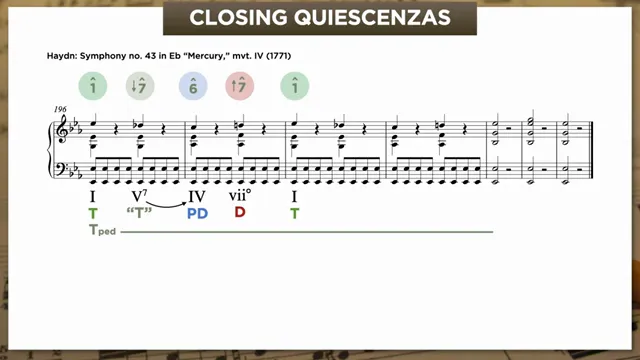
- The quiescenza is a tonic-pedal idiom built on a full functional cycle (T → applied chord → IV → dominant → T), with a signature chromatic upper voice called the Q-line (scale degrees: 1̂ → ♭7̂ → 6̂ → ♯7̂ → 1̂)
- Closing quiescenzas are formulaic, occur twice in a row, and foreground the Q-line; opening quiescenzas occur once, are more thematic, and often bury or fragment the Q-line
- The idiom works in minor too, and its inner chords can be compressed, repeated, or reordered — the ♭7̂ in the melody is usually the key tip-off
Structure of the Quiescenza ▶ 1:24
- Always starts and ends on root-position tonic over a tonic pedal
- Contains a full functional cycle: T → predominant → dominant → T
- Predominant area always includes IV, always preceded by an applied chord to IV (usually V⁷/IV, sometimes vii°⁷/IV); IV may continue to ii or minor iv
- Dominant slot: V⁷ or vii°⁷; either may be expanded or inverted in context
- Q-line (top voice): 1̂ – ♭7̂ – 6̂ – ♯7̂ – 1̂
Closing Quiescenzas ▶ 5:14
- Appear twice in a row after an authentic cadence; sound generic/filler-like
- Q-line prominent in top voice; chords evenly spaced
| Example | Key | Notes |
|---|---|---|
| Haydn, Symphony No. 43, mvt. IV | E♭ major | Q-line clearly on top |
| Mozart, Violin Sonata in B♭ (age 8) | B♭ major | Q-line notes embellished with turns |
| Beethoven, Mignon | F♯ major | Standard, audible Q-line |
| Beethoven, Violin Sonata No. 8 | — | Q-line in inner voice; countermelody in piano RH; gap with contrary motion between iterations |
Opening Quiescenzas ▶ 8:59
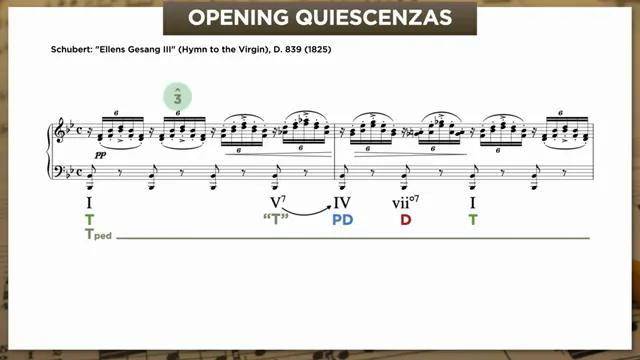
- Occur once; more thematic and memorable; Q-line often absent or hidden
- V⁷/IV frequently shares a bar with the opening tonic (it's essentially tonic + ♭7̂)
| Example | Key | Notes |
|---|---|---|
| Bach, Cello Suite No. 4, Prelude | E♭ major | Audible Q-line but breaks off early (no ♯7̂ → 1̂) |
| Bach, WTC Prelude in E♭ | E♭ major | No Q-line; motivic call-and-response texture |
| Bach, Two-Part Invention No. 14 | B♭ major | ♭7̂ appears only on last 16th note of bar |
| Schubert, Ellens Gesang III (Ave Maria) | — | Upper voice ascends by thirds (3̂–5̂–♭7̂), then descends chromatically to 5̂; uses vii°⁷ |
| Mozart, Magic Flute – Queen of the Night aria | — | Same upper-voice shape as Schubert but different harmonic alignment |
| Beethoven, Harp Quartet | — | Buried under melody; ♭7̂ in tune is the tip-off |
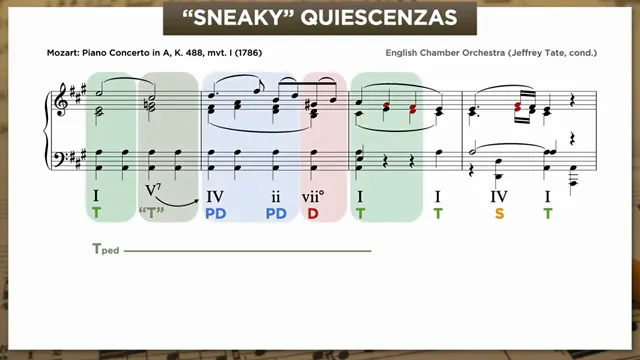
| Mozart, Piano Concerto K. 488 | — | 3-bar quiescenza + plagal tag; suspended tonic over ♭4̂ bass = striking Copland-esque sonority |
Quiescenzas in Minor ▶ 19:14
- Same structure; fully diminished seventh chords add extra dissonance
- Inner chords can be drastically compressed (e.g., Mozart Pamina aria: tonic = 1 bar, each subsequent chord halves in duration)
- Beethoven Pathétique Sonata: two back-to-back quiescenzas that repeat their 2nd and 3rd chords, then bass rises by step into cadence — ▶ 21:13