Key Takeaways
- V7 of IV is the dominant applied chord in practice; build it by adding a chordal 7th to the tonic triad — in major that means adding ♭7̂ (the telltale accidental); in minor, raise 3̂ instead
- The telltale notes are tendency tones: ♭7̂ (chordal 7th) pulls down by half-step in major; ♯3̂ (local leading tone) pulls up by half-step in minor — opposite expressive effects
- V7/IV and its inversions appear most often in chromatic bass lines (ascending or lament descents) and as passing/neighbor chords between I and IV
Building V7 of IV ▶ 1:19
| Context | Chord | Telltale Note | Resolves |
|---|---|---|---|
| Major | I + ♭7̂ → V7/IV | ♭7̂ (e.g., B♭ in C major) | down by half-step |
| Minor | i + ♯3̂ → V7/IV | ♯3̂ (e.g., G♯ in E minor) | up by half-step |
- A plain tonic triad could be reinterpreted as V/IV, but analysts normally reserve the applied label for a progression that makes that function audible; V7/IV supplies the clearest chromatic evidence
- Do not call V7/IV “I7”: in C major, a diatonic seventh above I would be B♮, while V7/IV requires B♭
Sound & Function ▶ 5:30
- Often functions as a tonic substitute — appears where tonic could have been (e.g., directly after dominant)
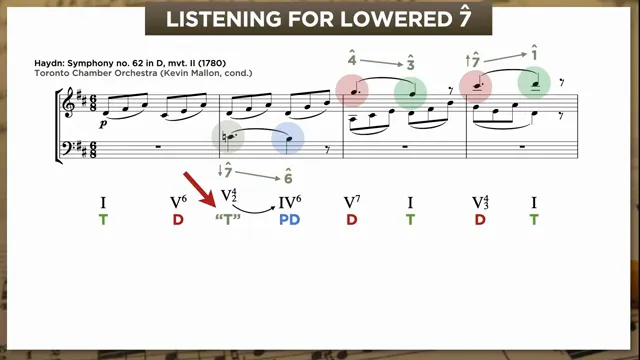
- ♭7̂ in major frequently appears in a frustrated leading tone pattern: 7̂ → ♭7̂ → resolves down into IV
- In major: chromatic lowering + downward resolution = relaxing effect; in minor: chromatic raising + upward resolution = intensifying effect
Inversions of V7/IV ▶ 13:55
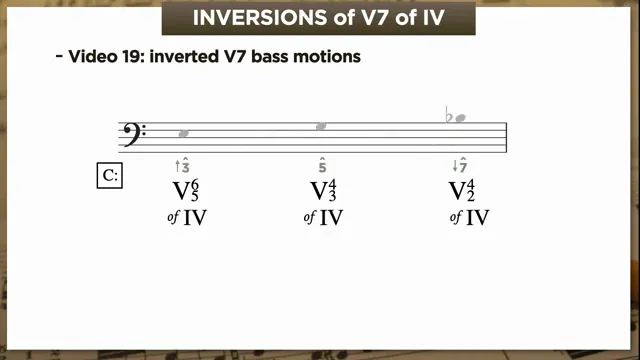
| Inversion | Bass Note | Bass Resolution |
|---|---|---|
| V⁶₅/IV | ♯3̂ | up → root-position IV |
| V⁴₃/IV | 5̂ | down → IV or IV⁶ |
| V⁴₂/IV | ♭7̂ | either direction |
- V⁶₅/IV in minor creates a rising chromatic bass: ♭3̂ – ♯3̂ – 4̂ (mirrors ♯4̂–4̂–5̂ with applied chords to V)
- V⁴₃/IV commonly used as a passing chord between I⁶ and IV (or between chords a third apart)
Worked Examples ▶ 3:57
- Haydn symphony slow movement — root-position V7/IV in major; chromatic bass with frustrated leading tone ▶ 3:57
- Weber, Der Freischütz overture — V7/IV as phrase climax, resolves to root-position IV ▶ 7:34
- Mozart K. 332 — V7/IV → IV⁶ over tonic pedal; classic opening formula (covered fully in Lesson 31) ▶ 9:03
- Mendelssohn, Songs Without Words — V7/IV in minor; ♯3̂ triggers chain of rising parallel thirds leading to V7/V ▶ 9:45
- Chopin Nocturne (minor) — V⁶₅/IV in second phrase; Purcell Dido, Beethoven Op. 110 — V7/IV in chromatic lament bass descents ▶ 12:05
- Chopin Op. 62 No. 2 / Beethoven Op. 30 — V⁴₃/IV as passing chord in bass-descending-by-thirds progressions ▶ 21:24