Key Takeaways
- A tonic pedal point is a fixed bass note on scale degree 1̂ while harmony changes above it — chords often clash with the bass because the pedal tone is not a chord member
- The three core away-and-back moves are: I → iv → I, I → V7 → I, and I → vii°7 → I (each progressively more dissonant); complete T–PD–D–T cycles over a pedal are also common, especially at piece openings
- Chord inversion labels are irrelevant over a pedal point — the bass is not a chord tone, so just write "V7 over tonic pedal"
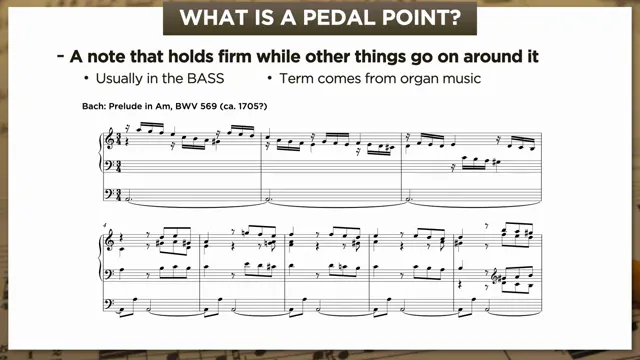
What Is a Pedal Point? ▶ 0:29
- Pedal point: a note (almost always bass) that holds stationary while other voices move above it; term derives from organ foot-pedals
- In this style, pedal points most often sit on scale degree 1̂ (tonic pedal) or scale degree 5̂ (dominant pedal)
- Tonic pedals anchor the key in the listener's ear → found at piece openings or after strong cadences
Away-and-Back: I → iv → I ▶ 4:54
- iv is relatively mild dissonance against the tonic bass
- Melodic tell: upper voice moves scale degree 5̂ → 6̂ → 5̂ (step up, step back)
- Examples: Schubert Piano Trio (slow mvt.), Mozart Violin Concerto K. 216, Haydn Cello Concerto no. 2, Haydn Piano Trio in E♭
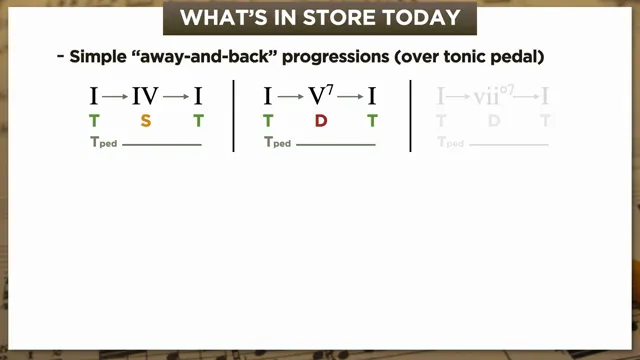
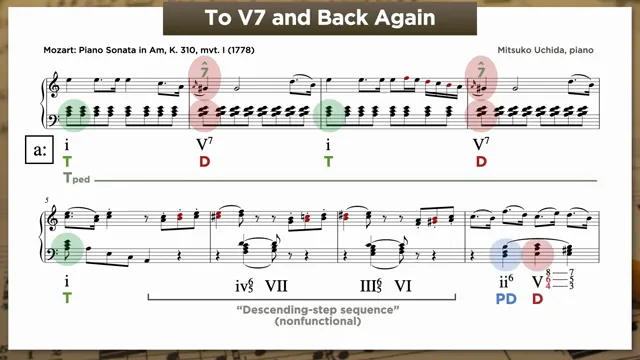
Away-and-Back: I → V7 → I ▶ 10:46
- Characteristic dissonance: the leading tone (most dissonant note against tonic bass) is often highlighted in the melody at each V7 arrival
- Common pattern: alternating I / V7 / I / V7 / I (see Beethoven Symphony no. 1, Mozart Eine kleine Nachtmusik, Mozart K. 310)
- Extreme case: Schubert Winterreise no. 24 — bass never moves for the entire song; frozen effect is deliberate text-painting
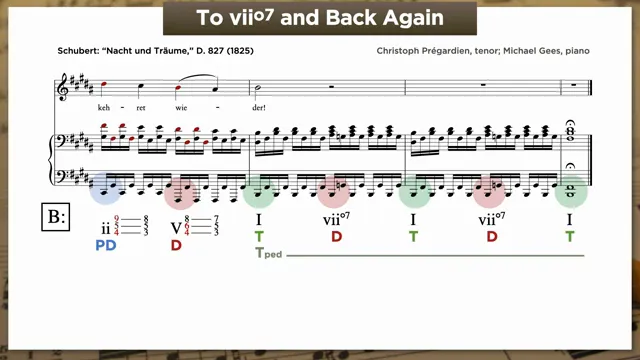
Away-and-Back: I → vii°7 → I ▶ 17:12
- vii°7 is far more dissonant than V7 over the pedal; adds "ferocity" or "romantic melancholy" depending on context
- Works in both major and minor; the chromatic note (♭6̂ in major) is the key color-change
- Examples: Haydn Farewell Symphony (minor), Schubert Nacht und Träume (major), Tchaikovsky Nutcracker
Complete T–PD–D–T Cycles Over a Pedal ▶ 20:39
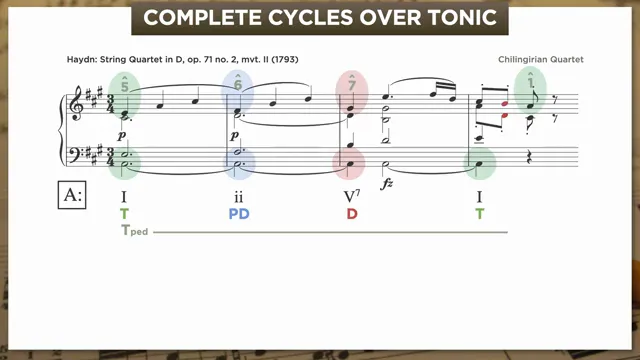
- Full functional cycle I – (ii or IV) – (V7 or vii°) – I all over a stationary tonic bass; extremely common at Baroque/Classical openings
- Melodic signature: stepwise ascent 5̂ – 6̂ – 7̂ – 1̂ in an upper voice across the four harmonies
- Examples: Haydn Op. 71 no. 2 quartet, Beethoven Op. 14 no. 1 sonata, Bach Cello Suite no. 1, Bach WTC Book I C minor Prelude, Tchaikovsky Dance of the Sugar Plum Fairy (with applied chord vii°7/V)
Mixed & Extended Pedal Progressions ▶ 25:22
- Progressions can combine away-and-back moves (e.g., I → V7 → I → vii°7 → I) for cumulative tension arcs — see Schubert Der greise Kopf (▶ 25:33)
- V7/IV (applied chord) can appear within a pedal progression, resolving to IV which then returns to I — preview of Lesson 30
- When melody is dense with non-chord tones, rely on inner voices to track harmony over the pedal