Key Takeaways
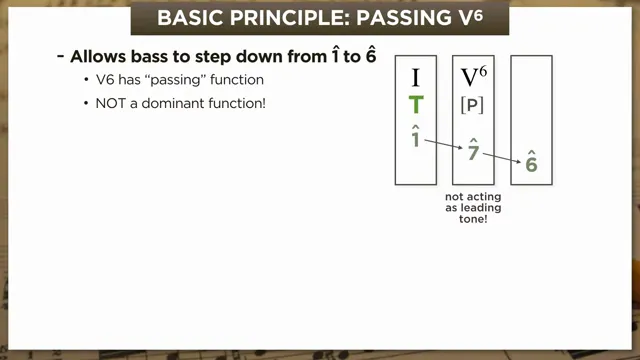
- Passing V6 uses the same spelling as dominant V6 but has a passing function, not dominant function — the bass steps down from scale degree 1̂ through 7̂ to 6̂
- Three targets after passing V6: root-position vi (bridging), iv6 (subdominant), or an applied chord to V
- Passing V6 is a non-functional passing chord — it connects functional chords but carries no harmonic function itself
The Problem: Harmonizing a Descending Bass ▶ 2:54
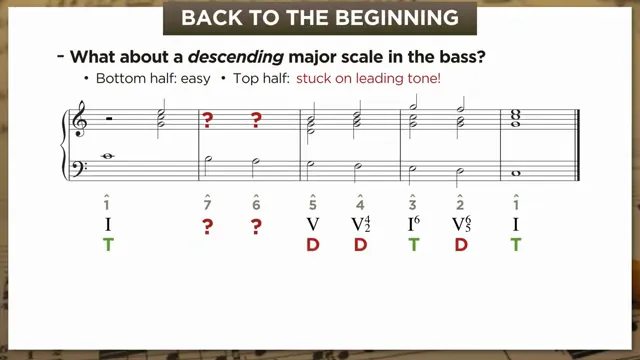
- Rising scale bass lines are easy with Big 18 chords; descending scale has a snag: 7̂ in the bass has only been seen rising (as leading tone)
- Need a chord that lets 7̂ step down to 6̂ — that chord is passing V6
Passing V6: Core Concept ▶ 5:26
- Same spelling as dominant V6, but 7̂ acts as a passing tone in the bass, not a leading tone — no upward pull
- Belongs to the family of non-functional passing chords: enter and exit by step, single direction; connect functional chords on either side
- Bass pattern: I → V6 (passing) → [vi / iv6 / applied chord to V]
Three Uses of Passing V6
1. Passing to vi (Bridging) ▶ 7:16
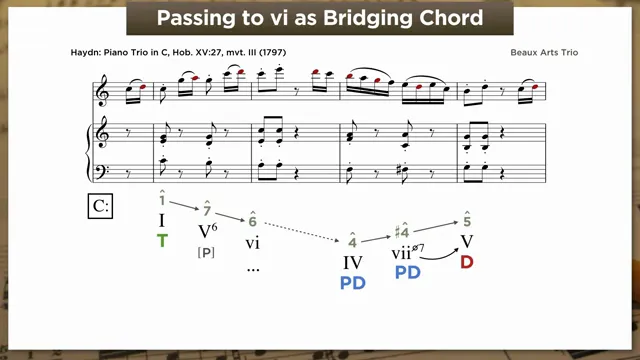
- Bass: 1̂ → 7̂ → 6̂, with root-position vi as bridging chord
- Common at phrase openings; vi then moves onward (e.g., leap to 3̂ or step to 5̂)
2. Passing to iv6 (Subdominant) ▶ 10:23
- Bass: 1̂ → 7̂ → 6̂, landing on iv6 (subdominant function); often moves to root-position iv
- Seen in slow, lyrical textures (Mozart K.332, mvt. II)
3. Passing to Applied Chord to V ▶ 13:02
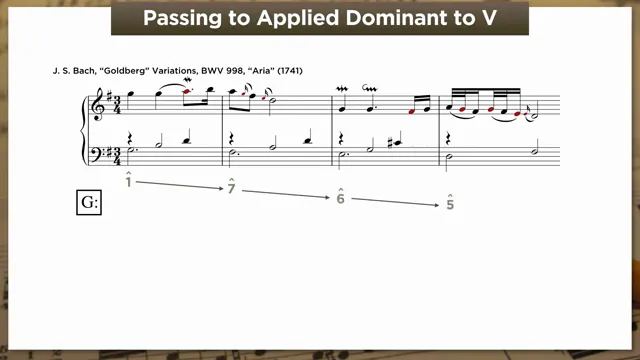
- Bass: 1̂ → 7̂ → 6̂ → 5̂; over 6̂ sits vii°6/V or vii°⌀7/V (requires raised 6̂ chromatically)
- Classic descending-to-dominant motion: I – V6(pass) – vii°6/V – V
Full Descending Scale Harmonization ▶ 15:32
Teaser: Sequences ▶ 16:00
- Sequence: a chord pair copied and transposed down by step or third, once or twice — harmony governed by pattern, not function
- Can produce non-functional chords (e.g., III6) not seen elsewhere; full treatment coming in a later video
- Next up: passing V6 in minor → the lament bass