Key Takeaways
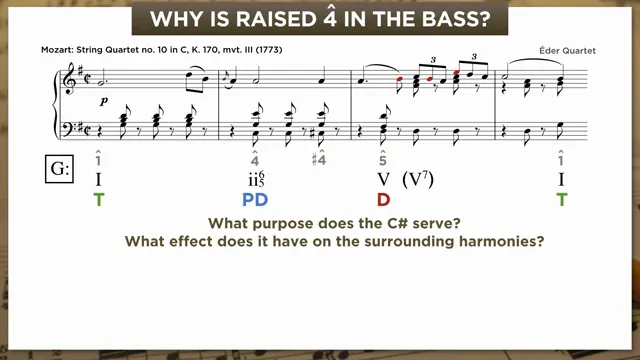
- Applied dominants to V contain raised scale degree 4̂ (the local leading tone)—normally an accidental that resolves up to scale degree 5̂
- Spell and resolve applied chords as if they were functioning in their "home key" (e.g., V⁶/V resolves exactly like V⁶ in the key of V)
- Label by function, not root — calling a chord "V⁷/V" tells you where it goes; calling it "II⁷" tells you almost nothing useful
What Is an Applied Dominant? ▶ 2:34
- Applied dominant (= secondary dominant = applied chord): a chord with dominant quality that resolves to something other than tonic
- Applied chords to V function as predominants — chromatic dissonance gives a stronger push to V than diatonic PD chords
- Applied chords ≠ modulation; the key has not changed unless confirmed by what follows
The Full Family of Applied Chords to V ▶ 11:15
| Symbol | Quality | Notes (C major/minor) | Common inversions |
|---|---|---|---|
| V/V | Major triad | D–F♯–A | Any; less common (less dissonant) |
| V⁷/V | Dom. 7th | D–F♯–A–C | Any |
| vii°/V | Dim. triad | F♯–A–C | 1st inversion mainly |
| vii°⁷/V | Fully dim. 7th | F♯–A–C–E♭ | Any except ²; diatonic-to-target minor form |
| viiø⁷/V | Half-dim. 7th | F♯–A–C–E | Usually root position; diatonic-to-target major form |
- In parallel C major and C minor, the same applied-chord spellings can be used; what changes is which notes need accidentals. The half-diminished form matches the target major key, while the fully diminished form supplies the lowered seventh associated with target minor and mixture
Voice Leading Rules ▶ 4:18
- Raised 4̂ (local leading tone) resolves up by half-step to scale degree 5̂
- Chordal 7th resolves down by step; chordal 5th steps down; root is common tone
- Frustrated leading tone: when an applied V⁷ resolves to V⁷ (not just V), raised 4̂ can move down by half-step to accommodate the 7th ▶ 26:31
Pro Tips ▶ 15:42
- Resolves to cad. ⁶₄ — applied chord → cad. ⁶₄ → V is very common; G♯ is often a common tone ▶ 15:42
- Applied chord as the only PD — no diatonic predominant required before it ▶ 18:02
- Raised 4̂ is not always in the bass—it can appear in any voice; look for the accidental ▶ 19:00
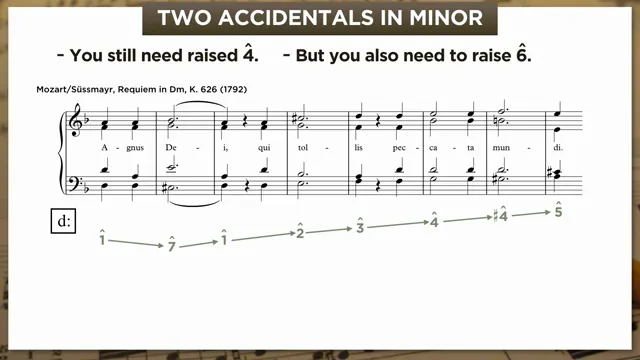
- Minor keys often need two accidentals—raise both 4̂ and 6̂ for V/V ▶ 20:12
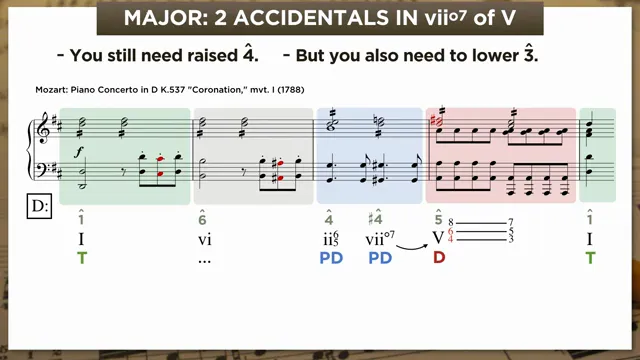
- vii°⁷/V in major needs two accidentals—raised 4̂ plus lowered 3̂; this creates parallel chromatic sixths with bass (♯4̂–5̂ in bass, 2̂–♭3̂–3̂ in soprano) ▶ 23:18
Ambiguity: Applied Chord vs. Modulation ▶ 28:33
- A phrase ending on root-position V⁷/V → V can be heard as half cadence in original key or PAC in the key of V — genuinely ambiguous until context confirms
- Analysis walkthrough of Mozart Piano Sonata in D major: ▶ 29:00
Quick Reference: Spelling Applied Chords to V
- Find scale degree 5̂ of your key—this is the chord your applied chord resolves to
- Pretend that note is tonic. Build the chord you need (V, V⁷, vii°, vii°⁷, viiø⁷) in that temporary key using its own key signature
- Compare to the real key signature. Any note that differs from the home key requires an accidental — sharps, flats, or naturals
- Resolve by tendency:
- Raised note (local leading tone) → up by half-step to scale degree 5̂
- Chordal 7th → down by step
- In minor: you will often need two accidentals (raised 4̂ and raised 6̂)
Worked example: V⁷/V in E♭ major
| Step | Work |
|---|---|
| Key of E♭ major | Key sig: B♭, E♭, A♭ |
| Scale degree 5̂ = B♭ | Target chord resolves to B♭ |
| Build V⁷ in B♭ major | F–A–C–E♭ (dom. 7th on F) |
| Compare to E♭ major | A♮ is chromatic (home key has A♭) |
| Accidental needed | A♮ (= raised scale degree 4̂) |
| Resolution | A♮ resolves up to B♭; E♭ (7th) resolves down to D |
Result: F–A♮–C–E♭ → B♭ chord — one accidental (♮ before A).
Supplementary context from Kostka & Payne, Tonal Harmony (8th ed.), Ch. 16.