Key Takeaways
- vii°7 (fully diminished, minor keys) and viiø7 (half-diminished, major keys) carry dominant function by sharing 3 notes with V7; use vii°7 constantly in minor, almost never in major
- Every inversion of vii°7 maps 1-to-1 with an inverted V7 sharing the same bass note—swap scale degree 5̂ for scale degree 6̂ to convert between them
- Voice leading is uniform across all inversions: 7̂↑, 2̂↑, 4̂↓, 6̂↓
Quality by Key ▶ 1:00
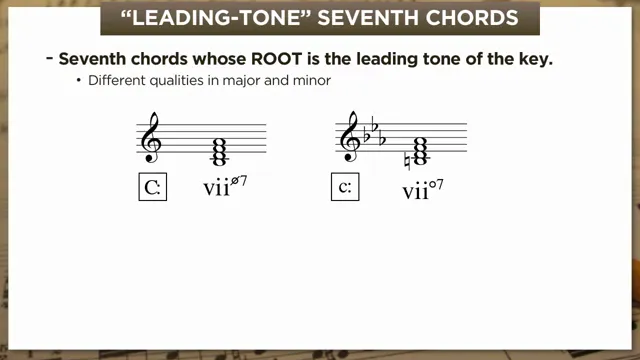
- Minor key → vii°7 (fully diminished 7th) — extremely common
- Major key → viiø7 (half-diminished 7th) — extremely rare; root position only, 6̂ virtually always in melody
- Keep the subtonic ♭VII chord distinct from leading-tone vii°—this lesson concerns chords built on the raised leading tone
Equivalence with Inverted V7s ▶ 6:22
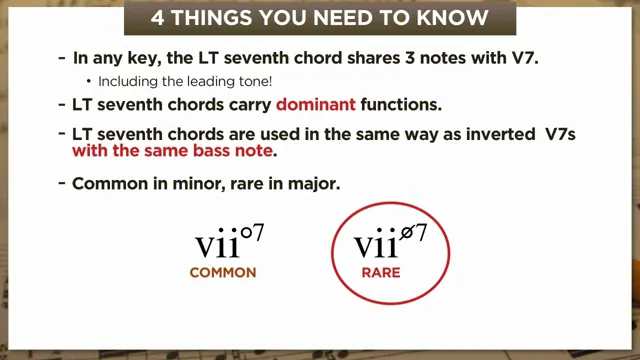
To convert any inverted V7 to its vii°7 equivalent: replace 5̂ with 6̂
| V7 Inversion | Bass Note | vii°7 Equivalent |
|---|---|---|
| V6/5 | 7̂ | vii°7 |
| V4/3 | 2̂ | vii°6/5 |
| V4/2 | 4̂ | vii°4/3 → resolves to I6 |
| (none) | 6̂ | vii°4/2 — not used |
Voice Leading ▶ 9:00
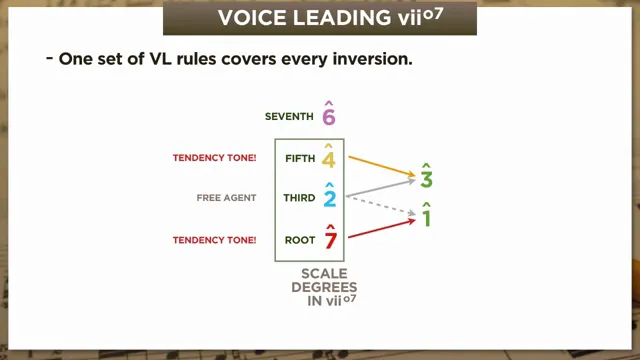
- 7̂ (leading tone) → up by step to 1̂
- 4̂ → down by step to 3̂
- 2̂ → preferably up to 3̂
- 6̂ (chordal 7th, new vs. V7) → down by step — same rule as all chordal 7ths