Key Takeaways
- The cadential 6-4 is not a tonic-function chord—it's a dominant-function event: scale degree 5̂ in the bass with non-chord tones (6th and 4th above) that resolve downward into V or V7
- Label it with figured bass over a single Roman numeral V (e.g.,
V: 6-4 → 5-3or6-4 → 7), not as I⁶₄ - The pedal 6-4 looks identical but arrives after the dominant bass is established — it's a separate idiom, not a cadential 6-4
Review: Three NCT Scenarios ▶ 1:19
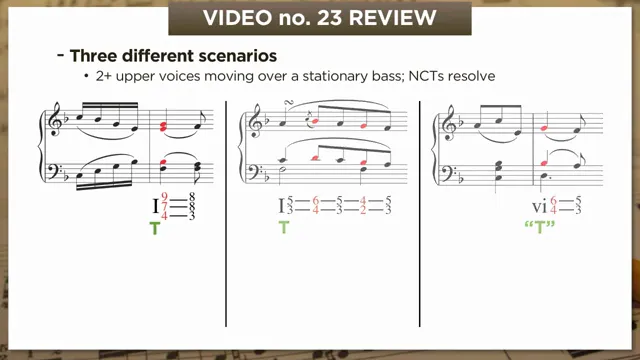
| Scenario | NCTs arrive with bass? | Form a recognizable chord? | Result |
|---|---|---|---|
| 1 | Yes | No | Figures (9, 7, 4) = obvious dissonance pile |
| 2 | No (after) | Yes | Pseudo-chords — no separate Roman numeral |
| 3 | Yes | Yes | Cadential 6-4 — figures show NCT motion, not inversion |
- Scenario 3 key rule: when
6-4 → 5-3appears over a stationary bass with horizontal lines, the 6-4 figures describe NCT resolution, not chord inversion
Why Not Label It I⁶₄? ▶ 7:22
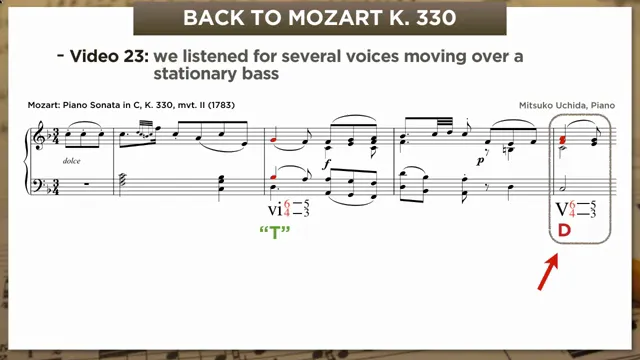
- Against I⁶₄: Roman numeral I implies tonic stability — this chord is among the least stable in the style; it never ends a phrase, never resolves directly to tonic
- For cadential 6-4 notation: function and label both say dominant; treats the idiom as one event; reflects how performers play the upper voices — as appoggiaturas leaning into resolution
Cadential 6-4: Core Facts ▶ 11:29
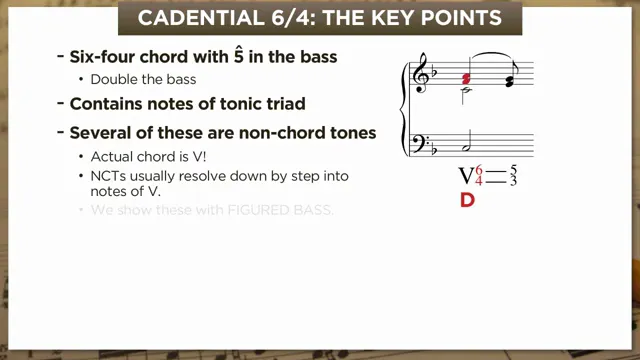
- Scale degree 5̂ in bass, always doubled in an upper voice; contains notes of tonic triad, but 6th and 4th are NCTs
- Appears on a strong beat; found at both half cadences (→ V) and authentic cadences (→ V or V7)
- Resolving to V7: all upper voices drop by step, requiring a third figure level —
6-4 → 5-4-3 → 7(the doubled bass note falls to the chordal 7th)
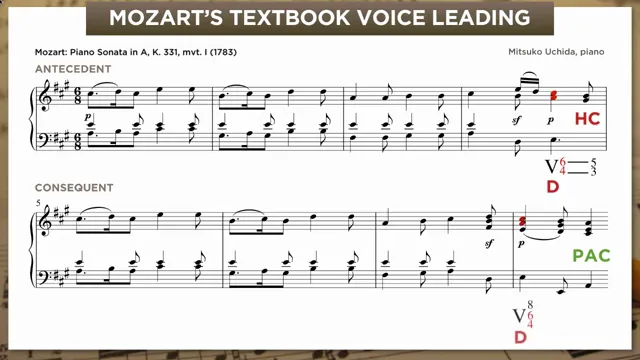
Messy Voice Leading in Real Music ▶ 15:38
- Textbook stepwise resolution is an idealization — Beethoven and Mozart routinely arpeggiate, leap, or redistribute voices across registers
- Common pattern: scale degree 5̂ in melody leaps down a 6th to the leading tone in the dominant chord
- Notation stays the same regardless; figured bass shows the idealized resolution even when actual voices don't move that way
Two Special Cases ▶ 20:43
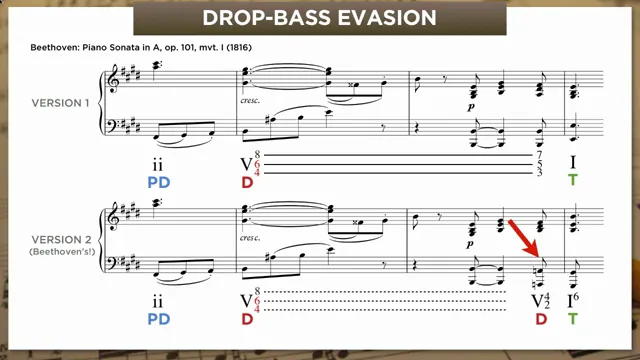
Irregular resolution → cadence evasion ▶ 20:49
- Bass drops by step along with upper voices → cadential 6-4 resolves to V⁴₂ instead of V; V⁴₂ → I⁶ = no cadence = evaded cadence (see Beethoven Op. 101)
Pedal 6-4 ▶ 22:41
- Same sonority (tonic notes over dominant bass) but bass is already on scale degree 5̂ before the 6-4 arrives — upper voices move away from V triad and back
- Not a cadential 6-4; named for the pedal point (stationary bass) beneath the motion