Key Takeaways
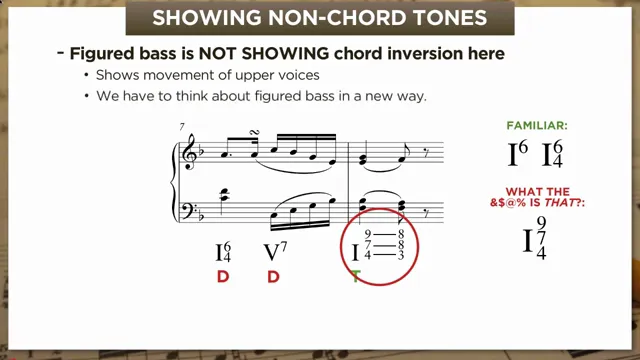
- Figured bass can show upper voice motion over a stationary bass — in this mode, read figures horizontally (pairs = stepwise melodic motion) not just vertically (stacks = chord inversion)
- The Roman numeral identifies the harmony and chord tones; figures track the non-chord tones and their resolutions; the two can tell you different things simultaneously
- In the stationary-bass patterns studied here, 6-4 → 5-3 shows non-chord tones resolving rather than a separate second-inversion chord (critical setup for Lesson 24: cadential 6-4)
Figured Bass for Non-Chord Tones ▶ 3:03
- Normal use: figured bass shows chord inversion (e.g., I⁶, V⁴₃)
- Extended use: when the bass holds still, figures track moving upper voices — read left-to-right as melodic intervals, not a single vertical stack
- Roman numeral = active harmony; any note not in that chord = non-chord tone (NCT)
- Two-stack notation: first stack = NCTs, second stack = their resolutions into chord tones
Common Situations for This Notation ▶ 8:38
- At cadences: multiple NCTs cluster on a strong beat, then resolve — especially dominant-to-tonic authentic cadences and half cadences
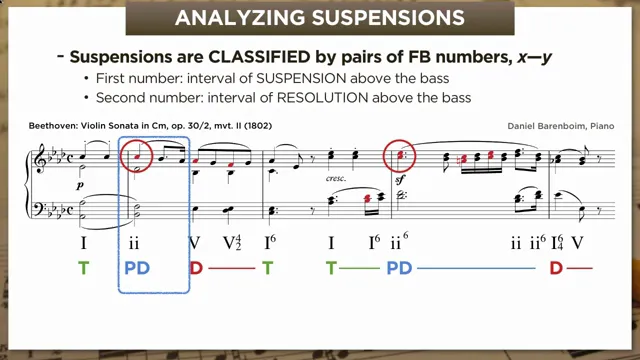
- Prominent suspensions: classified by a pair of figures separated by a dash (interval of suspension → interval of resolution above the same bass)
| Suspension Type | Figures | Motion |
|---|---|---|
| 9-8 suspension | 9–8 | 9th resolves down to octave |
| 7-6 suspension | 7–6 | 7th resolves down to 6th |
| 4-3 suspension | 4–3 | 4th resolves down to 3rd |
- Only prominent suspensions get labeled; analysts don't mark every single one
The "Apparent Chord" Paradox ▶ 14:32
- NCTs moving together over a pedal bass can produce sonorities that look like real chords — but may not function as chords
- Two interpretations always possible: (1) assign each sonority its own Roman numeral, or (2) treat as one harmony with NCT decoration
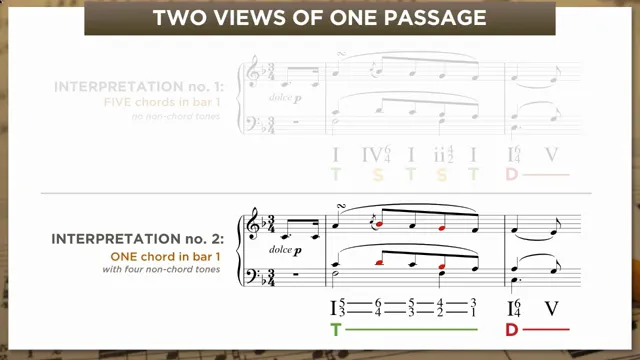
- Choose based on harmonic rhythm and functional logic — if Roman numerals produce nonsensical progressions (e.g., ii⁶₄ after V⁷), prefer the NCT reading
- Worked examples — Beethoven Op. 2 No. 1 (bars 1–2) and Mozart K. 330 slow movement: ▶ 15:16 and ▶ 19:42
Pro Tip: 6-4 → 5-3 Over Stationary Bass ▶ 23:18
- In this context, the pattern signals NCTs rather than a new second-inversion harmony — the Roman numeral names the chord, while the 6-4 figures name the embellishments
- Horizontal lines extending under subsequent figures = voice is held across the duration
- Leads directly into Lesson 24: the cadential 6-4