Key Takeaways
- Rhythm creates harmonic hierarchy: metrically strong chords are structural; weak-beat chords are embellishments — the same chord can play either role depending on context
- Passing and neighbor chords explain embellishing harmonies in melodic terms: classify by how the bass (or top voice) moves between structural chords
- Hearing deep melodic skeletons (often stepwise lines) across passages improves dictation accuracy and reveals family resemblances across unrelated pieces
Surface vs. Depth ▶ 0:11
- Surface: all literal chord changes (e.g., 25 chords in the Mozart concerto passage)
- Deep level: the slower harmonic motion felt underneath — same passage reduces to I → V → I (3 areas)
- Structural chord: carries the functional weight of a passage; embellishing chord: decorates or connects structural chords
- Depth metaphors are interpretive, not provable — goal is simultaneous awareness of both levels, not discarding the surface
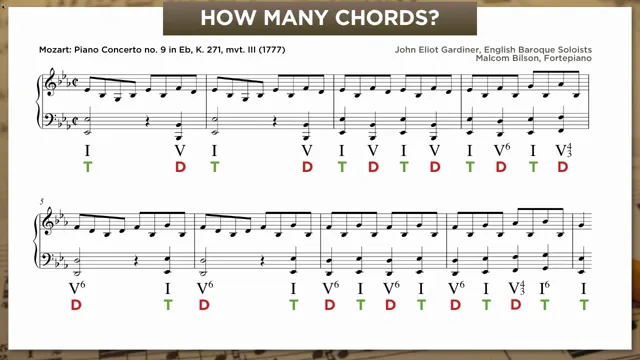
How Rhythm Builds Hierarchy ▶ 2:44
- Chords on strong beats feel structural; chords on weak beats feel embellishing
- Mozart concerto: bars 1–4 → tonic on downbeats (I is structural, V is decorative); bars 5–8 → dominant on downbeats (V is structural, I is decorative)
- Same chord pair, reversed hierarchy — context (not chord identity) determines role
Melodic Skeletons ▶ 5:01
- Strip away embellishing chords → the notes aligning with structural harmonies often form a simple stepwise melodic skeleton
- Mozart concerto skeleton: rising stepwise line in soprano; bass dips to vii° and returns
- Mozart G-minor Quartet slow movement: soprano rises 3̂→4̂→5̂, while the bass rises 1̂→2̂→3̂→4̂→5̂ in parallel tenths
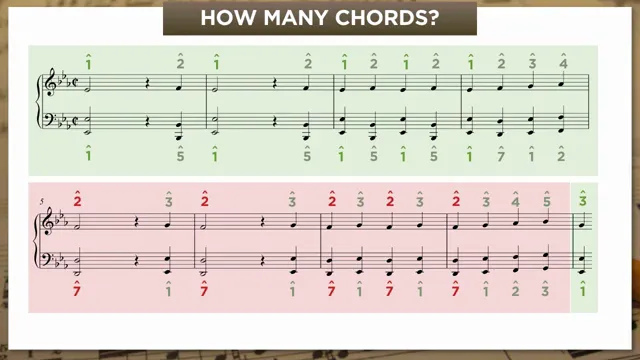
Full analysis walkthrough for both Mozart examples: ▶ 5:44 and ▶ 8:22
Contrapuntal (Passing & Neighbor) Chords ▶ 12:34
| Type | Bass motion | Example |
|---|---|---|
| Passing chord | Stepwise between two structural bass notes | V⁴³ linking I → I⁶ |
| Neighbor chord | Away-and-back to same structural bass note | I between two V⁶ chords |
| Incomplete neighbor chord | Leap into structural note (appoggiatura-like) | V⁶₅ leaping up before resolving |
| Upper-voice neighbor chord (Monahan's term) | Bass leaps, but top voice moves neighbor-style | V chords where soprano oscillates I→ii→I |
- These terms are borrowed from counterpoint: just as individual tones can pass or neighbor, so can whole chords
- Role is always contextual: V⁶ can be structural or a neighbor embellishing I, depending on meter
Cross-Piece Parallels ▶ 19:39
- The rising-bass + parallel-tenths framework (I–V–I–IV–V) recurs across repertoire:
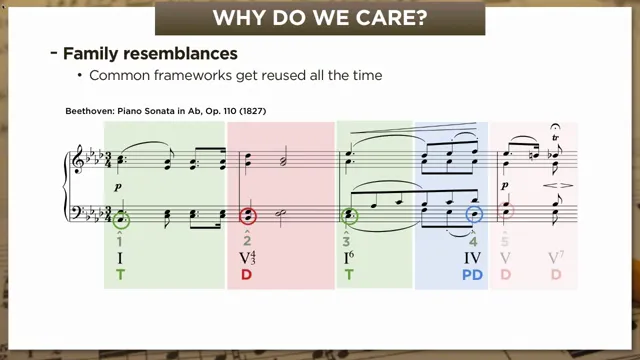
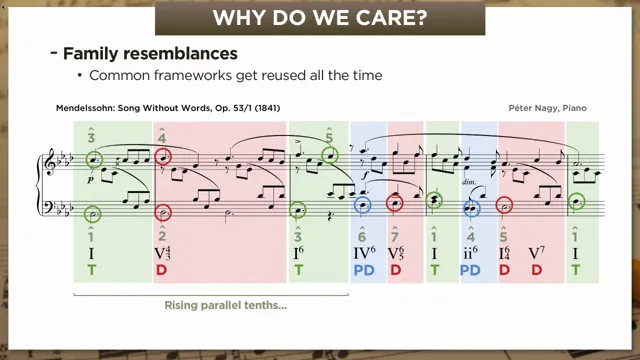
- Beethoven Op. 110 and Mendelssohn Op. 53/1 share the same deep bass/soprano framework as the Mozart Quintet — surfaces differ wildly; skeletons are near-identical
- Practical payoff: anchor dictation on the skeletal stepwise notes (which connect smoothly below the surface) rather than chasing every surface leap