Key Takeaways
- Subdominant function (S) = IV (any inversion) going back to tonic instead of forward to dominant — a plagal, "away-and-back" motion
- IV carries either predominant or subdominant function depending on context; no chord has a fixed function in isolation
- The S function often features scale degree 6̂ as an upper neighbor (5̂–6̂–5̂) and may use iv⁶–IV as an extended subdominant region
The Subdominant Function ▶ 0:40
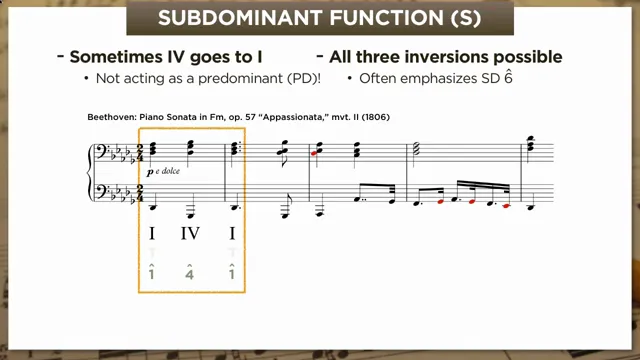
- Plagal motion = IV → I; when IV resolves to I (not V), it carries S (subdominant) function, not predominant
- All inversions of IV can carry S function; IV alone or iv⁶–IV together form a subdominant region
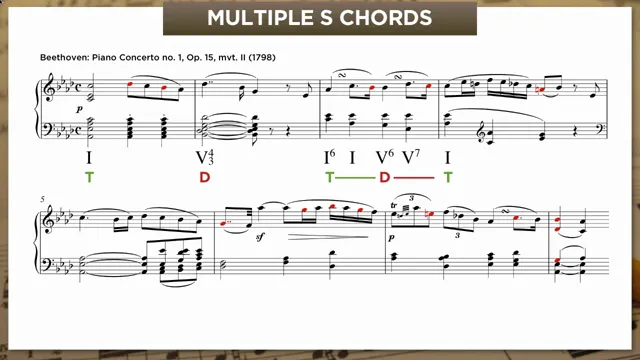
- Expanded functional model: T → PD → D → T or T ↔ S (S never proceeds to PD or D — always returns to T)
Single vs. Multiple S Chords ▶ 2:33
- Single S chord: root-position IV surrounded by tonic (Beethoven Appassionata, Schubert Arpeggione)
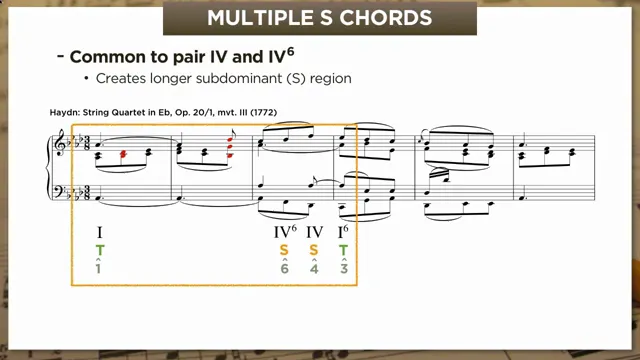
- IV⁶–IV pair: creates a longer subdominant region; iv⁶ almost never appears alone as S — it pairs with root-position IV
- Descending-thirds bass (1̂–6̂–4̂–3̂) = classic subdominant region between two tonic chords
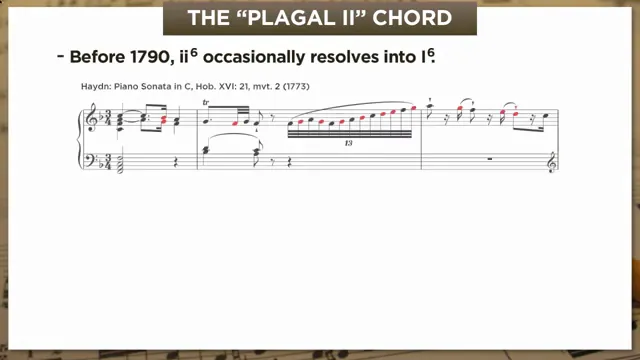
Plagal ii — Rare S-Function Exceptions ▶ 13:25
⚠️ These are exceptions — ii does not freely resolve to I
| Context | Progression | Era |
|---|---|---|
| Early Classical | ii⁶ → I⁶ (direct plagal resolution) | Pre-1790s only |
| Romantic minor | I → iiø⁴₂ → I (over tonic pedal) | 19th c. |
| Hollywood cadence | IV → iv → iiø⁶₅ → I | 19th–20th c. |
- Hollywood cadence: major IV → minor iv → iiø⁶₅ → I; popularized by Wagner, adopted by film composers (Newman's 20th Century Fox fanfare)
Contrapuntal Idioms Using S ▶ 19:54
Idiom 1 — Bass 1̂–6̂–4̂–3̂, melody 3̂–4̂–5̂ → harmonized I – iv⁶ – I⁶ (seen in Mozart & Haydn slow movements)
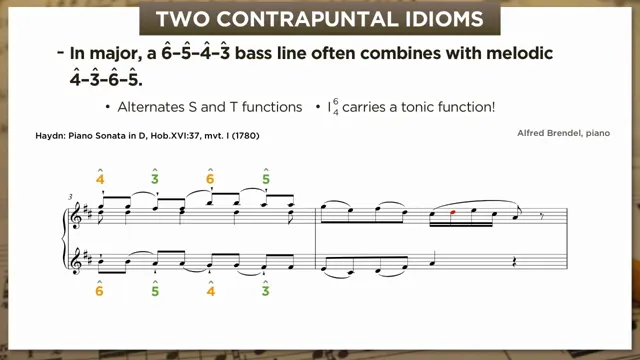
Idiom 2 — Bass 6̂–5̂–4̂–3̂, melody 4̂–3̂–6̂–5̂ → alternating S and T functions; I⁶₄ carries tonic function here