Key Takeaways
- All three V7 inversions follow one set of resolution rules: 7̂ rises to tonic, the chordal 7th falls by step, 5̂ may stay as a common tone, and 2̂ moves freely
- Bass inversion determines resolution target: V6-5 → I, V4-2 → I6, V4-3 → I or I6 (two options); voice leading is only strict when resolving to tonic
- The scale-degree 4̂ problem: bass can descend 4̂→3̂ freely, but 4̂ ascending to 5̂ requires a predominant over 4̂—you can't use V⁴₂ to climb upward
Tendency Tones & Resolution Rules ▶ 1:00
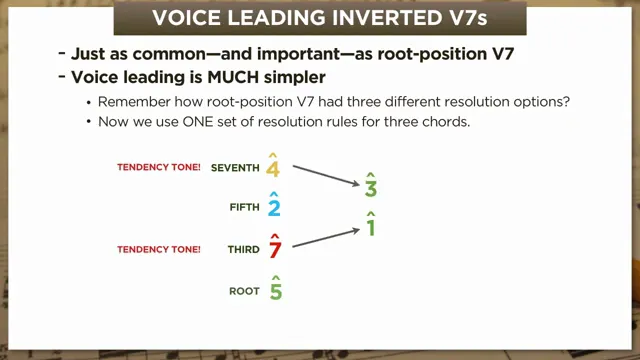
- 7̂ (leading tone) = tendency tone → resolves up by step to tonic (in any voice, including bass)
- Chordal 7th (scale degree 4̂) = tendency tone → resolves down by step to 3̂
- Scale degree 5̂ = common tone, stays put; scale degree 2̂ = free, typically moves down to 1̂, sometimes up to 3̂
Resolution Summary by Inversion ▶ 6:00
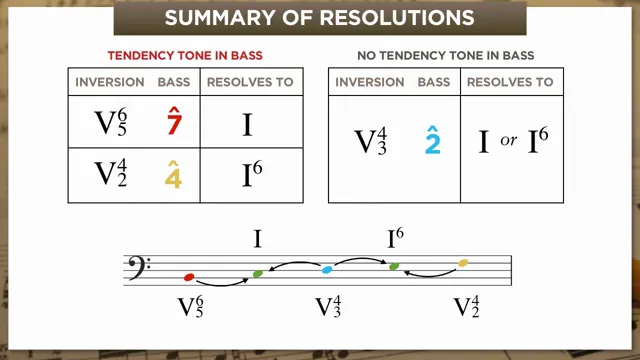
| Chord | Bass note | Resolves to |
|---|---|---|
| V6-5 | 7̂ (tendency ↑) | I (root position only) |
| V4-2 | chordal 7th (tendency ↓) | I6 (first inversion only) |
| V4-3 | scale degree 2̂ (free) | I or I6 |
- Voice leading is strict only when resolving to tonic; moving between V7 chords (any inversion) is completely free
Dominant Triads as "Incomplete" Inverted V7s ▶ 7:46
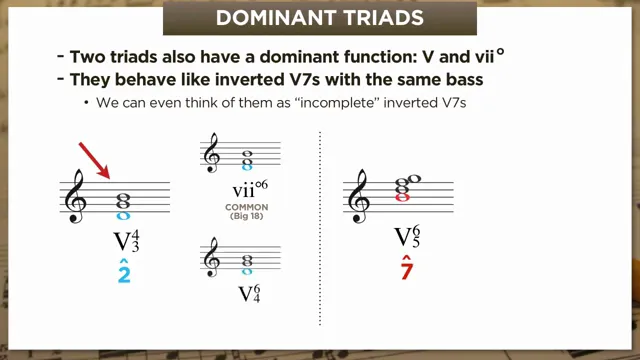
- vii°6 = V4-3 minus the root → behaves identically to V4-3
- V6 = V6-5 minus the chordal 7th → behaves identically to V6-5 (leading tone in bass → root-position I)
- vii° (root position) and V6-4 are rare; use only when forced by texture
Stepwise Bass Lines in the Bottom Tier ▶ 9:57
-
Bottom tier = scale degrees 7̂–1̂–2̂–3̂–4̂–5̂; inverted V7s enable stepwise bass throughout
-
Zigzagging: bass oscillates around tonic (e.g., I–V4-3–I–V6-5–I); inverted dominants embellish tonic without displacing it
-
Rising line limit: ascending bass can't pass through scale degree 4̂ using only tonics/dominants—V⁴₂ must resolve down, so a predominant is required over 4̂ to continue rising to 5̂
-
Analyzed examples: Beethoven C-minor Piano Trio ▶ 10:52, Schubert C-minor Sonata, Beethoven Op. 109, Mendelssohn Piano Trio Op. 1 ▶ 16:58
Leaping Bass Lines ▶ 18:47
- Bass may leap freely into an inverted V7; only the resolution step out to tonic must be stepwise
- Analyzed examples: Mozart K. 464 String Quartet, Beethoven 9th slow movement, Mozart D-minor Fantasy ▶ 19:00
Approaching Inverted V7s from Predominants ▶ 21:47
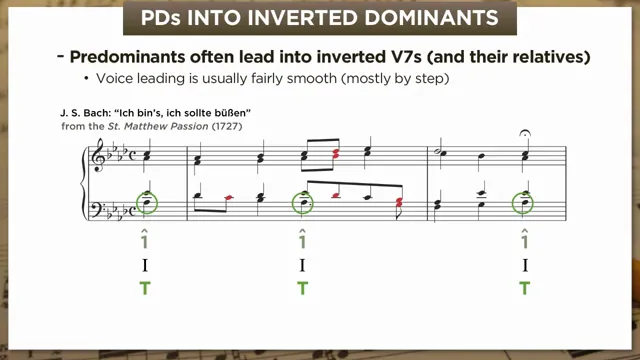
- Voice leading from pre-dominants (PD) into inverted V7s is free but tends to be smooth (stepwise), not leapy
- Analyzed: Bach Ich bin's chorale, Haydn Op. 20 String Quartet ▶ 22:27
Voice-Leading Exceptions ▶ 26:00
- V4-2 exception: scale degree 2̂ (chordal 5th, top voice) often leaps up to scale degree 5̂ instead of moving by step—a common pattern because it is not a tendency tone
- V4-3 exception: when V4-3 → I6, chordal 7th sometimes rises instead of falling — occurs when top voice moves in parallel tenths with bass; linear logic overrides tendency tone resolution
- Analyzed: Beethoven Pathétique slow mvt. ▶ 26:00, Beethoven Op. 31 No. 3 Scherzo ▶ 27:00