Key Takeaways
- Chords belong to three functional families — Tonic (T), Predominant (PD), Dominant (D) — and typically cycle T → PD → D → T
- The cadential I⁶₄ carries dominant function rather than tonic function; vi is ambiguous (tonic or predominant depending on context)
- Functional cycles can be incomplete, overlapping, or cross phrase boundaries — this is the norm, not the exception
The Three Functions ▶ 2:00
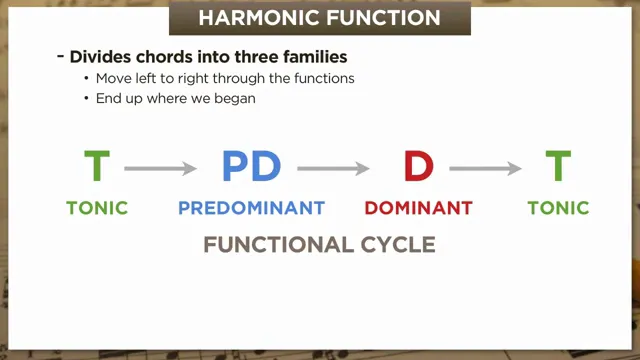
| Function | Primary Roman Numerals | Feel |
|---|---|---|
| Tonic | I (i) | Stable, at rest |
| Predominant | ii (ii°), IV (iv) | Motion away from home |
| Dominant | V, vii° | Leading tone pulls back to tonic |
Assignment rules for the Big 18:
- Only I/i = Tonic
- All ii and iv = Predominant
- Any chord containing the leading tone = Dominant
- Exception 1: vi = Tonic or Predominant depending on context
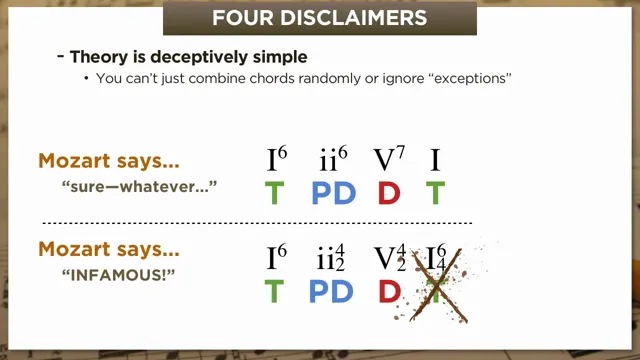
- Exception 2: I⁶₄ = Dominant (not tonic — Mozart's ghost will find you)
Complete Chord-to-Function Map (Major Key)
| Chord | Function | Why |
|---|---|---|
| I | T | The tonic triad — home base, point of rest |
| ii | PD | Contains 4̂ and 6̂, pulls toward V |
| iii | T | Shares two notes with I (3̂, 5̂); rare — mostly a passing chord |
| IV | PD | Contains 4̂ (tendency tone toward 3̂); classic pre-dominant |
| V | D | Contains the leading tone (7̂ → 1̂) |
| vi | T or PD | Shares two notes with I (T after V = deceptive cadence) or acts as PD when preceding ii/V |
| vii° | D | Built on the leading tone; functions as incomplete V⁷ |
- In minor, the same logic applies: V and vii° use the raised leading tone; ii° and iv are PD; i = T
- The cadential I⁶₄ is the big exception — despite its tonic-triad pitches, it functions as D because its upper voices resolve into V
Disclaimers ▶ 3:22
- Function theory is a starting point, not a complete rulebook — counterpoint governs which specific progressions are idiomatic
- Function is contextual, not inherent to a chord; chords sometimes take embellishing roles outside their default function
- Many progressions in classical music lie outside function theory entirely
Functional Cycles in Practice ▶ 6:21
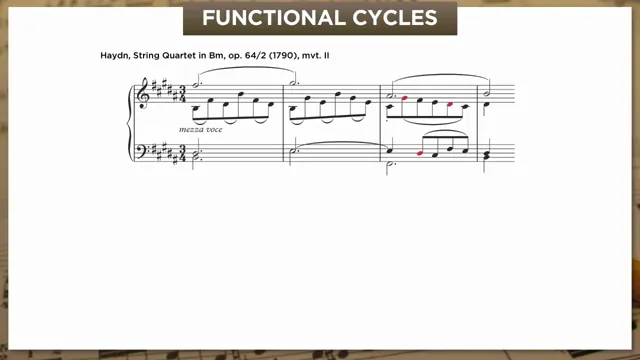
- Complete cycle: T → PD → D → T spanning one phrase (Haydn op. 64/2; Mozart K. 466) — ▶ 6:26
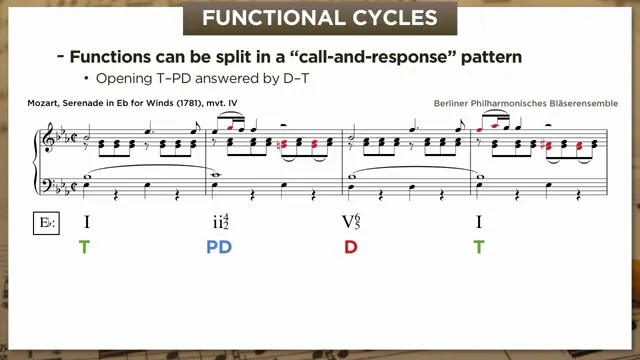
- Call-and-response: T→PD answered by D→T (Beethoven Egmont, Haydn Farewell) — ▶ 12:32
- Extended function: one function covered by multiple chords in a row (use a horizontal bracket); e.g. V + V⁴₂ both = Dominant — ▶ 13:19
- Overlapping cycles: closing tonic of one cycle = opening tonic of the next (Bach, Mozart K. 488) — ▶ 15:02
Incomplete Cycles ▶ 16:29
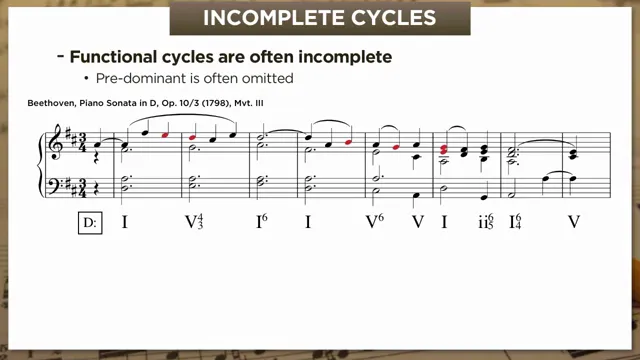
- Half cadence endings = cycle closes on D, no final T — extremely common
- T → D → T (no PD): composers save PD for the cadential cycle to give it expressive weight (Beethoven op. 7, 4th piano concerto)
- Cross-phrase cycles: tonic ending phrase 1 serves as the opening tonic of a cycle that resolves in phrase 2 — ▶ 20:52
Off-Tonic Beginnings ▶ 22:30
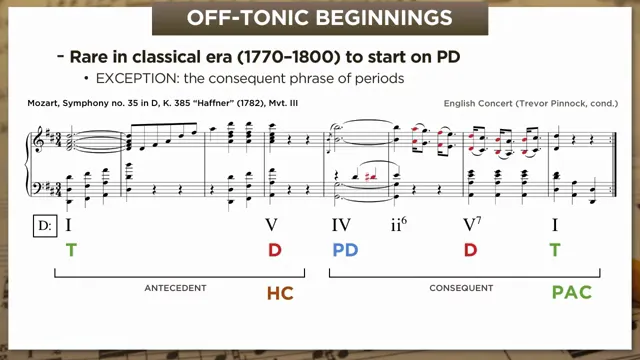
- Phrases can begin on PD or D instead of T, creating instability and forward drive
- Chopin nocturne: D → T repeated; Beethoven op. 7: long sustained D opens each phrase — ▶ 23:00
- Extreme case — Schumann Dichterliebe opener: vamps PD → D with no tonic stated at all — ▶ 24:12
- Most common legitimate off-tonic start: consequent phrase of a period begins on PD (Mozart Haffner) — ▶ 25:26
Supplementary context from Kostka & Payne, Tonal Harmony (8th ed.), Ch. 9.