Key Takeaways
- A major key has 49 possible diatonic triad and seventh-chord voicings, but the Big 18 selects 18 commonly used ones
- Read each chord in two ways: the Roman numeral names its root and quality; the figures or slash note identify its bass
- Chords sharing a bass note can sound more closely related than chords sharing a root, so bass-degree fluency matters
From 49 Possibilities to the Big 18 ▶ 1:48
- The full major-key inventory has 21 triad voicings (7 triads × 3 positions) plus 28 seventh-chord voicings (7 seventh chords × 4 positions)
- The Big 18 is a curated practice vocabulary, not a picture of all 49 possibilities and not one chord for every Roman numeral
- The diatonic iii chord still exists (Em in C major), but it is not selected for the Big 18; I⁶ is the core harmony in this set with E in the bass
The Big 18 in Major ▶ 6:27
| Bass degree | Chords available |
|---|---|
| 1̂ | I |
| 2̂ | ii, ii⁷, V⁴₃, vii°⁶ |
| 3̂ | I⁶ only |
| 4̂ | ii⁶, ii⁶₅, IV, V⁴₂, viiø⁴₃ |
| 5̂ | I⁶₄, V, V⁷ |
| 6̂ | IV⁶, vi |
| 7̂ | V⁶₅, viiø⁷ |
Every chord is written separately here. The rows contain 1 + 4 + 1 + 5 + 3 + 2 + 2 = 18 chords.
- I appears in all three triad positions; V⁷ appears in all four seventh-chord positions
- iii is absent; vi appears only in root position; ii and IV have no second-inversion form in this set
Big 18 in Minor ▶ 5:00
- The grid keeps the same bass positions while chord qualities shift (I/IV → minor, vi → major, ii chords → diminished or half-diminished)
- The set uses raised scale degree 7̂ as a leading tone; the lowered subtonic ♭7̂ is outside this curated vocabulary
- The root-position ii° triad is omitted because its diminished quality makes it less useful in this core set
Bass Voice & Chord Identity ▶ 11:47
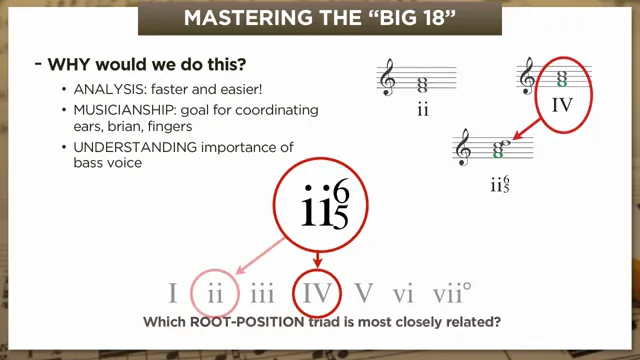
- ii6/5 shares 3 notes with both ii and iv — but shares a bass note only with iv, making it sound closer to iv in practice
- Counterpoint in outer voices (driven by the bass) shapes perceived character as much as Roman numeral labels
- Grid rows highlight these same-bass relationships; don't only think in columns (same root)
Building Fluency ▶ 9:53
- Goal: instant translation between Roman numerals + figures ↔ bass scale-degree lines (both directions)
- Practice strategy: master C major and C minor first; add keys gradually; coordinate ear, brain, and fingers at the piano
- Interactive study tool (Flash required):
sethmonahan.com/big18.html