Key Takeaways
- Keyboard style = 3 voices in the right hand + 1 bass in the left; prioritizes melody + bass as the structural outer voices, with inner voices as harmonic filler
- Core rules: no parallel perfect 5ths or octaves, aim for complete chords, use the smoothest connection possible (prefer contrary motion, especially for chords a step apart)
- Open hand shapes (4th, 5th, or stacked 4th+5th) are the one exception allowing a temporary 3-voice texture — valid only over first-inversion (6/3) chords
What Is a "Voice"? ▶ 0:23
- Voice = one independent melodic line that combines with others to form harmony (not necessarily sung)
- Classical harmony = the byproduct of 4 simultaneous melodic lines woven together
- 4 voices chosen because triads + seventh chords need ≥4 notes; more is unnecessary, fewer can't fill seventh chords
Chorale Style vs. Keyboard Style ▶ 1:57
Chorale style: all 4 voices on a grand staff, each fully independent; soprano/tenor stemmed up, alto/bass stemmed down
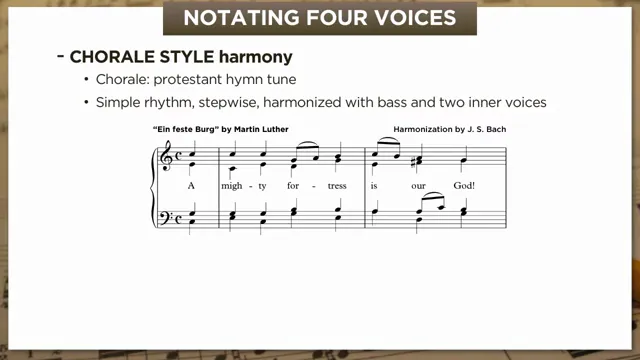
Keyboard style: 3 voices (right hand) + 1 bass (left hand); inner voices hang below the melody in the same hand
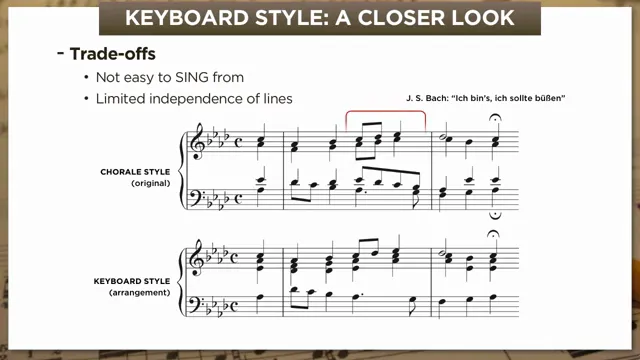
| Chorale Style | Keyboard Style | |
|---|---|---|
| Voice independence | Full | Limited (inner voices subordinate) |
| Singability | ✅ | ❌ (tenors too high) |
| Focus | All 4 lines equally | Outer voices primary |
| Error visibility | Harder | Easier |
| Melodic craft | Higher ceiling | More mechanical |
Voice-Leading Rules ▶ 10:07
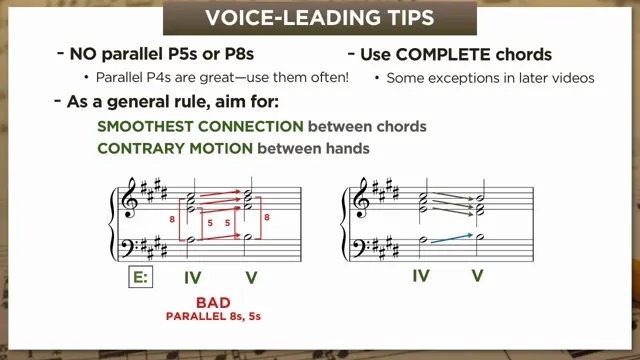
- No parallel perfect 5ths or octaves between any two voices across a chord change (parallel 4ths are fine)
- Complete chords: include all chord tones; omissions are rare exceptions for later
- Smoothest connection: keep voices stationary if possible; prefer steps over leaps, small leaps over large
- Contrary motion preferred, especially for root-position chords moving by step — similar motion risks parallel octaves/5ths
- Melody can override smoothness/contrary motion guidelines as long as no other rules break — a lively melody beats a boring one
Quick Reference: Connecting Two Chords
- Write the bass notes for both chords (given by the Roman numerals / figures)
- Place the first chord in the right hand — pick a voicing that puts the melody on top, uses a valid hand shape (triad or dissonant), and stays within an octave span
- Find common tones — any note shared by both chords stays in the same voice; don't move what doesn't need to move
- Move remaining voices the shortest distance — prefer steps over leaps, small leaps over large; aim for contrary motion between bass and right hand, especially when roots are a step apart
- Check for parallel 5ths and octaves — scan every voice pair across the chord change; if you find bad parallels, try contrary motion or redistribute the voicing
- Verify completeness and hand shape — confirm all chord tones are present and the right hand forms a recognized shape (two 3rds, 3rd+4th, or 3rd+2nd for seventh chords)
Right-Hand Shape Families ▶ 14:24
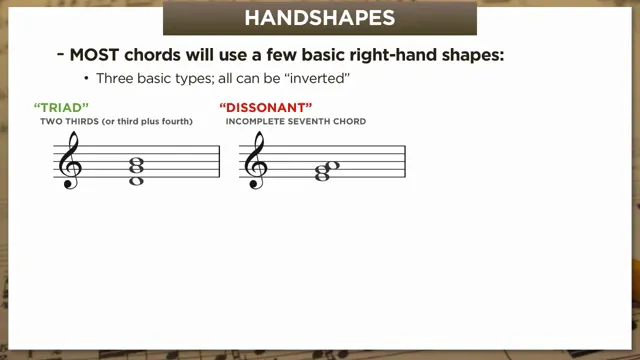
| Family | Shape | Use |
|---|---|---|
| Triad | Two 3rds, or 3rd + 4th (any order) | Most common — root position & inversions |
| Dissonant | 3rd + 2nd (any order) = incomplete 7th chord | Seventh chords |
| Open | 4th, 5th, or stacked 4th+5th (up to an octave) | First-inversion triads only |
- Never voice the right hand wider than an octave (no 9ths or 10ths)
- Unexpected hand shapes = either a special rule applies, or something went wrong
Open Hand Shapes & First-Inversion Triads ▶ 17:33
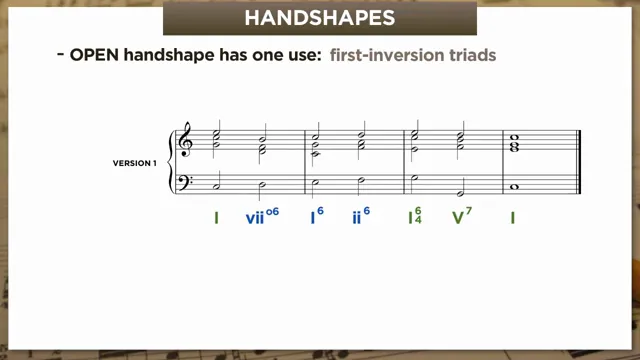
- Consecutive first-inversion triads moving by step create convoluted 4-voice juggling to avoid parallel octaves
- Solution: use open hand shapes → right hand moves in smooth parallel 4ths, simplifying to a 3-voice texture
- This 3-voice slip is acceptable (and historically authentic — Haydn, Mozart, Beethoven did it) only with open shapes over 6/3 chords
Supplementary context from Kostka & Payne, Tonal Harmony (8th ed.), Ch. 6–7.
Next: Special voice-leading rules for V⁷ → I