Key Takeaways
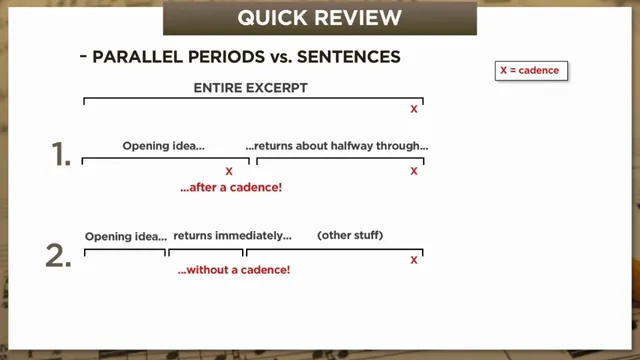
- Sentence form = short idea + immediate repetition (no cadence between) + continuation to a single cadence; period form = two phrases each ending in a cadence, with the opening returning after the first cadence
- The most common period type is the parallel interrupted period: antecedent (→ HC) + consequent restarts on tonic (→ PAC); periods can nest inside sentences, and vice versa
- Both forms are defined by two traits: repetition scheme (when/how opening material returns) and cadence type/placement
Sentence Form ▶ 1:07
- Sentence = presentation (basic idea + immediate repetition, usually over changed harmony) + continuation (more continuous, drives to a single cadence — any type: HC, PAC, IAC)
- Typical length ratio: 2+2+4 bars ("short–short–long"); can be asymmetrical (e.g., 2+2+6) or much larger (Mozart G-minor Symphony No. 40: 20 bars)
- Common harmonic pattern: basic idea over I, repetition over V, continuation restarts on I (I–VII–I bass line)
- Beethoven often builds mounting intensity in the continuation; not required — Mozart's examples stay even-keeled
- Sentences can modulate (e.g., Beethoven C-minor Violin Sonata: C major → G major)
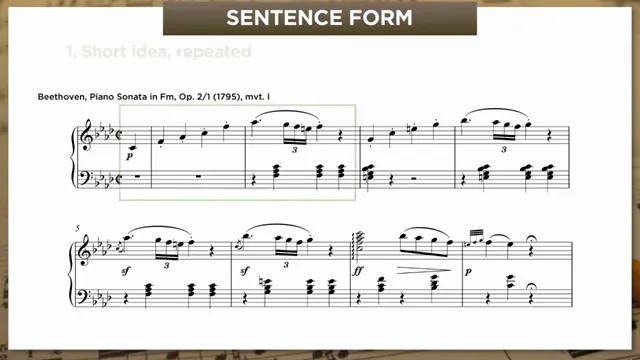
Worked examples: Beethoven Op. 2 No. 1 (F minor), Symphony No. 5, Mozart E♭ Concerto, G-minor Symphony No. 25, "Happy Birthday" — ▶ 1:36
Period Form ▶ 9:36
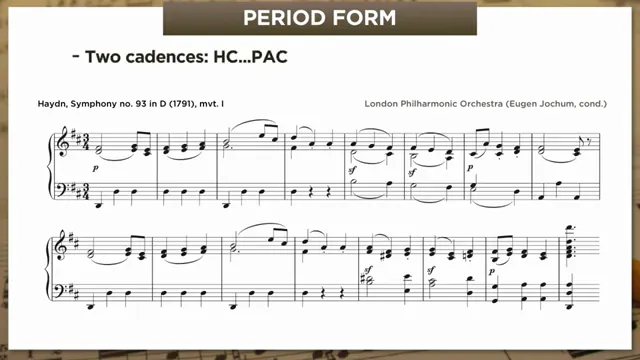
- Period = two phrases (antecedent + consequent) each ending in a cadence; together they form a larger coherent unit
- Interrupted tonal design: antecedent ends on HC (open/incomplete) → consequent restarts and closes with PAC (stronger closure)
- Parallel design: consequent phrase opens with the same material as the antecedent (at same or different pitch level)
Period Types
| Type | Phrase Openings | Cadences |
|---|---|---|
| Parallel interrupted | Identical restart on I | HC → PAC |
| Parallel (variant) | Similar but transposed/inverted | HC → PAC |
| Contrasting | Different openings | HC → PAC |
| Modulating | Parallel | HC → PAC in new key |
- Asymmetrical period: consequent is longer than antecedent — expanded from the middle or extended at the end (e.g., Mozart Piano Sonata K. 279: 4+4 → 4+6)
Worked examples: Mozart F-major Concerto, Haydn Sym. 93 & 102, Beethoven Pathétique, Mozart "Dissonance" Quartet — ▶ 9:52
Sentences Inside Periods ▶ 18:51
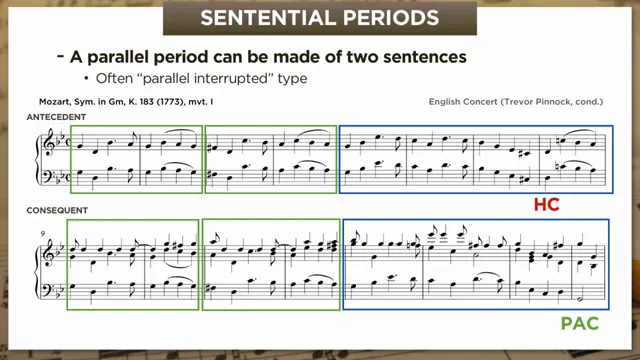
- A parallel interrupted period can be built from two sentences: sentential antecedent (→ HC) + sentential consequent (→ PAC)
- Mozart's favorite trick: quiet/sparse antecedent sentence → full orchestral consequent sentence (heard in G-minor Sym. No. 25, Sym. No. 39 finale)
- Not all sentential periods use intensification — Beethoven Op. 2 No. 2 keeps equal dynamics throughout