Key Takeaways
- Three cadence types ranked by strength: HC (open, weakest) < IAC (weak closure) < PAC (definitive closure)
- Cadences require both harmonic formula and contextual confirmation — not every V→I is a cadence
- Melodic top voice determines PAC vs. IAC: tonic in soprano = PAC; any other note = IAC
The Three Cadence Types ▶ 3:24
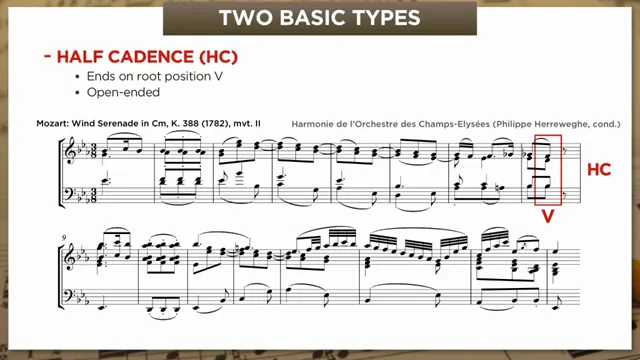
| Cadence | Formula | Top Voice | Strength |
|---|---|---|---|
| Half Cadence (HC) | Ends on root-position V | Any | Open/inconclusive |
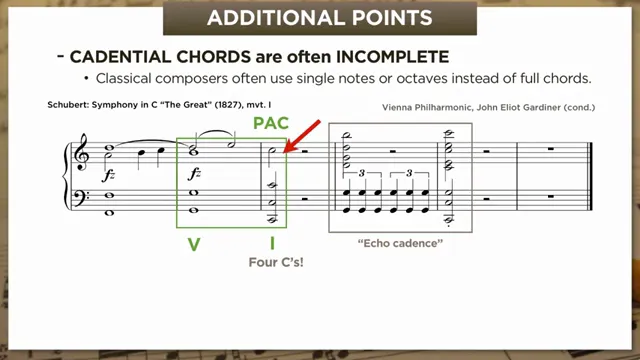
| Perfect Authentic Cadence (PAC) | Root-pos. V(7) → root-pos. I, strong beat | Scale degree 1̂ | Strongest closure |
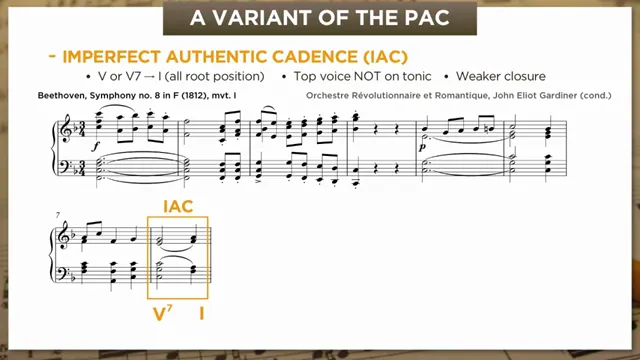
| Imperfect Authentic Cadence (IAC) | Root-pos. V(7) → root-pos. I | Any note except 1̂ | Intermediate closure |
- HC approach chord is flexible — can come from I, IV, chromatic bass, etc.
- IAC often placed on a weak beat to underscore its lesser finality (see Beethoven Op. 93, bar 8)
Cadences in Real Music ▶ 7:50
- Incomplete chords are normal — bare octaves or single notes can still project a full cadence (e.g., Schubert C-major Symphony PAC; Mozart E-minor Violin Sonata)
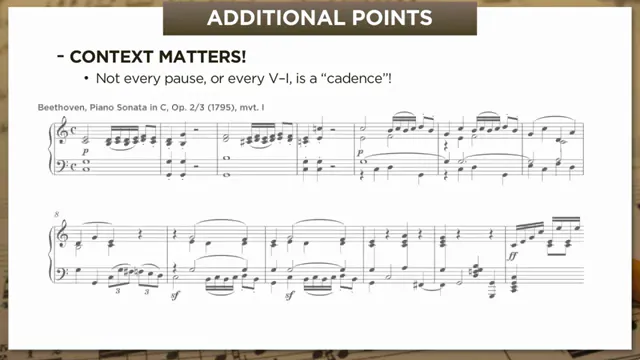
- Context required — a V pause inside a single opening gesture (Beethoven Op. 2/3, bars 1–4) is not a cadence; first real cadence arrives at bar 8
- Elision: cadence downbeat = simultaneous start of next phrase — no gap between phrases
- Melodic filler: one voice may keep moving through a cadential break; listen to the bass stopping, not the top voice (Mozart A-major Piano Concerto)
Contested Debates ▶ 13:12
- Phrases require cadences? — useful rule but not universal; a phrase ending on IV feels like a phrase even without I or V (Mozart string quartet minuet)
- Inverted dominant = authentic cadence? — bass 3̂–2̂–1̂ descent (Schubert Die Krähe) sounds cadential to many; others reject it for lacking root-position V
- Inverted or V7 dominant = HC? — first-inversion V or V7 landing at a phrase end sounds like HC; Prof. Monahan's view: let the ear decide, then fix the definition