Key Takeaways
- Non-chord tones (NCTs) are melodic notes foreign to the prevailing chord; they're classified entirely by stepwise motion into and/or out of the dissonance
- Most NCTs resolve by step; the exceptions (double-neighbor, escape tone, anticipation) are rarer and usually cadential
- Accented NCTs — especially suspensions and appoggiaturas — carry the most expressive weight; duration matters as much as beat placement
What Are Non-Chord Tones? ▶ 0:11
- Chord tones: notes belonging to the prevailing harmony; non-chord tones (NCTs) / non-harmonic tones: notes that don't
- NCTs are usually dissonant → require careful treatment in the classical style
- Classified by melodic context (approach + departure), not by pitch content
NCT Types: Step In, Step Out ▶ 3:34
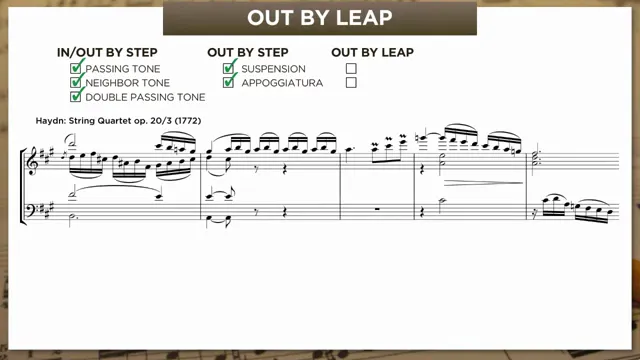
| NCT | Approach | Departure | Connects/Embellishes |
|---|---|---|---|
| Passing tone (PT) | step | step (same dir.) | chord tones a 3rd apart |
| Neighbor tone (NT) | step | step (reverse) | single pitch (upper or lower) |
| Double passing tone | step | step (same dir.) | chord tones a 4th apart; two NCTs in a row |
- PT and NT can bridge chord tones across a chord change, not just within one chord (▶ 8:41)
NCT Types: One Stepwise Move Out ▶ 9:43
| NCT | Approach | Departure | Notes |
|---|---|---|---|
| Suspension | held/re-struck from prior chord | step down (usually) | most common accented NCT |
| Appoggiatura | leap | step | highly expressive; almost always accented |
- Re-articulated suspension: NCT is re-struck (not held) at the chord change — same function as a regular suspension (▶ 12:39)
NCT Types: Leap Out or No Resolution ▶ 14:14
| NCT | Approach | Departure | Typical Context |
|---|---|---|---|
| Double-neighbor figure | step | leap (to 2nd NCT) → step | upper + lower neighbor pair encircling one chord tone |
| Escape tone | step | leap | cadences; scale degrees 2̂→3̂→1̂ |
| Anticipation | step or leap | none (harmony catches up) | cadences; scale degree 2̂ arrives early |
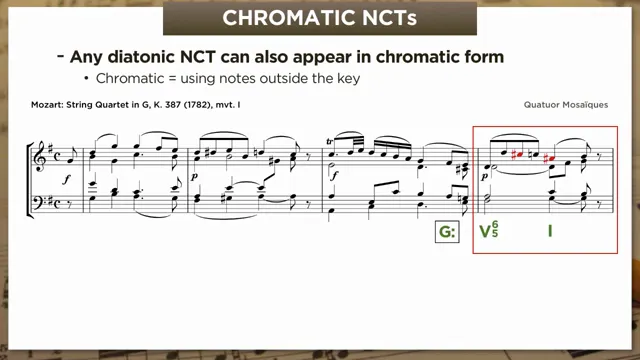
Chromatic NCTs ▶ 18:33
- Any NCT type can use a chromatic pitch (accidental outside the key)
- Identified the same way — motion in/out determines type; chromaticism is just a modifier (e.g., chromatic passing tone, chromatic appoggiatura)
Accented NCTs ▶ 20:50
- Accented NCT: falls on a strong beat and is held long enough to register as dissonant — duration matters as much as metric position
- Suspensions and appoggiaturas are nearly always accented; accented PTs and NTs are powerful but less predictable
- Beethoven → Wagner → Mahler show progressive exploitation of accented NCTs for expressive intensity (▶ 21:26)