Key Takeaways
- Five number systems in theory each describe a different relationship — mixing them up causes real errors (e.g., "the seventh goes up" is ambiguous: scale degree 7̂ rises, while a chordal seventh falls)
- Roman numerals and scale degrees are key-dependent; chord degrees, intervals, and figured bass are not (chord degrees stay fixed even when the key changes)
- Precision of language = precision of thought — always specify which kind of number you mean
The Five Number Systems ▶ 0:37
| System | Relates… | Key-dependent? |
|---|---|---|
| Roman numerals | chords → key (via root) | ✅ |
| Scale degrees | notes → key | ✅ |
| Chord degrees | notes → chord (root/3rd/5th/7th) | ❌ |
| Intervals | notes → other notes | ❌ |
| Figured bass | notes → bass note (via interval) | ❌ |
Roman Numerals & Scale Degrees ▶ 1:03
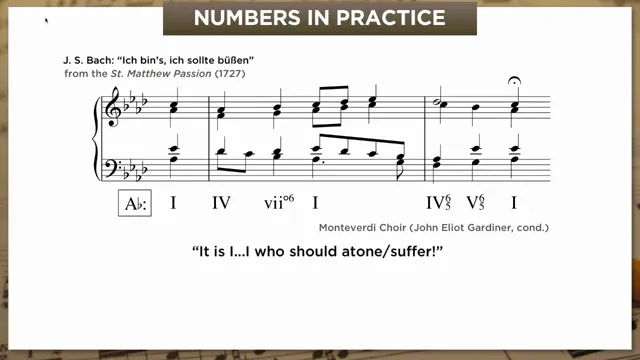
- Roman numeral identifies a chord by its root's position in the key (e.g., V = chord rooted on scale degree 5̂)
- Scale degree labels each individual note's position in the key — a single chord uses multiple scale degrees simultaneously
- Both change if the key signature changes (same voicing in F minor → different Roman numeral and scale degrees than in A♭ major)
Chord Degrees ▶ 5:31
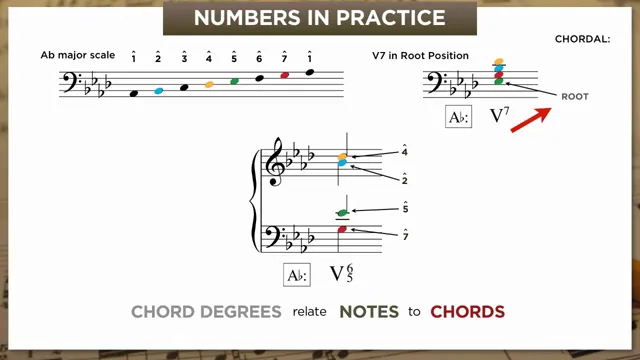
- Chord degrees = root, third, fifth, (seventh) — labels that travel with the chord regardless of key
- Inversion labels follow chord degrees: V⁶₅ = V7 with the chordal third in the bass
- Chord degrees remain unchanged when recontextualizing the same chord in a new key
Figured Bass ▶ 7:14
- Figured bass numbers = intervals above the bass note; "6/5/3" is shorthand for 6/5/3 above the bass
- Notes may appear a compound interval away (e.g., a "5" can sound as a 5th + octave); the figure still refers to the simple interval class
- Don't just convert figures to inversion labels — each integer corresponds to a specific note
Intervals ▶ 9:03
- Intervals describe the distance between any two notes — not anchored to key, chord, or bass
- Useful in analysis for voice-leading observation (e.g., soprano/alto moving in 3rds, with one expressive minor 2nd exception); ▶ see demonstration at 9:16
The Confusion Trap ▶ 11:19
- Classic error in dominant 7th resolution: chordal seventh must resolve down; scale degree 7̂ must resolve up — both live in the same chord
- "Missing the fifth" feedback is useless without specifying: scale degree 5̂? chordal fifth? figured-bass 5?