Key Takeaways
- A seventh chord = triad + one extra note a third above the fifth (4 notes, 3 stacked thirds); 5 qualities exist, 4 appear naturally in major, all 5 in minor
- V always carries a dominant seventh quality (major-minor 7th) in both major and minor keys; fully diminished leading-tone sevenths use raised 7̂ and are characteristic of minor
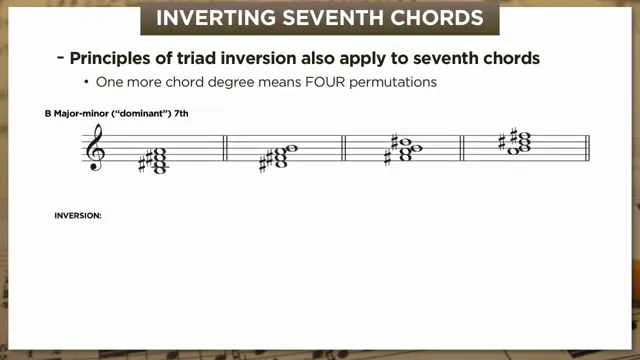
- Seventh chords have 4 inversions (root, 1st, 2nd, 3rd); abbreviated figured bass symbols are 7 → 6/5 → 4/3 → 4/2 (counting down from 7)
Seventh Chord Qualities ▶ 0:52
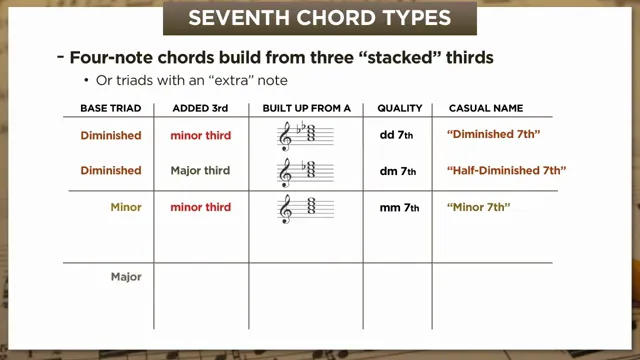
| Official Name | Casual Name | Bass Triad + Added 3rd |
|---|---|---|
| Diminished-diminished 7th | Diminished 7th (fully-dim) | Diminished + minor 3rd |
| Diminished-minor 7th | Half-diminished 7th | Diminished + major 3rd |
| Minor-minor 7th | Minor 7th | Minor + minor 3rd |
| Minor-major 7th | (not used in classical) | Minor + major 3rd |
| Major-minor 7th | Dominant 7th | Major + minor 3rd |
| Major-major 7th | Major 7th | Major + major 3rd |
- Each quality = raise one note from the previous (dim → half-dim → minor → dominant → major 7th)
Seventh Chords in Major Keys ▶ 3:45
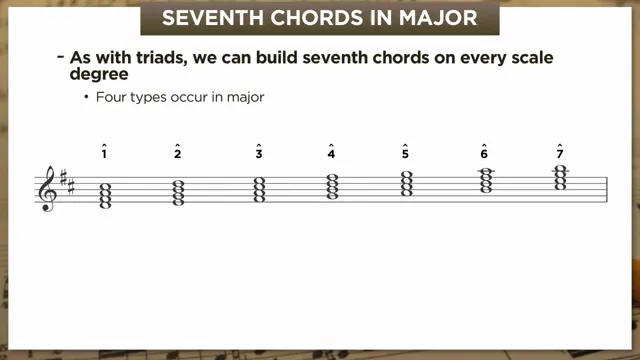
- I, IV → major 7th (uppercase RN + 7)
- ii, iii, vi → minor 7th (lowercase RN + 7)
- vii°⁷ → half-diminished 7th (lowercase + ø7)
- V⁷ → dominant 7th — the only major-minor 7th; fully-diminished does not occur naturally in major
Seventh Chords in Minor Keys ▶ 5:14
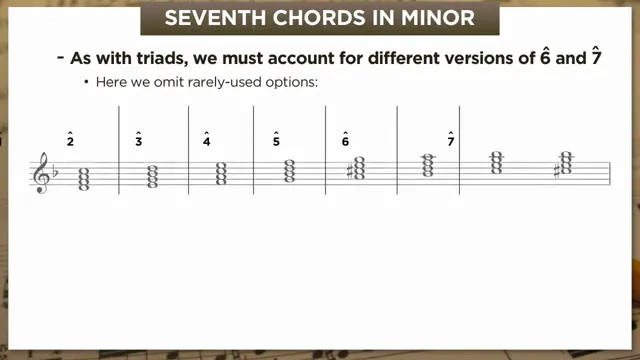
- i, iv → minor 7th; III, VI → major 7th; iiø⁷ → half-diminished
- VII⁷ (subtonic, natural minor) → dominant 7th quality; vii°⁷ (raised leading tone, harmonic minor) → fully-diminished 7th
- V⁷ always uses the raised leading tone → dominant quality; no minor-7th option on V
Inversions & Figured Bass ▶ 7:07
| Inversion | Bass Note | Abbreviation |
|---|---|---|
| Root position | Root | 7 |
| First inversion | Chordal 3rd | 6/5 |
| Second inversion | Chordal 5th | 4/3 |
| Third inversion | Chordal 7th | 4/2 |
- Memory tip: read abbreviations as counting down from 7 (7, 65, 43, 42) with a small skip between 3 and 2