Key Takeaways
- Roman numerals give the root (but not inversion); figured bass gives the inversion (but not root) — combined, they fully specify a chord within a key
- The two systems merge cleanly because both only require certain notes to appear somewhere above the bass, regardless of spacing or doubling
- Inversion affects stability: root position = most stable; first inversion = intermediate; second inversion (6-4) = least stable, requires special handling
Why the Systems Combine ▶ 0:46
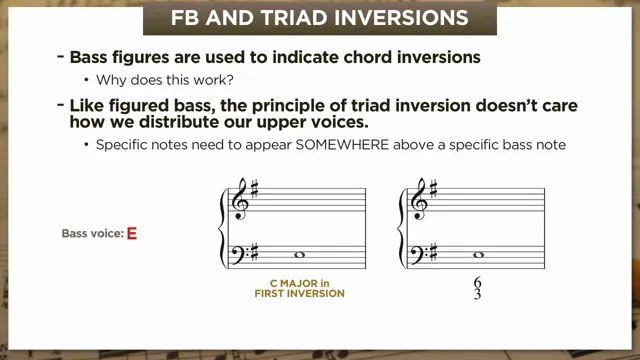
- Both systems are voicing-agnostic — they specify which notes appear above the bass, not their order, spacing, or doubling
- A "C-major triad in first inversion" and a "6-3 chord on E" are executed identically; closed, open, and doubled versions are all valid
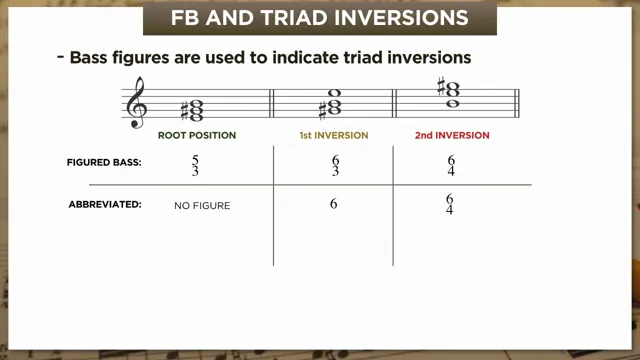
Triad Inversions → Figured Bass Equivalents ▶ 2:35
| Inversion | Full Figures | Abbreviation | Roman Numeral notation |
|---|---|---|---|
| Root position | 5-3 | (none) | I |
| First inversion | 6-3 | 6 | I⁶ |
| Second inversion | 6-4 | (none — always written out) | I⁶₄ |
Stability of Inversions ▶ 4:51
- Root position = most stable; the true "home base" of a key (pieces end here)
- First inversion = moderately stable; less grounded but not restless
- Second inversion (6-4) = highly unstable; sounds like it wants to resolve — requires careful, idiomatic treatment in the classical style
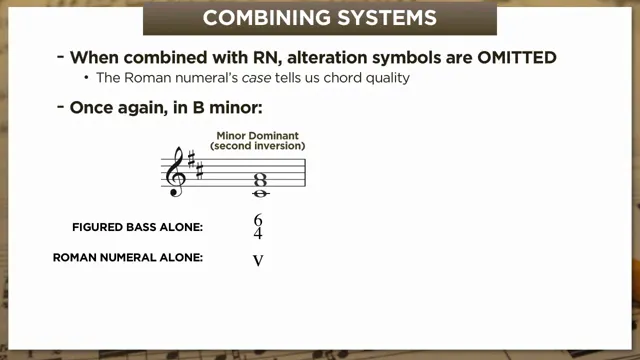
Accidentals: Omitting Alteration Symbols ▶ 7:53
- When Roman numerals and figured bass are combined, alteration symbols (slash, plus, etc.) are typically omitted from the figures
- The case of the Roman numeral (upper = major, lower = minor) already conveys chord quality and implies any necessary accidentals
- Example in B minor: uppercase V⁶₄ tells you to raise the 6th above the bass to A♯ — the slash is redundant (though some analysts still include it)
Non-Chord Tones (Preview) ▶ 10:29
- Figured bass can also represent non-chord tones — melodic embellishments that don't belong to the underlying triad
- Full treatment covered in a later video; seventh chords are next (Video 8)