Key Takeaways
- A triad's root never changes; the bass (lowest sounding note) determines inversion (root position / first / second)
- In any major key: I, IV, V = major; ii, iii, vi = minor; vii° = diminished — these qualities are automatic
- Minor keys add complexity: V is almost always raised to major; vii appears as both a subtonic triad (♮VII, major) and a leading-tone triad (vii°, diminished)
The Four Triad Types ▶ 0:42
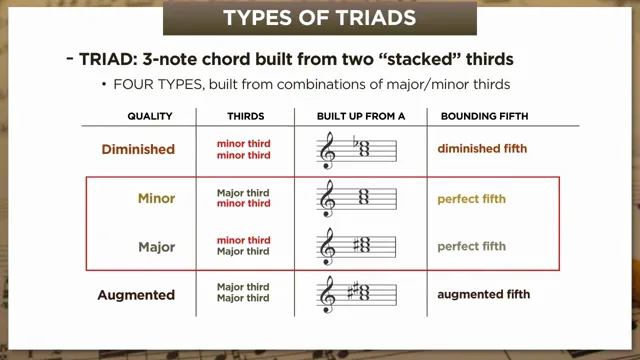
| Quality | Bottom 3rd | Top 3rd | Bounding 5th | Consonant? |
|---|---|---|---|---|
| Diminished | minor | minor | diminished | ✗ |
| Minor | minor | major | perfect | ✓ |
| Major | major | minor | perfect | ✓ |
| Augmented | major | major | augmented | ✗ |
- Each successive type is built by raising the top note of the previous chord by one semitone
- Major/minor are acoustically consonant (perfect 5th); diminished/augmented are dissonant and rarer
Chord Tones, Voicing & Position ▶ 3:33
- Root = note the chord is named after; chordal third = a 3rd above root; chordal fifth = a 5th above root
- A triad is defined by its three pitch classes — doublings and register don't change its identity
- Open position: gaps exist between notes where another chord tone could fit; closed position: no such gaps (notes packed as tightly as possible)
How to Identify a Mystery Triad ▶ 7:00
- Identify all notes (ignore doublings)
- Stack as thirds — try all three orderings in closed position; whichever gives a stack of thirds has the root on bottom
- Determine quality — check the bounding fifth (dim/perf/aug), then the bottom third (minor → minor triad; major → major triad)
Example analyzed at ▶ 7:00: chord with A, F♯, C♯ → F♯ minor
Diatonic Triads in Major Keys ▶ 8:35
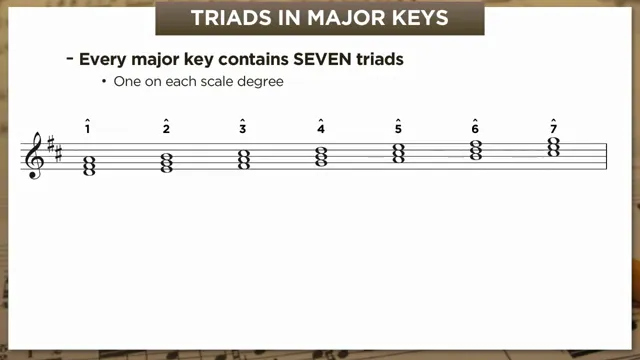
| Scale Degrees | Quality | Roman Numeral Style |
|---|---|---|
| I, IV, V | Major | Uppercase (I, IV, V) |
| ii, iii, vi | Minor | Lowercase (ii, iii, vi) |
| vii | Diminished | Lowercase + ° (vii°) |
- Functional names (tonic, supertonic, mediant, etc.) apply equally to chords and scale degrees
Diatonic Triads in Minor Keys ▶ 11:01
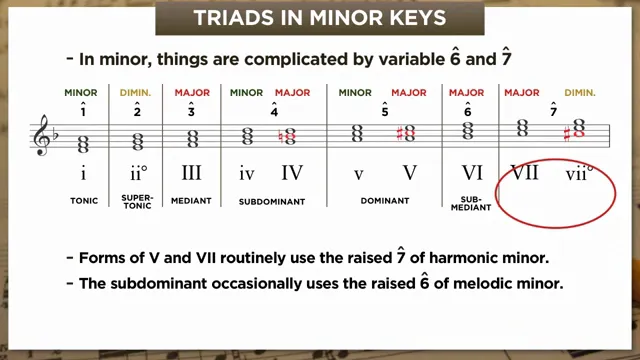
- Natural minor defaults: i, iv, v = minor; III, VI, VII = major; ii° = diminished
- Harmonic minor raises ♯7: turns v → V (major dominant — nearly universal in classical style); turns ♮VII → vii° (leading-tone triad, diminished)
- Melodic minor raises ♯6: turns iv → IV (major subdominant — less common)
- Subtonic triad (♮VII, major) vs. leading-tone triad (vii°, diminished) — different roots, different Roman numerals
Inversions ▶ 15:46
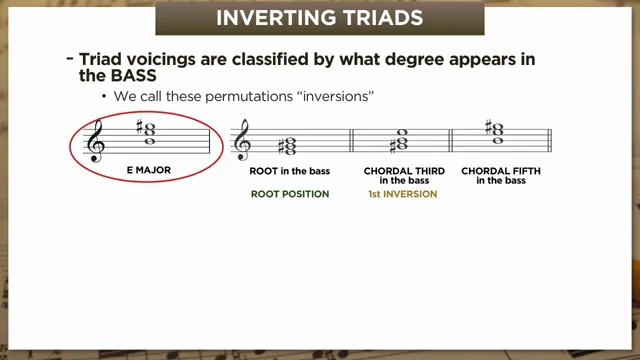
| Inversion | Bass note | Name |
|---|---|---|
| Root position | Root | — |
| First inversion | Chordal 3rd | 1st inv. |
| Second inversion | Chordal 5th | 2nd inv. |
- Root ≠ bass: root is an abstract property of the chord; bass is whichever note is lowest in a specific voicing
- Upper voice arrangement is irrelevant to inversion — only the lowest note matters
- Figured bass notation (6, 6/4) for inversions introduced in Video 7