Key Takeaways
- Every interval has two components: generic size (lines/spaces on staff) and specific size (diminished/minor/perfect/major/augmented)
- Family I (unisons, 4ths, 5ths, octaves) use dim/perfect/aug; Family II (2nds, 3rds, 6ths, 7ths) use dim/minor/major/aug — never cross families
- Inversion rule: specific quality flips (major↔minor, aug↔dim, perfect stays); generic numbers add to 9
Melodic vs. Harmonic; Simple vs. Compound ▶ 0:31
- Melodic interval: two notes in succession; harmonic interval: two notes sounded simultaneously — measured identically
- Simple interval: octave or smaller; compound interval: larger than an octave — treat compound as simple + octave(s)
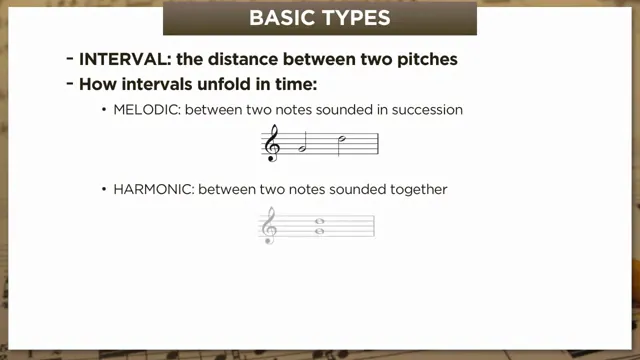
Generic Size ▶ 2:27
- Count lines and spaces spanned on the staff (inclusive) → unison through octave
- Unaffected by clef changes or accidentals — C♯ to E𝄫 is still some kind of third
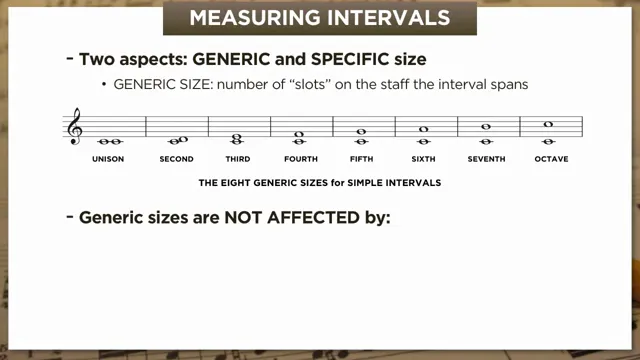
Specific Size ▶ 3:32
| Family | Generic Sizes | Available Qualities |
|---|---|---|
| I | Unisons, 4ths, 5ths, Octaves | Diminished · Perfect · Augmented |
| II | 2nds, 3rds, 6ths, 7ths | Diminished · Minor · Major · Augmented |
Semitone reference chart (use only as fallback):
| Semitones | 0 | 1 | 2 | 3 | 4 | 5 | 6 | 7 | 8 | 9 | 10 | 11 | 12 |
|---|---|---|---|---|---|---|---|---|---|---|---|---|---|
| Name | P1 | m2 | M2 | m3 | M3 | P4 | d5 | P5 | m6 | M6 | m7 | M7 | P8 |
Identifying Specific Size via Scales ▶ 7:32
Family I (4ths & 5ths): Does the top note appear in both major and minor scales of the bottom note?
- Yes → Perfect; No → reckon as ±1 semitone from perfect → aug or dim
- Speed tip: matched accidentals (both ♯, both ♭, or both ♮) = Perfect — except B & F, which need mixed accidentals to be perfect
Family II (3rds, 6ths, 7ths): Does the top note appear in the major or minor scale of the bottom note?
- In major scale → Major; in minor scale → Minor; neither → modify up/down from the known interval
- ⚠️ This scale method does not work for 2nds — count semitones instead
Inverting Intervals ▶ 11:18
- Inversion: swap bottom and top notes
- Generic pairs (add to 9): 1↔8, 2↔7, 3↔6, 4↔5
- Quality flips: major↔minor, aug↔dim, perfect→perfect
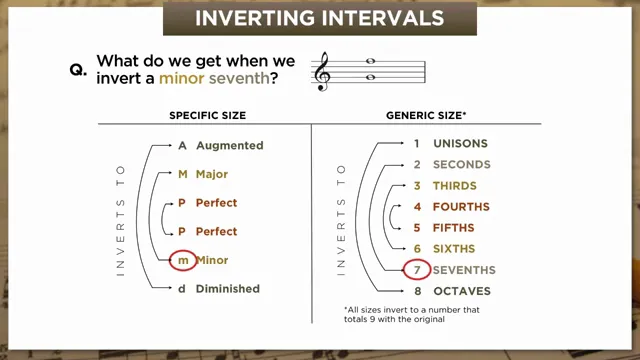
Practical trick for hard intervals: invert → ID the now-small interval → re-invert using the chart
- Example walkthrough (G→F♯ → major 7th): ▶ 13:47