Key Takeaways
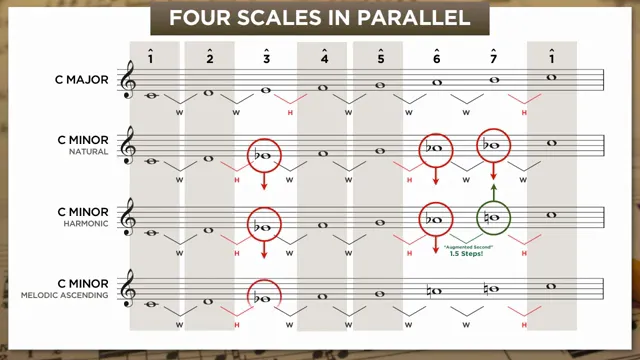
- Three minor scale variants differ only in whether scale degrees 6̂ and 7̂ are raised or lowered — think of them as a single flexible system, not separate scales
- Harmonic minor raises 7̂ to restore the leading tone; melodic minor also raises 6̂ to eliminate the resulting augmented second
- Parallel thinking (minor as major with lowered 3̂, 6̂, and 7̂) is more practical for memorization than relative-key thinking
Natural Minor ▶ 0:18
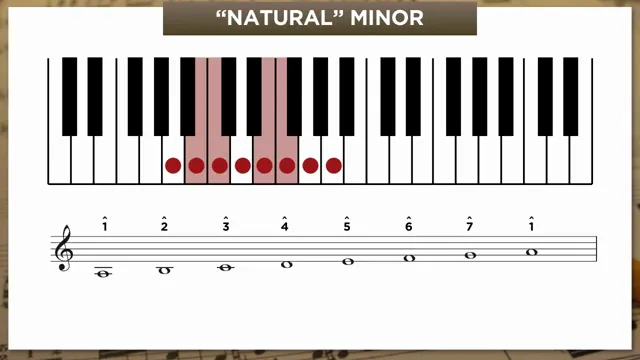
- Natural minor: major scale restarted on scale degree 6̂ — same notes, different tonic; half steps fall between 2̂–3̂ and 5̂–6̂ (vs. 3̂–4̂ and 7̂–1̂ in major)
- Subtonic: name for lowered 7̂ in natural minor — a whole step below tonic, with no leading-tone pull
Harmonic Minor ▶ 2:03
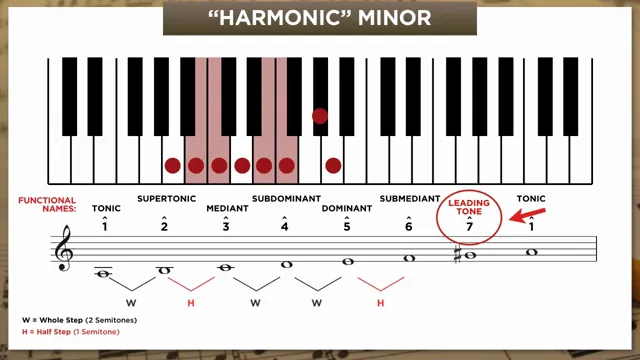
- Harmonic minor: raises 7̂ by semitone → restores leading tone and its gravitational pull toward tonic
- Side effect: the gap between 6̂ and 7̂ becomes 3 semitones — an augmented second, historically treated as awkward in this voice-leading style
Melodic Minor ▶ 3:40
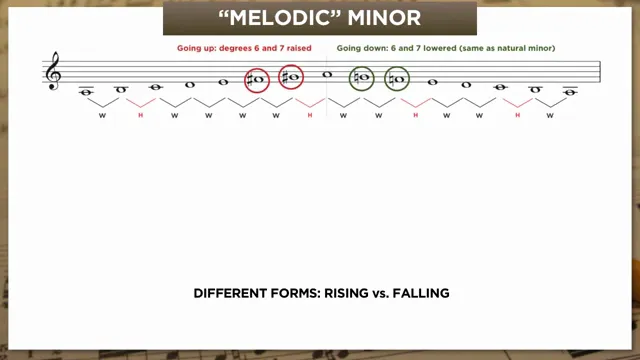
- Melodic minor: raises both 6̂ and 7̂ — eliminates the augmented second while keeping the leading tone
- Conventional form: ascending = raised 6̂ and 7̂; descending = lowered 6̂ and 7̂ (back to natural minor)
- In practice, composers used raised/lowered forms freely in either direction — see Beethoven op. 95 and Bach E-minor partita examples ▶ 4:55
Parallel Comparison: Major vs. Minor ▶ 8:15
- All four parallel scales (major + 3 minors) share scale degrees 1̂, 2̂, 4̂, and 5̂ — only 3̂, 6̂, and 7̂ vary
| Scale | vs. Major: lower these degrees |
|---|---|
| Natural minor | 3̂, 6̂, 7̂ |
| Harmonic minor | 3̂, 6̂ |
| Melodic minor | 3̂ only |
- Parallel thinking is essential for 19th-c. music (Schubert, Mahler), where major/minor toggle note-by-note