Key Takeaways
- The major scale's identity is its W-W-H-W-W-W-H step pattern — apply it starting on any note to build any major scale
- Half-steps (E→F, B→C in C major) are the scale's defining moments; they signal the key to the listener
- Spelling matters: every major scale must use exactly one of each letter name — never mix e.g. G and G♭ in the same scale
The Half-Step/Whole-Step Pattern ▶ 2:00
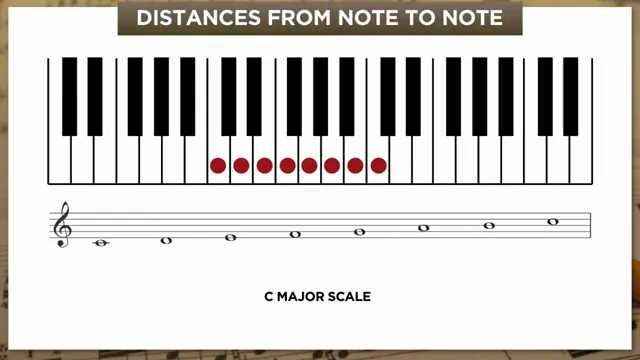
- Whole step: two notes separated by one note in between (e.g., C→D, with C♯ between)
- Half step (semitone): closest possible distance; no note between them — only two in the major scale: E→F and B→C
- Full pattern: W – W – H – W – W – W – H
Scale Degrees & Functional Names ▶ 3:19
| Degree | Functional Name |
|---|---|
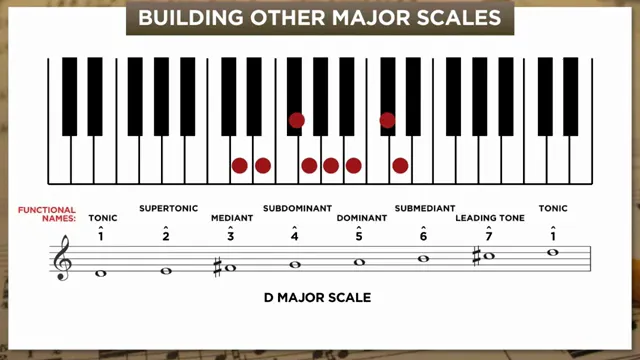
| 1̂ | Tonic |
| 2̂ | Supertonic |
| 3̂ | Mediant |
| 4̂ | Subdominant |
| 5̂ | Dominant |
| 6̂ | Submediant |
| 7̂ | Leading tone — pulls strongly toward tonic |
- Caret (^) above a number denotes a scale degree on the page
- Leading tone (7̂) is the most functionally descriptive name — its tension toward tonic becomes critical in minor scales (Video 3)
Building Major Scales on Other Notes ▶ 4:45
- Same W-W-H-W-W-W-H pattern, new starting note — add sharps/flats as needed to preserve the pattern
- Spelling rule: one letter name per scale degree — use A♭, not G♯, if A is the required letter
- Worked example — E♭ major spelled out step by step: ▶ 6:35
What's Next
- Memorizing all 15 major scales via key signatures — covered in Video 2