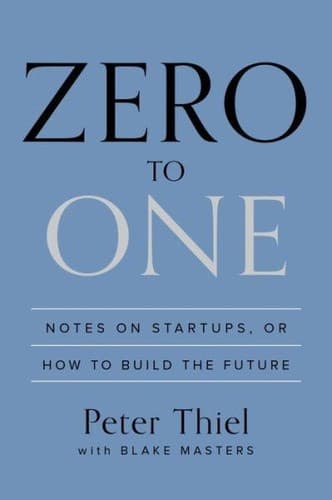
Core Idea
- Thiel’s central distinction is 0 to 1 versus 1 to n: real progress creates something new, while copying merely scales what already exists.
- The book argues that startups matter because they are the main way new technology gets built, and the future will be shaped more by technology than by globalization.
- His bigger claim is that success comes from seeing and exploiting hidden truths—in markets, products, timing, people, and distribution—before they become obvious.
Startups, Monopoly, and the Real Questions
- Thiel rejects the idea that entrepreneurship can be reduced to a formula; innovation requires first principles, not best practices.
- He repeatedly asks founders: “What important truth do very few people agree with you on?” because contrarian answers reveal unrecognized opportunities.
- He argues that competition is usually destructive, not healthy: under perfect competition, profits disappear, while durable value comes from creating a monopoly in his sense.
- A monopoly is not a legal abuse of power but a company so differentiated that it has no close substitute.
- The most valuable businesses combine some mix of proprietary technology, network effects, economies of scale, and branding.
- Proprietary technology must usually be about 10x better than the nearest alternative in an important dimension to create a real advantage.
- Network effects work only when a company starts with a small, valuable market, as Facebook did at Harvard, and expands from there.
- Scale matters especially in software, where low marginal costs let the best product spread its fixed costs over far more users.
- Brand can help, but Thiel treats brand as dangerous if it is not backed by real technology, scale, or network effects.
- His preferred path is to start small, monopolize a niche, and then expand deliberately rather than enter a broad market head-on.
- PayPal’s move from a failed PalmPilot idea to eBay PowerSellers is his model of finding a concentrated market that truly needed the product.
- He criticizes disruption as an overused self-image; the goal is not to be a noisy first mover but to become the last mover and own the market.
Seven Questions for Building a Durable Company
- Thiel says cleantech failed because most companies could not answer seven business questions well: engineering, timing, monopoly, people, distribution, durability, and secret.
- The engineering question asks whether the product is genuinely order-of-magnitude better, not merely cleaner or more socially desirable.
- The timing question asks whether the market is truly ready; solar, for example, did not have the exponential improvement curve that made computing a good bet.
- The monopoly question asks whether the company can dominate a real market, not a fictional one created by shrinking the category rhetorically.
- The people question asks whether the team is made of real builders rather than salesman-executives who look good but cannot create the technology.
- The distribution question asks whether the company can actually reach customers; raising money or courting governments is not a substitute for sales.
- The durability question asks what will happen in 10 or 20 years, including pressure from China, fracking, or other outside changes.
- The secret question asks whether the company has discovered something specific and non-obvious rather than merely repeating a broadly approved truth.
- Tesla is his main cleantech exception because it answered all seven questions: strong technology, good timing, a small market it could own, a capable founder, direct distribution, a durable lead, and a real secret.
- Tesla also shows that “green” can be a weak pitch unless the product itself is desirable; it succeeded partly because it made electric cars cool, not just virtuous.
Planning, Founders, Secrets, and Distribution
- Thiel contrasts definite and indefinite views of the future; modern culture tends toward indefinite optimism, hoping for a better future without making concrete plans.
- He treats leanness as a method, not a goal: iteration alone is not enough if a company lacks a bold, definite plan.
- Because the future is shaped by a few outsized outcomes, the power law dominates venture capital and life choices; diversification cannot save you from choosing badly.
- Great companies therefore require intense selectivity, and great people should focus on what they are uniquely good at rather than generic “well-roundedness.”
- Thiel argues that many important discoveries are still secrets—hard but knowable truths—while mysteries may be unsolvable.
- He says four trends discourage secret-seeking: incrementalism, risk aversion, complacency, and the “flatness” of globalization.
- The best entrepreneurs behave like conspirators in a noble sense: they share the secret with the people they need, and no more.
- Founding matters because bad early choices are hard to reverse; a startup built on a bad foundation is difficult to fix later.
- He emphasizes founder alignment: co-founders should know each other well, ownership/possession/control should be clear, and boards should stay small.
- Recruiting is core and should not be outsourced; people join startups for mission and the chance to do irreplaceable work, not for perks.
- Internal conflict can kill a company like an autoimmune disease, so each person should have one clear responsibility and be aligned around a shared worldview.
- Thiel says everyone sells: founders sell to employees, investors, media, and customers, and a great product without a distribution plan is not a good business.
- Distribution depends on the product and may take the form of complex sales, personal sales, marketing/advertising, or viral growth.
- He stresses the economics of distribution with CLV vs. CAC: customer lifetime value must exceed customer acquisition cost.
- PayPal’s referral-driven growth is his key example of viral distribution, while Better Place shows that even large funding cannot overcome weak customer adoption.
- For him, computers are most valuable as complements, not substitutes: software should help humans solve hard problems rather than simply replace them.
- He is skeptical of “big data” or “machine learning” when treated as ideologies of substitution, and he frames strong AI as a distant possibility rather than a reason to stop planning now.
What To Take Away
- Look for where a market is still secret, small, and misspecified, rather than chasing what everyone already agrees is important.
- The right startup question is not “How do I enter a big market?” but “How do I build something 10x better, own a niche, and make it durable?”
- Good companies are built by founders who think definitively, align their teams, and master distribution as carefully as product.
- Thiel’s deepest warning is that civilization can drift into imitation and indecision; the antidote is to think for yourself and create something genuinely new.
Generated with GPT-5.4 Mini · prompt 2026-05-11-v6