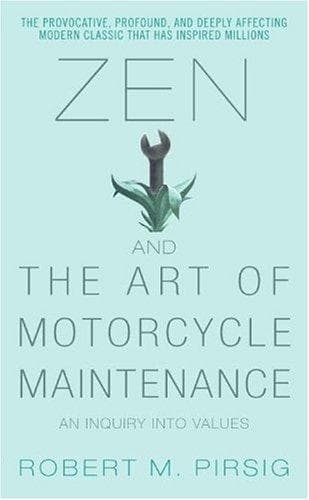
Core Idea
- The book uses a motorcycle trip and a father-son relationship to ask what Quality is and why modern life keeps splitting reason from lived experience.
- Its central claim is that good work, good thought, and good living all depend on a nondual relation to reality in which the worker is not detached from the work.
- Motorcycle maintenance becomes the governing metaphor: technical care is not opposed to art or Zen-like awareness, but is a form of disciplined attention.
Main Arguments and Concepts
- Pirsig divides experience into romantic and classical modes: romantic sees immediate appearance, feeling, and surface; classical sees underlying form, structure, and system.
- A motorcycle can be read both ways, and the conflict between these visions explains many of the book’s human and cultural tensions.
- The narrator’s road philosophy insists that the machine is not just steel but a hierarchy of concepts, tolerances, and functions that only works when understood carefully.
- His repeated repairs show that real maintenance depends on precision, patience, and caring, not on blind obedience to manuals or professional detachment.
- The book’s critique of mechanics is not anti-technology; it targets the spectator attitude that fixes parts without identifying with the work.
- The larger target is the “system” of modern rationality, which the narrator treats as a structure of thought rather than merely factories, governments, or machines.
- Pirsig argues that attacks on technology miss the point if the conceptual habits that produce it remain unchanged.
- The story of Phædrus reveals the cost of pursuing rationality to the limit: an extraordinary mind, later shattered by electroshock, who chased the foundations of science and reason until they broke him.
- Phædrus’s inquiry into science leads through induction, deduction, and the limits of scientific method, which can multiply hypotheses and facts without ever fully grounding truth.
- The book treats science as powerful but incomplete: laws, logic, and even “objectivity” are human constructions that organize experience rather than simply mirror a ready-made world.
- Kant and Hume are used to show how mind supplies form to experience, so the “real” motorcycle is partly a mental construction stabilized by a priori ordering.
- The key philosophical move is the rejection of subject/object as ultimate categories in favor of Quality, which comes before both.
- Quality is described as the event from which subject and object arise; it is not just preference, mood, or measurable property.
- Pirsig repeatedly stresses that Quality cannot be neatly defined because it is the preintellectual source of the definitions themselves.
- Phædrus’s classroom experiments show that students already recognize Quality when they rank papers, even if they cannot formulate it.
- His no-grades experiment is meant to free students from rote imitation and reveal genuine engagement, though it also creates a vacuum for some students and even a breakdown.
- The famous “seed crystal” metaphor captures how a small question can precipitate a whole philosophical structure once the mind is supersaturated with the right tensions.
- The Church of Reason episode shows Phædrus defending the university as a state of mind and a continuing body of inquiry, not just a building or bureaucracy.
- His encounter with Eastern thought, especially the Tao Te Ching, helps him see Quality as a generative, indefinable source rather than a property to be analyzed away.
- The book presents gumption as the psychic fuel needed for work, and gumption traps as the things that drain it.
- External gumption traps include bad sequencing, intermittent failures, unavailable or defective parts, and the temptation to rush when behind.
- Internal gumption traps include value rigidity, ego, anxiety, boredom, and impatience; each distorts perception and blocks effective work.
- The cure for these traps is not technique alone but a shift in attitude: slow down, re-see the facts, and let Quality guide what matters first.
How the Journey Enacts the Philosophy
- The motorcycle trip itself is a test case for the philosophy because the road forces attention to weather, fatigue, risk, maintenance, and relationship.
- The narrator’s rituals of tuning, checking, and adjusting show how careful work can become a kind of meditation.
- Chris’s illness, anger, and eventual recognition of his father make the philosophical crisis personal: the narrator has tried to live beyond duality while failing to face the deepest split in his own life.
- The father-son conflict resolves only partially through confession, not because ideas are solved, but because honesty restores some shared reality.
- The final movement from Chris’s death to the birth of Nell shifts the book from personal grief to the idea of pattern: what is lost is not just a body but a living configuration of relation and memory.
- Pirsig ends by treating spirit, self, and identity as patterns that persist through change, giving the book its quiet insistence that meaning survives beyond material form.
What To Take Away
- The book’s most important distinction is not motorcycle vs. philosophy, but detached knowing vs. engaged care.
- Quality is the book’s central but deliberately unfinalized idea: it names the source of better judgment before theory splits the world into subject and object.
- Pirsig’s deepest critique is of any system that forgets the human act of selection, attention, and responsibility inside science, art, work, and family.
- The title’s promise is fulfilled less by Zen doctrine than by a disciplined way of being present to problems until work, thought, and life stop feeling separate.
Generated with GPT-5.4 Mini · prompt 2026-05-11-v6