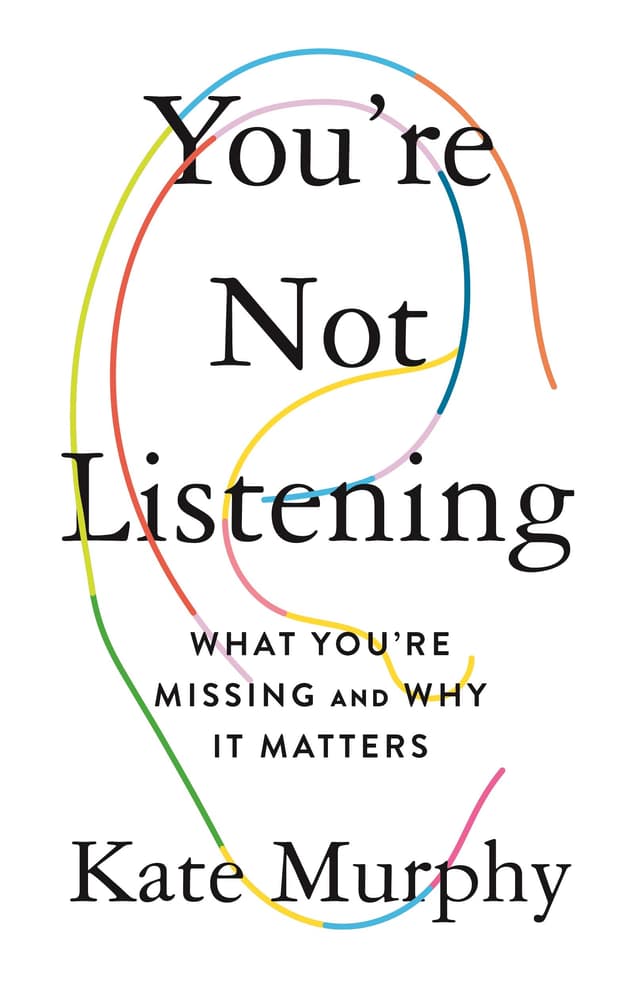
Core Idea
- Murphy argues that listening is a scarce social skill and a civic necessity in an age that rewards speaking, broadcasting, and self-definition more than attention to others.
- She treats listening as more than hearing words: it includes context, tone, body language, pauses, emotion, and what the speaker is revealing to themselves while speaking.
- The book’s central claim is that many forms of loneliness, misunderstanding, political polarization, and relational friction are rooted less in bad intent than in habitual, culturally reinforced non-listening.
Why Listening Matters
- Murphy links poor listening to the modern loneliness crisis, arguing that people can be surrounded by connection and still feel unseen because connectedness is two-way.
- She frames loneliness as a serious public-health issue, citing associations with premature death, heart disease, stroke, dementia, weakened immunity, and suicide.
- Social media, phones, and curated “sound bubbles” are presented as weak substitutes for real conversation because they amplify performance, outrage, and narrow signals instead of mutual understanding.
- Political life also rewards crosstalk and grandstanding, so polling, media proxies, and online churn often replace actual listening to communities.
- When Murphy asks “Who listens to you?”, many people struggle to answer, which underscores how rare sustained attention has become.
How Listening Works
- Murphy draws a key distinction between hearing and listening: hearing is passive, while listening is an active mental act that works hard to build meaning.
- Research she cites suggests that in good conversation, speaker and listener brain activity can synchronize, and better overlap correlates with better understanding.
- Listening is shaped by attachment patterns: secure attachment tends to support empathy and openness, while anxious, avoidant, or disorganized patterns interfere with receptivity.
- Good listening helps the speaker feel “experienced” rather than managed; it conveys interest in the person’s inner life instead of teaching, fixing, or critiquing.
- Curiosity is the engine of listening: children ask questions naturally, and figures like Studs Terkel model the idea that everyone has something to teach if you ask well.
- Attentive listening draws out more detail, while inattentive listening makes people less articulate and less willing to elaborate.
Common Ways Listening Fails
- Murphy’s recurring warning is that people often use questions and responses to shift attention back to themselves rather than support the speaker.
- She borrows Charles Derber’s distinction between shift responses and support responses: one redirects attention, the other encourages elaboration.
- Leading, agenda-driven, or overly detailed questions can derail thought, while open prompts such as “How did it happen?” or fill-in-the-blank questions keep the speaker’s thread alive.
- People often assume they know spouses, friends, and children better than they do; this closeness-communication bias leads them to stop listening and to overestimate understanding.
- Stereotypes, identity cues, confirmation bias, and social signaling also distort listening, because people think they know what someone means before hearing them out.
- Tone-deaf replies fail because they address facts while missing the emotional meaning; Murphy stresses that good listeners hear the why beneath the what.
- Even well-meant fixing, minimizing, or advising can function as a refusal to listen when the real need is recognition rather than solution.
Practices, Examples, and Social Uses of Listening
- Murphy emphasizes that silence is often part of good listening: pauses can signal respect, create space for disclosure, and reveal more than constant talk.
- She contrasts “silent with” and “silent to”; the former is receptive and supportive, while the latter is punitive or withholding.
- Cross-cultural examples show that silence is not universally awkward; in places like Japan and Finland it can signal modesty, respect, or security.
- She uses clearness committees and Parker Palmer’s experience to show how faithful, open questions can help a person hear their own motives more clearly.
- Family examples and Vanderbilt research suggest that children solve problems better when adults listen first, because being heard improves both validation and thinking.
- Murphy treats listening as hospitality: full attention “welcomes” another person’s words and feelings into your consciousness.
- Bartenders, negotiators, psychotherapists, priests, hairdressers, and moderators all appear as professional models because they know that people disclose more when they feel safely heard.
- Naomi Henderson and qualitative focus-group work illustrate that what matters in life cannot always be counted; careful listening can reveal motives that data alone misses.
- She also uses improv comedy and Google’s teamwork research to show that the best groups depend on turn-taking, social sensitivity, and responding to partners rather than controlling the scene.
- Good interviewers such as Terry Gross and observers with a “third ear” listen for inhalations, pauses, tiny tonal shifts, and the meanings hidden in what is not fully said.
- The book ends by turning inward: inner speech is socially formed, and the voices we hear inside ourselves are shaped by earlier listening, attachment, reading, therapy, and conversation.
What To Take Away
- Listening is an ethical and cognitive discipline, not a passive courtesy, and it matters in relationships, institutions, and public life.
- The book’s recurring test of good listening is whether another person feels more understood, more curious, and less alone after speaking with you.
- Murphy’s strongest claim is not that speaking is bad, but that talk without listening becomes performance, control, or noise.
- Her final implication is that improving listening can change not only conversations but also the inner voice people carry into the rest of their lives.
Generated with GPT-5.4 Mini · prompt 2026-05-11-v6