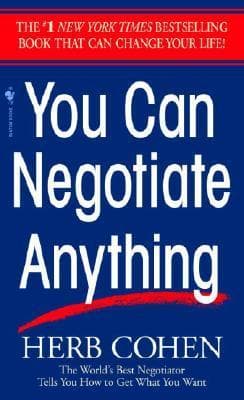
Core Idea
- Cohen’s core claim is that negotiation is everywhere: at work, at home, with institutions, and even in apparently fixed situations, because most outcomes are shaped by prior bargaining.
- Every negotiation turns on three variables—Information, Time, and Power—and each side usually overestimates the other side’s share of all three.
- Power is perceptual and morally neutral: it is the capacity to get things done, and if you believe you have it, that belief itself matters.
How Power Works
- Cohen treats power as a bundle of practical sources: legitimacy, competition, risk-taking, commitment, expertise, needs, investment, reward/punishment, identification, morality, precedent, and persistence.
- Legitimacy is the force of accepted authority, from price tags and hotel checkout times to IRS rules, but that authority can often be challenged when it is itself the result of a negotiation.
- Competition is one of the strongest forms of leverage: if your money, services, or idea are wanted by more than one party, your value rises sharply.
- He repeatedly warns never to enter a negotiation without alternatives, because a person with no options is treated lightly.
- Risk-taking should be moderate, not reckless; syndicating risk or spreading exposure makes bold moves safer.
- Commitment grows when others help create the outcome; people are more invested in what they helped build, and group unity matters.
- Expertise depends on perceived specialized knowledge, so you should establish credentials early, prepare thoroughly, and bring in your own expert if needed.
- Needs matter more than stated positions, because the same offer can be accepted or rejected depending on the other side’s real interests.
- Investment is leverage: the more time and energy the other side has spent, the harder it is for them to walk away.
- Reward and punishment work largely through perception; if others think you can help or hurt them, you have clout.
- Identification is powerful because people cooperate with those they feel understood by, and professional calm often beats aggression.
- Morality can persuade when it matches the other side’s ethical frame, but it fails when their worldview differs.
- Precedent can either trap people in “we’ve always done it this way” or justify a demand by showing similar outcomes elsewhere.
- Persistence matters because concessions often appear only near deadlines, when pressure peaks.
Timing, Information, and Tactics
- Time is strategic because deadlines are usually more flexible than they look, and the other side almost always has a deadline too.
- Cohen says to keep your own deadline hidden, understand the penalties for missing it, and use delay when it improves your position.
- Information should be gathered before the formal negotiation begins, since people become defensive once the “red light” is on.
- Early information comes best from nonthreatening sources like secretaries, clerks, spouses, technicians, competitors, or prior customers.
- During negotiation, selective self-disclosure can elicit reciprocal information and build trust.
- Nonverbal cues matter most in clusters, not one at a time, and concession patterns often reveal more than words.
- The monetary-increment game uses shrinking concessions to make a ceiling seem real; abrupt jumps signal hidden room to move.
- Cohen is suspicious of simple “no’s,” treating them as reactions that can change as information and time accumulate.
Emotional and Collaborative Negotiation
- Cohen treats emotion as a tool: tears, silence, laughter, walking out, veiled threats, guilt, and irrationality can all be deployed strategically.
- He argues these displays often work because they create uncertainty, guilt, fear, or discomfort in the other side, not because they are inherently “natural.”
- He also shows how to recognize and neutralize tactics like the nibble by naming them or laughing them off.
- In hard confrontations, calmness is usually stronger than escalation: stay reasoned, lower your voice, and let the bully become the embarrassing party.
- Cohen’s alternative to win-lose bargaining is Win-Win / collaborative negotiation: start from the problem, not the positions.
- The goal is to uncover the real needs beneath money, price, salary, or rates, then build a solution that satisfies both sides.
- His recurring examples—the family vacation, the antique clock, the Howard Hughes/Jane Russell deal—show that “winning” on the numbers can still fail if the process leaves someone dissatisfied.
- Collaboration requires trust, empathy, shared information, moderate risk, and a willingness to use the other side’s ideas instead of merely defeating them.
- He explicitly distinguishes collaboration from compromise: compromise often means both sides give up what they wanted, whereas collaboration tries to enlarge or reframe the solution.
Dealing With Bureaucracies and Closed Systems
- Modern institutions turn people into faceless “statistical” ciphers, so Cohen urges negotiators to humanize themselves and the situation.
- When dealing with police, housing managers, computer systems, or large organizations, the tactic is to shift the interaction from abstract rule-enforcement to a personal relationship.
- He advises asking for help “as a favor to me,” making the decision-maker feel concern, obligation, or investment in you as a person.
- The same logic appears in his stories about traffic stops, apartment superintendents, computer errors, and service complaints: get out of the category and into the human relationship.
- He recommends moving up the chain when the first contact has no authority, because higher-level people can make exceptions and see the broader picture.
- Written memorialization matters too: the party who drafts the memorandum of agreement or takes notes often shapes the final understanding.
- Phone negotiations are riskier because they lack visual cues and make it easier to say no, so important requests should be handled in person when possible.
What To Take Away
- Negotiation is a reality test: know your information, time, and power before you act, because wishful thinking is a bad strategy.
- Power is not just formal authority; it comes from leverage, perception, and the ability to shape what the other side thinks is happening.
- The best deals are often process victories as much as outcome victories, because tone, trust, and identification can matter as much as the final terms.
- Cohen’s final message is that the good life is active and responsible: use power to move things, help others along the way, and refuse to become a passive statistic.
Generated with GPT-5.4 Mini · prompt 2026-05-11-v6