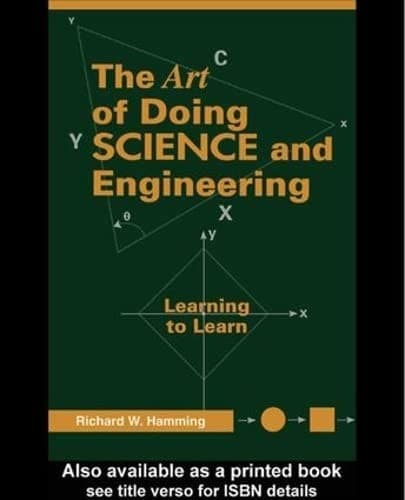
Core Idea
- Greatness is learnable: Excellence comes from preparation, directed vision, and relentless practice—not innate genius.
- Master fundamentals deeply: Surface knowledge blocks progress; understand core principles before specializing or using tools.
- Anticipate the future: Study how great minds think and where your field is heading; prepare for what's coming, not what was.
Preparation & Opportunity
- Question accepted rules relentlessly—ask "why?" even when experts say "that's how it's done."
- Do back-of-the-envelope calculations to reality-check claims and build intuition.
- Saturate yourself with hard problems; let your subconscious work on them constantly.
- Luck favors the prepared mind—recognize opportunities only if you've mastered the fundamentals.
Vision & Direction
- Define your vision of future greatness early; a directed path gets you proportional to n, not √n.
- Regularly ask: "What's possible? What's likely? What's desirable?" in your field.
- Work on important problems only—trivial work is time lost from your career.
- Keep 10-20 hard problems simmering; drop everything when a breakthrough appears.
Learning & Execution
- Learn by grasping core principles, not memorizing details.
- Teach (and learn from) by studying style and thinking method, not just results.
- Master fundamentals by hand before outsourcing to tools—integration by hand teaches pattern recognition.
- "The purpose of computing is insight, not numbers"—seek understanding over output volume.
Systems & Measurement
- Don't optimize components; optimizing one part often degrades the whole system.
- Design for change and unknowable future upgrades; assume specs will be exceeded.
- Assume published accuracy is overstated by 5x; pretest all data for inconsistencies.
- You get what you measure: Think through unintended consequences before implementing metrics.
- Use full dynamic range of rating scales; understand how measurement distorts reality.
- Recognize when definitions shift in time-series data—flag this explicitly.
Technology & Innovation
- Watch emerging tech early; recognize paradigm shift implications before experts do.
- Ask "what else must change?" when adopting new technology systemically.
- Verify test equipment is as reliable as what's being tested.
- Simulations are essential but dangerous; always ask "Why should anyone believe this?" before trusting results.
- Use analogies aggressively—most breakthroughs combine unrelated fields.
Career Development
- Master three presentation modes: formal talks, written reports, informal conversations—selling ideas is essential.
- Schedule regular "great thinking" time away from daily tasks to stay strategic, not just tactical.
- Build diverse knowledge with multiple retrieval "hooks" for cross-disciplinary insight.
- Tolerate ambiguity: believe in your field AND see room for improvement simultaneously.
- When promoted, actively avoid blocking the next generation; let go of exclusive knowledge.
Action Plan
- Pick one hard problem worth 5+ years of effort; define your vision of solving it.
- Audit your learning: Are you grasping principles or memorizing details? Shift to first principles immediately.
- Design an experiment to validate a core assumption in your work; use back-of-the-envelope math first.
- Block 2-4 hours weekly for strategic thinking away from urgent tasks—let problems percolate.
- Identify what you're measuring and unintended consequences; adjust metrics to optimize global performance, not just components.
Generated with Claude Sonnet 4.6 · prompt legacy-pre-v6 · model inferred from repository history