Core Idea
- Watts’s central claim is the law of reversed effort: the more directly we try to secure ourselves, the more insecure and divided we become.
- The cure for modern anxiety is not stronger control, but seeing that the separate, defending “I” is largely an illusion produced by thought, memory, and anticipation.
- Wisdom begins when one stops seeking final security in the future and learns to inhabit the only reality there is: the present moment.
How Watts Reframes Religion, Science, and Reality
- Watts argues that science gives no logical basis for belief in God, absolutes, or an eternal order beyond experience, but this does not make religion meaningless.
- Religion fails when treated as factual belief about origins, prophecy, or afterlife; it becomes valid again when understood as symbols of present experience.
- He distinguishes belief from faith: belief clings to mental positions, while faith is an open yielding to reality without preconception.
- Science and religion are not enemies in his account; they use different languages, with science speaking mainly of prediction and religion speaking of the present.
- His notion of metaphysical is not speculative theory but a way of indicating the reality behind named, classified “things.”
- The world of separate objects is a product of thought, naming, and comparison; reality itself is prior to all such divisions.
- Negative religious language about God as infinite, eternal, and unchanging is meant to point beyond definition, not to create another object in the universe.
- Watts repeatedly stresses that trying to define ultimate reality is circular, like a knife trying to cut itself, because language is made from the same reality it tries to describe.
The Mechanics of Suffering and Self-Deception
- Human misery comes from splitting experience into I and me, mind and body, self and world, and then trying to protect one side against the other.
- The sense of a separate self is maintained by memory, verbal labeling, and rapid thought, like a stick whirled into a circle of fire.
- Time is partly a mental construction: the future is a realm of fantasy and the past a storehouse of labels, while actual life happens only in the now.
- People try to make present life tolerable by future guarantees—success, retirement, heaven, progress, or endless pleasure—but this postpones living.
- Modern civilization intensifies this problem through clocks, schedules, machines, consumer stimulation, media, advertising, and “dope” that distracts from emptiness.
- Watts says the attempt to escape pain through toughness, repression, intoxication, or self-defense only deepens the split that causes suffering.
- He contrasts the body’s own wisdom with “brainy” overthinking, arguing that civilization overuses abstraction and neglects instinctual, bodily knowing.
- Desire becomes insatiable when the brain imagines an indefinitely extended future of pleasures and tries to compress it into a short lifespan.
Present Awareness, Eternal Life, and Freedom
- Watts’s practical answer is not a technique but awareness: look directly at present experience without naming, comparing, or fleeing it.
- When one watches closely, no separate thinker or experiencer can be found apart from the experience itself.
- Resistance to fear, boredom, grief, or pain becomes part of the suffering; openness is more like water, a cushion, or judo, yielding without collapse.
- Full awareness dissolves the false problem of “surrendering the self,” because there is no separate self to surrender in the first place.
- In this light, Christian ideas of grace and Christ are read as symbols of realizing that there is no isolated ego standing apart from God or reality.
- Watts treats sayings such as “I and the Father are one” and “I do nothing of myself” as expressions of this undivided consciousness.
- He warns that a false mysticism can inflate the ego by identifying the separate self with God; genuine insight is the end of self-clutching, not its glorification.
- Eternal life is not endless duration after death but the realization that the present moment is timeless and complete.
- Heaven is the present instant, because the instant leaves no room for the ego’s baggage of past and future.
- Hell is the endless loop of self-consciousness and self-possession, a closed circle in which the self tries to observe or secure itself.
- The deepest freedom is a mind no longer divided against itself, where hands can handle, eyes can see, and thought can think without self-preoccupation.
What To Take Away
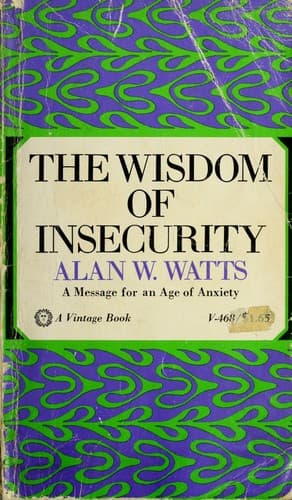
- Watts’s book is a sustained argument that the quest for absolute security is itself the source of insecurity.
- His answer is a radical shift from future-oriented control to immediate, nonverbal awareness of what is already happening.
- He recasts religion, immortality, and salvation as names for the direct realization of undivided present reality rather than as promises about another world.
- The book’s lasting provocation is that life does not need to be completed by the future; in awareness, it is already here and already whole.
Generated with GPT-5.4 Mini · prompt 2026-05-11-v6