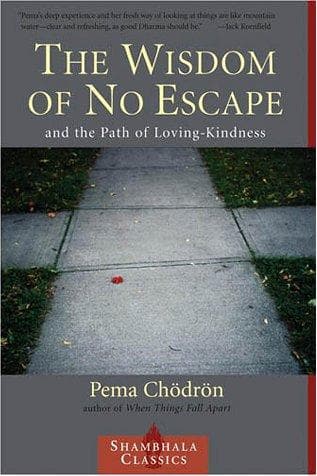
Core Idea
- The book argues that awakening begins with being willing to be exactly where you are, without embarrassment, self-improvement schemes, or harsh self-judgment.
- Loving-kindness (maitri) starts with befriending oneself as one is; from that basis, compassion, clarity, and fearlessness can expand outward to other beings.
- Pema Chödrön presents meditation and daily life as one continuous practice of seeing experience clearly, loosening fixation, and discovering that suffering and wisdom are not separate substances.
The Ground of Practice: Maitri, Satisfaction, and Honesty
- The “ground” of the path is satisfaction with this body, mind, and emotional life as the exact material of practice, not as obstacles to be replaced.
- She repeatedly warns that spiritual practice often hides subtle aggression: the wish to become a better person, have a different mind, or escape discomfort.
- The method is to meet experience with gentleness, precision, and openness: gentle in tone, precise in seeing, open in letting go.
- Her basic meditation instruction is simple: sit with good posture, follow the out-breath, and label thoughts “Thinking” when they arise, then return without drama.
- The point is not tight concentration; only a portion of awareness stays on the breath, while the practice leaves room for the rest of life.
- Letting go is not forced suppression; it happens through the combination of precision and gentleness, especially in the natural gap at the end of the out-breath.
- Chödrön treats the human condition as an innocent misunderstanding, not original sin: like being in a dark room and not seeing the light switch.
- Her lineage examples, especially the Karma Kagyü “mishap lineage,” emphasize that realization does not require saintliness; struggle, flaw, and confusion are part of the path.
- The core insight is that what we already are—messy, mixed, imperfect—is also our wealth and beauty.
Seeing Clearly: The Four Reminders, Weather, and the Trap of Clinging
- The four reminders are the book’s central orientation to practice: precious human birth, impermanence, karma, and the futility of samsara.
- Precious human birth means being in a condition that is not crushed by extreme suffering and not so cushioned by comfort that we drift into ignorance.
- Impermanence makes life urgent and precious: we are aging and dying from the moment we are born, so the question is how to live this brief time awake.
- Karma is presented simply as cause and effect, especially the way repeated mental actions condition future states of mind and conduct.
- Samsara is the repetitive habit of rebuilding zones of safety, clinging to comfort, and replaying the same emotional tape to avoid groundlessness.
- Life is compared to weather: moods, thoughts, and energies change constantly, and suffering comes from resisting that change while trying to maintain a solid “me.”
- Emotional states are not treated as private failures but as shifting conditions that can teach us if we do not harden into them.
- The book’s practical response to fear and turbulence is to ask real questions, stay present, and notice how the mind manufactures escape routes.
- Chödrön insists that we should not prefer either the busyness of samsara or the spaciousness of nirvana, because both can become a basis for ego.
- The deepest obstacle is not experience itself but the way we cling to concepts, identities, and comfort in order to avoid being fully alive.
Practices of Courage: Tonglen, Refuge, Renunciation, and Ritual
- Tonglen is the book’s signature compassion practice: breathe in suffering and breathe out well-being, training the heart to stop preferring comfort over pain.
- Tonglen exposed the author’s own use of calm meditation to avoid pain, and she treats that exposure as the beginning of bodhicitta, the awakened or courageous heart.
- The practice is staged from general openness to specific situations and then to all beings, but its essence is touch-and-go rather than heroic mastery.
- Bodhicitta is described with images of an obscured diamond, butter in cream, oil in a sesame seed, and treasure under dirty rags: already present, needing uncovering.
- Taking refuge in Buddha, Dharma, and Sangha is not comfort-seeking; it is the adult act of leaving the cradle, cutting the umbilical cord, and learning to live without constant reassurance.
- Refuge means removing the armor each person uses to protect vulnerability, and the armor varies from person to person, so the work is individualized.
- Renunciation is not negativity; it is letting go of holding back, opening to the teachings of the present moment, and releasing nostalgia for samsara.
- Renunciation is linked to playfulness and fearlessness, like ravens in harsh weather that grab on and then let go into the wind.
- Ritual matters because it joins heaven and earth, vision and practicality; ordinary gestures such as bowing, gassho, or handling a bowl can preserve awareness and gratitude.
- Her emphasis is not on perfect technique but on wholehearted engagement that keeps the heart open to both suffering and tenderness.
What To Take Away
- The path is not about becoming someone else; it is about learning to stay present with what is already happening, without self-hatred or evasive spiritual ambition.
- Meditation, the four reminders, tonglen, and refuge all serve one aim: to loosen the grip of ego so that clarity and compassion can operate together.
- The book’s recurring test is whether you can meet discomfort, impermanence, and ordinary life with enough honesty to stop escaping and enough warmth to keep going.
- Chödrön’s distinctive claim is that this very mess, this very moment, is the doorway: the obstacle is also the path, and the wound is also where the heart can open.
Generated with GPT-5.4 Mini · prompt 2026-05-11-v6