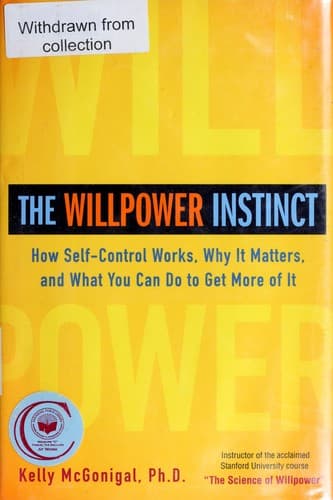
Core Idea
- Willpower is a trainable skill made of three capacities: “I will” power, “I won’t” power, and “I want” power.
- The book treats self-control as a biological, psychological, and attentional process, not a moral trait or fixed character flaw.
- The central strategy is to understand the specific way you fail, notice choices earlier, and build habits that strengthen the brain systems that support self-control.
How Willpower Works
- The prefrontal cortex is the brain’s self-control system; it helps bias attention and action toward the harder, longer-term choice.
- McGonigal emphasizes that temporary states like stress, sleep deprivation, distraction, alcohol, hunger, and loneliness can weaken this system even in healthy people.
- She frames willpower as an instinct with a bodily signature: the willpower response is more like pause-and-plan than fight-or-flight.
- Heart rate variability (HRV) is presented as the best physiological marker of self-control; higher HRV predicts better resistance to temptation, focus, and persistence.
- HRV and willpower are supported by sleep, exercise, social connection, relaxation, and meditation, and undermined by chronic stress, illness, poor diet, and poor air quality.
- Slow breathing at about 4–6 breaths per minute is one immediate way to raise HRV and re-engage the prefrontal cortex.
- Exercise is described as a short-term willpower miracle because it reduces cravings right away and improves mood, brain function, and baseline self-control over time.
- Sleep loss is treated as temporary mild prefrontal dysfunction, which is why getting more sleep or napping can restore self-control.
- A recurring point is that many failures happen on autopilot: people underestimate how often they choose, so self-awareness is itself a willpower intervention.
- Meditation matters less as relaxation than as practice in noticing distraction and returning attention, which transfers to daily self-control.
Temptation, Reward, Stress, and the Future
- Chapter 5’s key claim is that the brain confuses the promise of reward with happiness; craving is not the same as pleasure.
- Dopamine is the neurotransmitter of wanting/seeking, not liking; it spikes in anticipation and drives action, even when the eventual payoff disappoints.
- Olds and Milner’s rats, human brain-stimulation cases, and modern fMRI work all show a reward system that can generate compulsive seeking without satisfaction.
- Modern life is full of dopamine triggers: food cues, discounts, novelty, social media, video games, erotic images, and marketing tactics designed to intensify wanting.
- The author calls this dopaminization: samples, scarcity cues, novelty, and scent marketing are engineered to make products feel more desirable.
- Desire has a built-in stress component; wanting often feels urgent, anxious, and uncomfortable because the reward system also activates stress circuitry.
- Stress, guilt, shame, and anxiety make temptation stronger by pushing the brain toward short-term relief behaviors like eating, drinking, shopping, or web surfing.
- Terror-management cues, including mortality reminders, can increase comfort-seeking, status buying, snacking, and procrastination.
- The antidote to this stress loop is not willpower alone but calmer forms of relief that activate serotonin, GABA, oxytocin, and the relaxation response.
- Future rewards are discounted, so immediate gratification makes the future feel cheap; this is the logic of delay discounting.
- The book uses the Marshmallow Test, precommitment examples, and the “ten-minute rule” to show how distance and delay weaken temptation.
- Precommitment works by limiting options before temptation arrives, so the future self cannot easily reverse the decision.
- McGonigal also stresses future-self continuity: people often treat their future selves like strangers, which leads them to overburden tomorrow and indulge today.
- Visualizing or interacting with the future self makes long-term consequences feel more real and improves saving, planning, and follow-through.
Acceptance, Not Suppression
- Chapter 9 argues that trying to suppress thoughts, emotions, and cravings backfires; “I won’t” power is weak when aimed at inner experience.
- Wegner’s white bear experiments show ironic rebound: trying not to think something makes it return more strongly, especially under stress or fatigue.
- The book models suppression as an operator and a monitor; the monitor keeps scanning for the forbidden thought and can keep the problem alive.
- Repeated intrusive thoughts can feel important or true simply because they recur, which is a major source of anxiety and self-doubt.
- The solution is acceptance: let thoughts and feelings be present without believing them or acting on them.
- Acceptance is presented as useful for anxiety, depression, food cravings, and addiction because it breaks the link between feeling and reflexive escape.
- The author’s four-step craving protocol is: notice the craving, accept it, step back so thoughts are not commands, and remember your goal.
- Surfing the urge treats cravings like a wave that rises and falls; in Bowen’s studies it reduced smoking and weakened the link between bad mood and use.
- A similar logic underlies the no-dieting diet: shift from prohibition to what you will do instead, turning an “I won’t” goal into an “I will” goal.
- Self-forgiveness is not permission to quit; it reduces shame, prevents the what-the-hell effect, and helps people resume behavior without spiraling.
- The deepest lesson is that you cannot fully control what appears in mind, but you can choose what you believe, what you rehearse, and what you do.
What To Take Away
- Willpower improves when you notice the cue earlier, reduce autopilot, and support the brain states that make self-control easier.
- The book’s recurring warning is that stress, scarcity, guilt, and temptation cues often masquerade as motivation but actually weaken self-control.
- The most useful change is usually not harsher self-judgment, but better design: stronger habits, fewer triggers, more realistic commitments, and more vivid future thinking.
- McGonigal’s bottom line is that self-control is not about becoming immune to desire; it is about learning to relate differently to desire, discomfort, and the future.
Generated with GPT-5.4 Mini · prompt 2026-05-11-v6