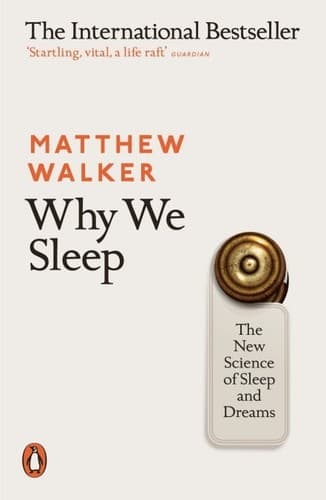
Core Idea
- The book’s central claim is that sleep is not downtime but the most effective daily reset for brain and body health, touching memory, emotion, immunity, metabolism, cardiovascular function, and longevity.
- Sleep loss is framed as a modern public-health crisis: habitual short sleep is linked in the book to higher risks of depression, accidents, obesity, diabetes, cancer, Alzheimer’s disease, heart disease, and premature death.
- The question “Why do we sleep?” is presented as the wrong one; sleep serves multiple functions at once, and its value cannot be reduced to a single benefit.
How Sleep Works
- Sleep timing is governed by two independent systems: circadian rhythm (the internal 24-hour clock) and sleep pressure (adenosine buildup from being awake).
- The suprachiasmatic nucleus in the brain acts as the master clock, reset mainly by light; chronotype is strongly genetic, so “larks” and “owls” are biologically different rather than lazy or disciplined.
- Melatonin is the “hormone of darkness” that signals night but does not create sleep, and over-the-counter supplements are portrayed as poorly regulated.
- Caffeine works by blocking adenosine receptors, so it masks sleepiness rather than removing sleep pressure; its long half-life means evening caffeine can quietly damage sleep.
- Sleep is measured and divided through polysomnography into NREM and REM cycles, repeating roughly every 90 minutes, with deep NREM concentrated early in the night and REM dominating later sleep.
- The book treats sleep as a sequence of distinct biological modes: wake as reception, NREM as reflection, and REM as integration.
- Sleep is presented as universal across animals, though the structure varies widely; some species show unihemispheric sleep, while humans may show only a weak version in unfamiliar environments.
- The author emphasizes that missing sleep is not the same as paying debt later: some lost benefits, especially from the first post-learning night, are not fully recoverable.
What Sleep Does for the Brain and Mind
- Deep NREM sleep is described as the stage that restores learning capacity by refreshing the hippocampus and transferring fragile memories toward long-term storage.
- Sleep spindles and slow waves are key mechanisms: they protect sleep from noise, strengthen memory transfer, and predict better next-day learning.
- Sleep after learning improves both facts and skills; classic examples include better recall after naps, faster motor-sequence learning after a night of sleep, and stage-specific gains tied to spindle-rich sleep.
- REM sleep is portrayed as less about storing individual facts and more about recombining material into abstractions, relational insight, creativity, and “the gist.”
- The book’s “overnight therapy” idea is that REM widens associative thinking, helping the mind connect distant memories and solve problems that wakeful logic could not crack.
- Dream reports and MRI studies are used to argue that dreams are not random replay but selectively organized around emotional concerns and autobiographical material.
- The author treats REM dreams as a state with normal features resembling psychosis—hallucination, delusion, emotional lability, and amnesia—but occurring in sleep.
- Dream science is linked to real-world creativity: the book highlights stories such as Mendeleev, Otto Loewi, and musicians’ dream-inspired ideas as examples of REM-fueled insight.
- Lucid dreaming is presented as real and measurable, but the author treats its value cautiously rather than as an obvious good.
Consequences of Too Little Sleep
- Sleep deprivation makes the amygdala more reactive and weakens prefrontal control, so emotional responses become more extreme, more volatile, and less context-sensitive.
- The book argues that short sleep pushes people toward both negative and positive extremes: irritability, anxiety, aggression, impulsivity, reward-seeking, and risk-taking.
- Psychiatric illness and sleep disruption are described as two-way streets: insomnia can worsen depression, anxiety, bipolar disorder, PTSD, schizophrenia, and suicidality, while those disorders also disturb sleep.
- CBT-I is highlighted as the preferred treatment for insomnia and as potentially helpful across several psychiatric conditions.
- Sleep loss impairs attention, memory, and judgment, with classroom and MRI evidence showing large drops in new learning after all-nighters or fragmented deep sleep.
- In aging and dementia, deep NREM sleep declines sharply; the author links this to brain atrophy, worse overnight memory, and a possible early marker for Alzheimer’s risk.
- The book argues that sleep helps clear waste via the glymphatic system, which is especially active in sleep and may remove amyloid and tau.
- Short sleep is tied to cardiovascular stress through sympathetic activation, higher cortisol, blood pressure changes, and accelerated vascular damage.
- It also disrupts metabolism: sleep loss increases hunger hormones, lowers satiety signals, worsens glucose handling, and shifts eating toward high-calorie foods.
- The author uses controlled studies to show that sleep restriction can raise calorie intake, increase obesity risk, and impair body composition during dieting.
- Sleep loss damages immune function and is associated in the book with poorer vaccine response, more infections, lower natural killer cell activity, and higher cancer risk.
- The book extends sleep’s influence to reproductive hormones, appearance, microbiome health, gene expression, and telomeres, arguing that chronic short sleep alters biology at multiple levels.
Sleep Across Life and Society
- Sleep needs and architecture change across the lifespan: infants spend far more time in REM, children gradually consolidate sleep, teenagers shift later, and older adults lose deep sleep.
- Adolescents’ late schedule is presented as biological, not defiant; the author argues schools and families should adapt rather than blame teenagers.
- In older adults, fragmented sleep is treated as partly a consequence of brain and circadian changes, not proof that seniors “need less sleep.”
- The book argues humans are naturally suited to biphasic sleep—a long night sleep plus an afternoon nap—rather than the rigid modern monocycle.
- Modern life is blamed for widespread sleep deprivation: electric light, caffeine, alcohol, fixed work schedules, and early school start times all conflict with biology.
- The author’s social and policy argument is that sleep should be accommodated in schools, medicine, business, transportation, and military settings, not treated as a private weakness.
- CBT-I, flexible schedules, nap-friendly workplaces, better hospital lighting/noise control, and drowsy-driving prevention are presented as the most practical reforms.
What To Take Away
- Sleep is not a luxury; in the book’s view, it is a core maintenance system for the brain and body.
- The book’s strongest recurring distinction is between circadian timing and sleep pressure, which together explain sleep onset, jet lag, caffeine effects, and chronotype.
- The author’s main caution is that many modern habits and institutions systematically extract sleep, and the biological costs show up across cognition, emotion, disease, and public safety.
- If one theme ties the whole book together, it is that ignoring sleep is not neutral: it steadily undermines health, performance, and judgment.
Generated with GPT-5.4 Mini · prompt 2026-05-11-v6