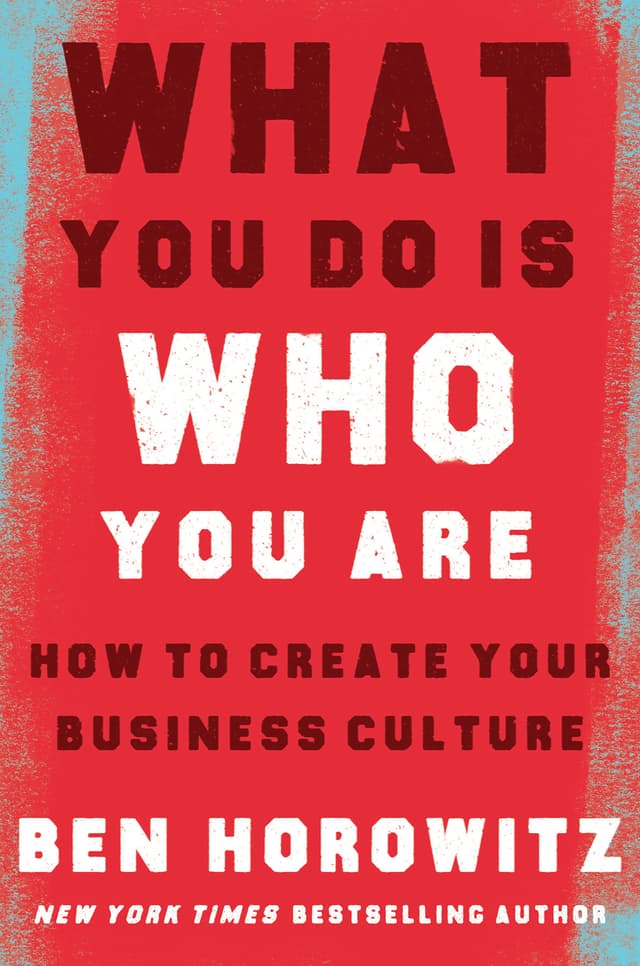
Core Idea
- Culture is not what leaders say; it is what people repeatedly do, especially in gray areas where no policy settles the question.
- Horowitz’s central claim is that virtues are actions, not beliefs: a company’s real culture shows up in punctuality, confrontation, quality standards, ethics, and how leaders behave under pressure.
- Because culture is dynamic, leaders must design it deliberately to fit strategy, personality, and the business moment, or it will form accidentally.
How Culture Gets Built
- Horowitz studies leaders who changed culture in hard circumstances, using historical models such as Toussaint Louverture, the samurai, Genghis Khan, and Shaka Senghor rather than idealized corporate success stories.
- Louverture shows how to keep what works, import what is needed, and make ethics explicit: he used existing rebel strengths, adopted French military methods, and turned a slave revolt into a disciplined state-building force.
- His “shocking rules” and symbols mattered because they were concrete: no concubines for married officers, elaborate uniforms, living with soldiers, no booty, no revenge, and explicit rules linking conduct to liberty.
- Horowitz also uses Louverture to argue that culture can outlast individuals; even after betrayal and capture, the Haitian Revolution’s army still helped destroy Napoleon’s attempt to restore slavery.
- The samurai illustrate a code of virtues as behavior: bushido tied courage, loyalty, honor, politeness, self-control, and sincerity to visible action, especially with death in mind.
- The samurai code worked because it was specific, teachable through stories, and operational in edge cases; abstract praise was less useful than vivid examples like the “Blood Genealogy” story.
- Shaka Senghor’s prison story shows that culture is first tested in daily survival and trust: he learned that the real culture was what new people experienced, not what leaders claimed.
- Senghor’s reform effort depended on constant contact—eating, studying, and working together—because culture change becomes real only when it is repeated and visible.
The Main Mechanisms Horowitz Repeats
- Keep what works means retaining useful inherited strengths instead of wiping them out, as Louverture did with voodoo songs and African tactics, and as Steve Jobs did by preserving Apple’s integrated hardware-software identity.
- Shocking rules are memorable, culture-revealing commands that people encounter often enough to matter; they should be simple enough to shape behavior, like “If you are on time, you are late,” “No PowerPoint,” or “Move fast and break things.”
- Such rules work when they encode real priorities: Tom Coughlin’s punctuality rule built readiness, VMware’s 49/51 partnership rule signaled generosity without naivety, and Amazon’s door desks and no-PowerPoint policy made frugality and written thinking visible.
- Walk the talk is non-negotiable because employees copy leaders’ actions more than their speeches; Horowitz uses Louverture, Hillary Clinton’s email behavior, and his own near-mistake at LoudCloud to show how quickly inconsistent behavior teaches the wrong lesson.
- Leaders must sometimes publicly admit and overcorrect when they violate the code, or the earlier lesson persists.
- Bringing in outside leadership can be necessary when a company needs a different virtue set; Horowitz cites Mark Cranney at LoudCloud, whose urgency and sales aggression helped create an enterprise sales culture.
- Cultural orientation is real orientation: new hires learn what is rewarded and punished from day one, so the first weeks are often decisive.
- Horowitz emphasizes that culture is universal, not compartmentalized; office conduct, relationships, and behavior outside formal work all become part of the system.
Inclusion, Ethics, and Corporate Power
- Genghis Khan is Horowitz’s model for inclusion by incorporation: he united people across tribes and religions by rewarding contribution, not lineage.
- The Mongol system was radical because it treated ability and loyalty as more important than birth, from military ranks to administrative appointments, and made conquered talent part of the empire’s engine.
- Genghis’s version of inclusion was also brutally pragmatic: loyalty had to be bilateral, and betrayal was punished universally, even though the society remained tyrannical and above the law in some respects.
- Horowitz uses modern examples like Don Thompson, Maggie Wilderotter, and Slack to show that inclusion works when companies start with the job they need, then recruit and integrate talent without creating second-class categories.
- He warns against “Urban HR”—treating women or minorities as fundamentally different from “regular” talent—because separate channels can mark people as exceptions rather than full participants.
- Slack’s shift from empathy to collaboration shows how a value can be weaponized and then replaced with a more actionable one; the point is to define behavior that improves the company, not merely sound humane.
- Horowitz’s ethics argument is blunt: if winning is the goal, leaders must explain why cheating, pillage, harassment, or corruption would destroy the real purpose.
- Uber and Huawei are cautionary examples of buggy cultures: hypercompetitive systems can normalize harassment, rule-bending, sanctions violations, and theft if ethics are not made concrete.
- “Integrity” or “do the right thing” is too vague unless it is translated into observable standards and tests that people can actually fail.
What To Take Away
- Culture is an operating system, not branding: it is the pattern of repeated action that determines how a company decides, hires, fights, and fails.
- Strong cultures are built through specific virtues, vivid stories, and repeated signals, not inspirational slogans.
- The hardest part is not inventing values but making them real in decisions, exceptions, promotions, and everyday behavior.
- Horowitz’s bottom line: what you do is who you are, and if leaders want a different organization, they must change what the organization does.
Generated with GPT-5.4 Mini · prompt 2026-05-11-v6