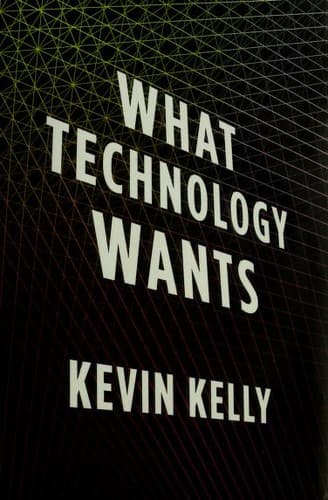
Core Idea
- Kelly argues that technology is not a pile of gadgets but a living system he calls the technium: tools, machines, software, laws, institutions, and culture that collectively generate more technology.
- His central claim is that the technium has its own direction and partial autonomy; it is created by humans but not fully controlled by human intention.
- Technology’s “wants” are not conscious desires but tendencies toward self-assembly, self-perpetuation, complexity, and expansion of possibilities.
Technology as Evolutionary Continuation
- Kelly treats technology as evolution accelerated, extending the same self-organizing process that produced life.
- He argues that evolution is not just random drift but also shaped by inevitability: physics, geometry, chemistry, and self-organization repeatedly funnel life toward similar solutions.
- Convergent evolution is his key evidence: eyes, wings, echolocation, warm-bloodedness, and streamlined aquatic bodies evolved more than once in unrelated lineages.
- He uses repeated features like rhodopsin, bilateral symmetry, and metabolic scaling laws to suggest that nature repeatedly “finds” certain structures because they work.
- On this view, DNA is a uniquely powerful molecule for self-replication and complexity generation, and the technium is its technological extension.
- Language is the bridge between biology and technology: it enabled cumulative innovation, making culture and tools evolve much faster than genes alone.
The Long Arc of Progress and Its Costs
- Kelly insists that progress is real, though uneven and non-utopian: over long periods, societies get richer, longer-lived, more educated, and more morally expansive.
- He links progress to expanding minds, cumulative knowledge, urbanization, science, and cheap energy, especially coal and oil, but rejects energy alone as an explanation.
- He argues that science was the decisive accelerator because it created a better system for learning, storing, and distributing reliable knowledge.
- Progress also expands moral concern, with the circle of “us” widening from family and tribe toward nation and beyond.
- Cities are a major engine of progress: they are the largest technology humans build, and people move to them for freedom, opportunity, and specialization despite slums and hardship.
- The costs of the technium are real: technogenic problems include pollution, climate change, toxins, obesity, species loss, propaganda, and nuclear risk.
- Kelly says many technologies first create problems and then new technologies are needed to address those problems, in Brian Arthur’s sense that “problems are the answers to solutions.”
- He argues that modern systems also erode direct human competence by offloading memory, labor, and even parts of daily life into machines.
How to Judge, Steer, and Live with Technology
- Kelly rejects both naive celebration and total rejection; he wants people to coax technology toward its “inherent good” of increasing choices, freedom, and possibility.
- He proposes reading technologies through 13 exotropic trends: efficiency, opportunity, emergence, complexity, diversity, specialization, ubiquity, freedom, mutualism, beauty, sentience, structure, and evolvability.
- A technology is more “inevitable” and convivial, in his sense, when it advances more of those trends.
- He uses mechanized agriculture as an example of something partly inevitable because it increases efficiency and specialization, while criticizing industrial farming for monoculture, fossil dependence, and ecological simplification.
- His ideal alternative is not a return to the past but advanced gardening: decentralized, hyperlocal, highly specialized food systems layered with better tools.
- Kelly’s preferred policy stance is a Proactionary Principle: anticipate, test, monitor, correct, and redirect technologies rather than trying to ban them in advance.
- He argues the Precautionary Principle fails because the real effects of new tools are often unknowable until they are widely used.
- He uses the Amish as a model of selective adoption: they are not anti-technology, but community-governed, empirical, and willing to use a tool in one context but not another.
- Their rule of thumb is effectively “try first and relinquish later, if need be”, which Kelly contrasts with ideological all-or-nothing stances.
- He also cites the minimite idea: use the least technology needed to do the job, though he notes that such simplicity depends on the larger technium outside the community.
- Kelly takes the Unabomber seriously as a diagnosis of technology’s autonomy and self-serving momentum, while rejecting his conclusion that technology must be destroyed.
What To Take Away
- The book’s big claim is that technology is a self-propelling evolutionary system, not just a set of tools under human control.
- Kelly’s deepest optimism is that the technium tends toward more structure, diversity, intelligence, and choice, even when it also produces new harms.
- His deepest warning is that technological gains routinely bring unintended, technogenic costs that must be watched, measured, and corrected.
- The practical stance he favors is neither surrender nor rejection, but disciplined participation: understand technology’s direction, then steer it toward what enlarges life.
Generated with GPT-5.4 Mini · prompt 2026-05-11-v6