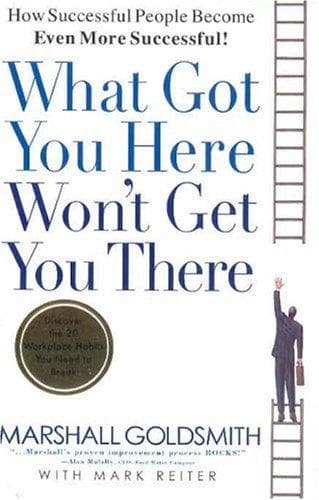
Core Idea
- Success can become the main obstacle to further success: the behaviors that helped people rise often become the very habits that cap their growth.
- Goldsmith’s central claim is that most high performers do not need more talent; they need to stop a handful of interpersonal “transactional flaws” that distort how others experience them.
- The book’s “You Are Here” metaphor is about blind spots: successful people often misread their own impact and need outside feedback to see what others actually see.
The 20 Habits That Hold People Back
- Goldsmith groups the recurring problems into 20 correctable habits, such as winning too much, adding too much value, passing judgment, speaking when angry, negativity, withholding information, failing to give recognition, claiming credit, making excuses, not listening, failing to express gratitude, punishing the messenger, passing the buck, and an excessive need to be “me.”
- These are not treated as deep character defects or technical gaps; they are everyday behaviors that damage trust, motivation, and cooperation.
- Winning too much is the urge to turn even trivial moments into contests, as in the father who beats his 9-year-old son at basketball or the dinner guest who would rather be “right” than simply enjoy the meal.
- Adding too much value means interrupting or “improving” others’ ideas in ways that reduce their ownership more than they improve the idea.
- Passing judgment, starting with “No/But/However,” and telling the world how smart we are all function as status moves that make others defensive or resentful.
- Destructive comments, speaking when angry, and negativity are framed as especially corrosive because they are remembered by others long after the speaker forgets them.
- Withholding information, failing to recognize, claiming credit, making excuses, and passing the buck all trade short-term control for long-term mistrust.
- Clinging to the past can explain behavior but often becomes a shield against change, while playing favorites rewards those who flatter us rather than those who contribute.
- Refusing to express regret, not listening, and failing to express gratitude are powerful because they signal disrespect, entitlement, or indifference.
- Excessive need to be “me” is the habit of treating one’s flaws as identity, as if saying “that’s just who I am” makes them untouchable.
- Goal obsession is treated separately because it is not transactional, but it can still drive transactional flaws when people chase the wrong target or pursue a goal at the expense of the mission.
Why Successful People Resist Change
- Goldsmith argues that success itself creates self-delusion: people overestimate their contribution, assume their habits caused their success, and dismiss criticism in stages of confusion, denial, and attack.
- He says successful people are often “slightly dented” in proprioception—they do not accurately sense how they come across to bosses, peers, subordinates, customers, or family.
- Beliefs that support achievement also make change harder: “I have succeeded,” “I can succeed,” “I will succeed,” and “I choose to succeed” all strengthen confidence but can harden into resistance.
- Goldsmith calls the error of linking a habit to success just because success followed it superstition; people confuse “because of” with “in spite of.”
- His examples, including the brilliant but poor-listening executive Harry, show how people rationalize annoying traits as strengths.
- The book’s practical diagnosis is that many leaders are not bad people; they are often high achievers whose behavior is simply no longer optimal at the next level.
- Peter Drucker’s insight anchors the method: leaders often need to learn what to stop, not just what to start.
Feedback, Apology, and Change
- Goldsmith’s preferred diagnostic tool is confidential 360-degree feedback, because traditional criticism is too face-threatening, too tied to the past, and too likely to trigger defensiveness.
- He asks raters to make Four Commitments: let go of the past, tell the truth, be supportive, and choose one behavior to improve in themselves too.
- The better question is not “What do you think of me?” but “How can I do better?” because future-focused advice is less identity-threatening than verdicts about the self.
- Feedback only identifies the gap; apology is the first real change move, and Goldsmith insists it should be brief, sincere, and free of rationalization.
- After apologizing, people must advertise the change, because coworkers will not notice improvement unless it is repeated, visible, and sustained.
- Follow-up is the difference-maker: understanding is not the same as doing, and many people fail to change simply because they are busy or slip back into old habits.
- Feedforward is Goldsmith’s alternative to feedback: ask for two suggestions for future behavior, say “thank you,” and do not argue about the past.
- He presents “leave it at the stream” as the governing ethic: do not carry old disputes, judgments, or excuses into the next interaction.
How the Book Reframes Leadership
- Goldsmith repeatedly insists that leaders are judged not by intent but by how their behavior lands, especially when they have power over pay, status, and opportunity.
- A boss’s self-image is often wrong, or at least irrelevant, if employees experience the boss differently; the “How to Handle Me” memo is meant to align the boss’s intentions with the team’s lived reality.
- Some leaders fail because they are too accessible, too debate-driven, or too certain their standards matter to others; effective leadership requires understanding that others are not the same as you.
- The book’s ideal leader is not bland or fake, but someone who can reduce ego, apologize, listen, thank, and make room for others’ contributions.
- Goldsmith’s deepest organizational warning is that talented people leave not only for money but for meaning, respect, growth, and better treatment.
What To Take Away
- Do less of what damages relationships: Goldsmith’s core prescription is often subtraction, not self-improvement theater.
- Use outside feedback to see yourself more clearly: your own sense of your behavior is usually incomplete, especially after success.
- Treat apology, gratitude, listening, and follow-up as leadership tools: they are not soft extras; they are the mechanics of sustained change.
- Measure success by the mission and the people, not by ego or momentum: what got you here may be exactly what keeps you from getting there.
Generated with GPT-5.4 Mini · prompt 2026-05-11-v6