Core Idea
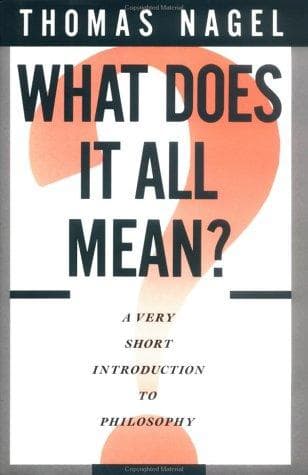
- Thomas Nagel treats philosophy as ordinary reflection pushed to its hardest limits: questions about reality, knowledge, mind, freedom, morality, justice, death, and the point of life itself.
- The book’s recurring method is to show why familiar answers break down, especially when we compare the inside perspective of lived experience with the outside perspective of objective description.
- Nagel is not trying to settle every problem; he is showing why some of the deepest questions remain genuinely puzzling even after careful thought.
Knowledge, Other Minds, and the Mind-Body Problem
- On skepticism, Nagel argues that all evidence for an external world comes through one’s own mind, so any proof of a world beyond experience risks circularity.
- Solipsism—the possibility that only your own mind exists—cannot be conclusively refuted, even if it is nearly impossible to believe in practice.
- A related reply is verificationism, the idea that what could never be observed by anyone may be meaningless to call real, but Nagel treats this as a way of dissolving skepticism by narrowing what counts as reality.
- In the problem of other minds, we observe bodies and behavior, not another being’s experience, so our belief that others are conscious goes beyond direct evidence.
- He extends that worry outward to animals, plants, cells, and computers, asking how far consciousness may reach if inner experience is always hidden from view.
- In the mind-body problem, Nagel contrasts dualism, physicalism/materialism, and dual aspect theory, but his main pressure is against reducing conscious experience to brain processes alone.
- His key objection to physicalism is that experience has an inner feel that is not captured by causal description; knowing the brain’s mechanisms is not the same as knowing what pain or taste is like.
- He emphasizes that pain is not just what is caused by injury and causes yelping, because it also feels a certain way.
Meaning, Freedom, Morality, and Justice
- In the chapter on meaning of words, Nagel asks how a finite sound or mark can refer to so many things, including absent, distant, hypothetical, and future ones.
- Definitions cannot fully explain meaning, because they stop somewhere, and private mental images do not solve the problem unless we can also explain how those images connect to the world.
- His point is that meaning seems nowhere located in a single word, image, or mental event, yet language still succeeds in reaching beyond what is immediately present.
- On free will, he distinguishes merely having an opportunity from truly being able to do otherwise in the same circumstances.
- Determinism threatens responsibility because if prior conditions and laws fix every action, the agent could not have done otherwise.
- But indeterminism does not solve the problem, because an undetermined choice can seem random rather than genuinely free.
- The result is a tension that Nagel leaves unresolved: if an act is determined, it seems unfree; if it is undetermined, it seems not fully owned by the agent.
- In right and wrong, Nagel argues that morality cannot be reduced to rules, punishment, social approval, or self-interest.
- He rejects the idea that morality is simply grounded in religion, since divine commands would presuppose wrongness rather than create it, and fear of punishment is the wrong motive.
- His central moral test is the “How would you like it if someone did that to you?” argument: if harm to you would give others a reason not to do it, consistency requires recognizing the same reason in reverse.
- Morality, for Nagel, requires seeing one’s own good and harm from a general point of view, not only from the inside.
- He also raises the question of impartiality: morality asks us to consider everyone’s interests, but it is unclear how much weight to give ourselves, family, or community.
- Nagel rejects full relativism, since we can judge our own society’s standards to be mistaken rather than merely different.
Death, Meaning of Life, and What Remains
- In justice, Nagel distinguishes deliberate discrimination from inequalities that arise through ordinary social and economic processes.
- He thinks differences in birth circumstances and talent are matters of luck, and when they produce major disadvantages they are unfair even if no one intended them.
- His favored response is redistributive taxation and public social welfare, which offset inherited disadvantage, though he notes that this interferes with innocent economic choices.
- On death, he says it can be understood from the outside even if one cannot fully imagine one’s own nonexistence from the inside.
- If dualism is false, survival after death is unlikely without bodily revival; if it is true, an afterlife is at least conceptually possible, though not guaranteed.
- He treats death as a negative good when it ends suffering and a negative evil when it cuts off future life and goods.
- The deepest fear of death is still puzzling, because it is not just fear of lost pleasures but fear of becoming nothing, even though we accept our own past nonexistence.
- In the meaning of life, Nagel says the problem arises when we step back and ask what the whole of life is for, not merely what each activity is for.
- Any larger purpose can itself be questioned again, which is why social, historical, and familial explanations do not finally resolve the issue.
- Religious meaning would have to work by making God the ultimate terminus of explanation and value, but Nagel says he does not fully understand how that answer succeeds.
- If life has no objective point, our activities may seem absurd not because they are meaningless in every local sense, but because we see both how seriously we take them and how small they are in the larger scheme.
What To Take Away
- Nagel’s central achievement is to make ordinary certainties feel philosophically unstable without claiming that everyday life is simply false.
- The book is organized by enduring contrasts: appearance/reality, inside/outside, opportunity/ability, rules/wrongness, self-interest/impartiality, and point/meaning.
- He repeatedly resists simple reductions of mind to brain, morality to self-interest, freedom to randomness, and meaning to usefulness.
- The open-endedness is deliberate: the book’s deepest claim is that these questions remain real even when no final answer seems available.
Generated with GPT-5.4 Mini · prompt 2026-05-11-v6