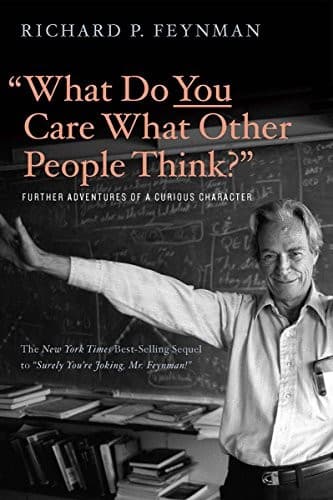
Core Idea
- Feynman’s central ethic is intellectual honesty: name things by what they are, test assumptions directly, and do not let authority, ritual, or public relations replace reality.
- The book is split between personal stories that explain how he became this way and the Challenger investigation, where that habit of mind becomes a public duty.
- Across both parts, Feynman treats science as something that increases wonder, not reduces it, because explanation reveals deeper structure, function, and uncertainty.
How Feynman Learned to Think
- His father taught him science by turning abstractions into vivid reality, like imagining dinosaurs in the family home or using tiles and wagon-and-ball examples to show patterns and inertia.
- The key lesson was that knowing a name is not knowing a thing; bird names in many languages do not teach what the bird is or does.
- He learned mathematical reasoning by understanding what algebra and calculus were for, not by memorizing rules.
- His father also taught him to question uniforms and status: a pope or general is still just a person in costume.
- His mother influenced him differently, through humor and compassion; he says laughter and human compassion are among the highest forms of understanding.
- Feynman’s skepticism extended to religion when stories were presented as fact without honesty; being told a made-up story as if it were documented broke his trust.
- Arlene became the emotional and practical center of this world: their relationship rested on radical honesty, playful independence, and her recurring challenge, “What do you care what other people think?”
- He describes Arlene as changing him too, making him more sensitive while he helped her take things less solemnly and think independently.
- Her illness and death are recounted as a sequence of diagnosis, truth-telling, marriage under constraint, hospital life, and gradual dying rather than as a sentimental climax.
- He admits he misread her medical condition because he trusted circumstantial evidence and assumed doctors were more reliable than they were.
- Her insistence on being told the truth mattered to him: once she knew, she focused on what could be done next.
- After her death, he was struck by how physically ordinary it seemed at the moment, and his grief arrived later in ordinary life, such as seeing a dress she would have liked.
Other People, Other Minds
- The book repeatedly shows Feynman as someone who notices how differently people think under the surface, even when they appear to do the same task.
- His counting experiments showed he could maintain a rhythm in his head but could not talk at the same time, while John Tukey could count and speak because he used a different internal representation.
- Feynman’s point is that self-report is unreliable unless behavior reveals what mental process is actually being used.
- He is fascinated by names, memory, and social rituals, whether he is forgetting Herman Goldschmidt until a funeral, navigating hotel customs, or describing the awkward rules of dances and introductions.
- His letters from travel show a comic eye for formalism, from royal encounters to hotel bathroom absurdities to the differences between cities, cultures, and institutions.
- He is often amused by bureaucratic or ceremonial language because it hides real conditions instead of clarifying them.
- In letters from places like Trinidad, Geneva, Poland, Athens, and Japan, he repeatedly looks for the concrete mechanism beneath the official story.
- He also resists easy stereotypes, such as broad claims about women or nations, preferring to isolate the actual behavior or system involved.
- His brief notes on culture and poverty in Trinidad, rebuilding in Poland, or ancient technology in Greece are exploratory rather than grand theories; he presents them as observations or best guesses, not final answers.
The Challenger Investigation: What Actually Failed
- Feynman joined the presidential commission reluctantly but quickly turned it into an exercise in direct inquiry: ask many technical questions, get fast answers, then ask better questions.
- He was frustrated by commission meetings that were too formal, too vague, and too dependent on prepared presentations instead of field evidence.
- The crucial technical focus became the solid rocket booster field joint, whose two quarter-inch O-rings had to seal a large joint that could rotate open under pressure.
- Thiokol and NASA already knew the joint did not work as designed; prior flights showed blowby, erosion, and scorched seals, yet the system kept being treated as acceptable.
- Feynman saw the central reasoning error: NASA and contractors were using past successful flights and computer analysis as if they proved safety, when they only showed the next flight might also get lucky.
- He compares this to Russian roulette: success does not convert a risky design into a safe one.
- A key clue from General Kutyna was simple observation, not theory: cold stiffens rubber, so the O-ring’s ability to rebound quickly is reduced at low temperature.
- Feynman made the point publicly with an ice-water demonstration showing the O-ring did not spring back normally at 32°F, helping make the temperature effect undeniable.
- He also found that the famous low-temperature launch readings were partly a measurement problem, since the infrared thermometer had been used incorrectly and needed time to equilibrate.
- His field work showed that the launch hardware itself had visible evidence of failure, including puffs of black smoke from the booster joint.
- In other areas of the shuttle, he found a sharp difference in engineering culture: the avionics were disciplined, redundant, and well tested, while the boosters and main engines showed looser standards and more optimism than evidence justified.
- Management’s stated failure estimates for the main engines were wildly lower than engineers’ own judgments, revealing a large gap between official confidence and technical belief.
- He concludes that shuttle development was often top-down, especially for the main engine, which made reliability harder to establish and fix.
- His Appendix F formalizes the same point: certification standards had gradually loosened, and “safety factor” rhetoric was being used to tolerate anomalies that should have been treated as warning signs.
- The deepest institutional problem is not one bad calculation but a culture that lets public relations outrank reality.
What To Take Away
- Scientific honesty means following the evidence even when it makes an organization look bad or forces an embarrassing conclusion.
- Names, labels, and success records are not understanding; Feynman keeps showing that the real thing is in the mechanism.
- Different people and teams can reason in radically different ways, so good investigation must go to the field and test what is actually happening.
- The Challenger story is Feynman’s clearest demonstration that credible engineering depends on admitting uncertainty, not smoothing it over.
Generated with GPT-5.4 Mini · prompt 2026-05-11-v6