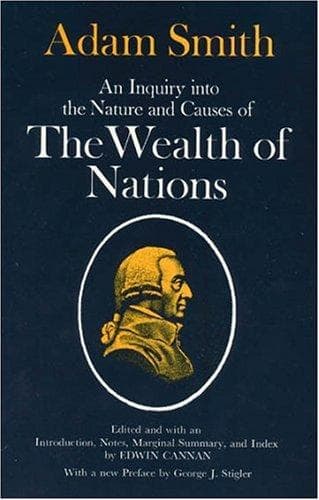
Core Idea
- Wealth is the annual produce of a nation’s land and labour, not its stock of gold and silver.
- The decisive forces are division of labour, capital accumulation, market extent, and the institutional rules that let labour and stock move to their most productive uses.
- Smith builds a theory of prices, wages, profit, rent, money, trade, taxation, and public policy around one central question: what enlarges the nation’s neat revenue and what merely redistributes or wastes it?
How Wealth Is Created and Distributed
- Division of labour is the great source of productivity: it sharpens dexterity, saves time, and encourages machinery, as shown by the pin factory example.
- Division of labour depends on the extent of the market; water carriage, rivers, and coastal trade matter because they enlarge exchange and specialization.
- Money arises from the inconvenience of barter, and metals become money because they are durable, divisible, and easy to stamp.
- Smith’s key value distinction is value in use versus value in exchange; labour is the real measure of exchangeable value, while money gives only nominal price.
- In the “early rude state,” labour alone determines prices; once stock and land are appropriated, prices resolve into wages, profit, and rent.
- Natural price is the level that covers the natural rates of wages, profit, and rent; market price fluctuates around it according to supply, effective demand, monopoly, and accidents.
- Wages, profit, and rent have natural rates that vary by place and time, and each is shaped by the condition of society, competition, and institutional restraints.
Wages, Profit, Rent, and Social Progress
- Wages rise when demand for labour grows faster than supply; the best-paid labourers are usually in the progressive state, not necessarily the richest or most stationary state.
- Smith contrasts North America’s high wages and rapid population growth with England, China, Bengal, and declining or stagnant economies where wages sink toward subsistence.
- Masters usually have the upper hand in wage bargaining because they are fewer, can combine more easily, and can wait longer than workers.
- Labour is not free from social judgment: free labour is cheaper than slave labour in the long run because free workers manage their own maintenance more frugally and effectively.
- Profit of stock tends to fall as society grows wealthier, because accumulated capital increases competition; interest is only a rough guide to ordinary profit.
- Profits are lower in great towns than in remote districts, and higher where stock is scarce, risk is large, or trades are newly opened.
- Smith distinguishes apparent profit from hidden wage-like recompense for skill, trust, irregularity, and hardship; these explain why dirty, dangerous, or highly trusted jobs pay more.
- Rent is the residual the tenant can afford to pay after replacing stock, paying wages, and earning ordinary profit; it is a monopoly price set by what the farmer can give, not by landlord expense.
- Rent rises with fertility and especially with situation; roads, canals, and navigable rivers enlarge markets and raise rents by lowering carriage costs.
- Human food is the fundamental source of rent and of later demands for dress, furniture, ornaments, and metals; food abundance creates secondary value.
Institutions That Raise or Distort Wealth
- Smith repeatedly attacks monopolies and exclusive privileges: corporations, apprenticeship statutes, settlement laws, trade bounties, and colonial exclusions all obstruct the free movement of labour and stock.
- Corporation rules and long apprenticeships are treated as enlarged monopolies that raise wages and profits in some employments while restricting entry and mobility.
- Settlement laws are especially harsh because they prevent workers from moving where labour is wanted, violating natural liberty and depressing wages in some parishes.
- Public endowments often weaken diligence: schools, universities, and clergy become less active when salaries and privileges replace dependence on fees and reputation.
- Smith’s treatment of education and religion is institutional, not sentimental: incentives matter, and fixed endowments often produce stagnation, while voluntary support and competition sustain effort.
- The mercantile system confuses wealth with bullion, treats foreign trade as a zero-sum rivalry, and uses duties, bounties, drawbacks, and monopolies to secure a favourable balance of trade.
- Smith argues that trade between nations is ordinarily mutually beneficial; what matters is the increase of the annual produce’s exchangeable value, not the accumulation of precious metals.
- The home trade supports more domestic productive labour than foreign consumption trade, which in turn is better than the carrying trade.
- Some restraints can be justified for defence or to offset taxes on domestic goods, but most import restrictions and export bounties merely enrich particular merchants and manufacturers at public expense.
- Colonial monopoly is condemned as a costly distortion: the empire’s trade advantages are real, but monopoly concentrates capital in slower-return channels, raises British profits, and damages the natural balance of industry.
Public Finance, Debt, and the Limits of State Action
- Smith distinguishes gross revenue from neat revenue; real national wealth is what remains after maintaining fixed and circulating capital.
- Money is not revenue but an instrument of circulation; paper money and banks can free coin for other uses, but only within strict limits.
- Bank credit can enlarge active capital when it replaces idle specie, but over-issue, speculative redrawing, and loans for fixed projects create instability and fraud.
- Public debt shifts the burden of state spending from current taxpayers to future ones and diverts capital from productive employment to unproductive consumption.
- Taxes should be proportional, certain, convenient, and economical to collect, but Smith shows how taxes on necessaries, wages, houses, transfers, and trade often fail these maxims.
- The most successful taxes are those that do not heavily distort production or mobility; the worst are those that multiply collection costs, smuggling, and arbitrary assessment.
- Government should do what private individuals cannot do well: justice, defence, certain public works, and some education and infrastructure, preferably funded by direct users where possible.
What To Take Away
- Smith’s core insight is that prosperity comes from productive organization and institutional freedom, not from hoarding money or forcing trade into favoured channels.
- His framework links everyday prices to a broad social order: wages, profit, and rent rise or fall together with population, capital, market size, and policy.
- Many policies praised in his era—monopoly rights, trade bounties, settlement laws, excessive endowments, and mercantile restrictions—are criticized because they redirect wealth rather than create it.
- The book’s enduring claim is that a nation grows richer when labour, stock, and land are allowed to flow toward their most productive employments under stable justice and limited but effective government.
Generated with GPT-5.4 Mini · prompt 2026-05-11-v6