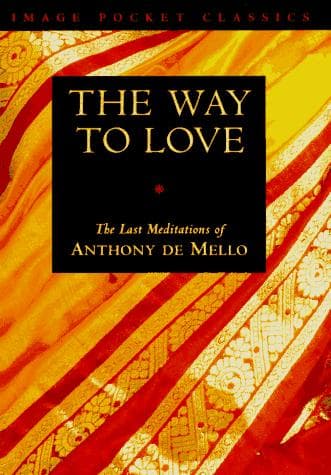
Core Idea
- Happiness, love, and freedom are already present; what hides them is programming—the inherited mental conditioning of beliefs, fears, attachments, and expectations.
- Suffering is usually not caused by reality itself but by the mind’s false stories about reality, especially the belief that one cannot be happy without certain people, outcomes, or approvals.
- The real path is not technique or self-improvement but awareness: seeing clearly what is happening in oneself and others until illusion loses its power.
The Real Source of Suffering
- The deepest trap is attachment: emotional clinging to persons, things, success, power, approval, or identity as if they were necessary for happiness.
- Attachment produces a predictable cycle of thrill, anxiety, possessiveness, boredom, and sorrow rather than lasting fulfillment.
- Ordinary disturbances like jealousy, insecurity, comparison, ambition, and fear of loss are treated as surface forms of this deeper clinging.
- De Mello describes the mind as a kind of computer loaded by culture, parents, religion, and past experience, demanding that reality conform to its expectations.
- Much of what people call a happy life is really pursuit of worldly feelings—self-glorification, success, popularity, and power—while missing soul feelings like wonder, friendship, and absorption.
- His recurring image of the tourists on a bus captures this blindness: people sit in beautiful country with the shades down, arguing over status while missing the scenery.
How Freedom Happens: Seeing, Not Forcing
- The key move is to see the belief or attachment itself and recognize that it is what creates the emotion, not the external event.
- De Mello repeatedly says that understanding dissolves what effort cannot; once an attachment is truly seen as a source of misery, it begins to lose its grip.
- He contrasts this with harsh renunciation, which can become another form of struggle, control, or self-denial rather than real freedom.
- The practice is close observation without judgment: look at a person, event, feeling, or desire until the projection, prejudice, or illusion is exposed.
- Insecurity is shown to be internal rather than situational, since the same circumstances can produce confidence in one person and fear in another because of different emotional programming.
- He warns that many forms of “thinking” are really the heart defending its desires and fears with rationalizations.
- Therefore, clear thinking requires freedom from desire and fear, not merely intelligence or education.
- The goal is to become awake enough to respond from reality instead of from conditioning.
Love, Prayer, and the Unpossessive Life
- For de Mello, love is not sentiment but clear seeing and a response to what is actually there.
- Love is indiscriminate like the sun, rain, lamp, rose, or tree: it gives without manipulation, favoritism, or demand for return.
- Love is also unself-conscious; genuine goodness does not perform itself for credit or image.
- Because attachment turns love into possession, real love requires freedom rather than control, jealousy, or dependence.
- His sharp formula is that one must be willing to say to the beloved, “I leave you free to be yourself,” or else the relation is a chain disguised as love.
- He insists that the first act of love is seeing the other person plainly, without projection, memory, or fantasy.
- Many chapters link love with solitude, because one can only love when one no longer uses people as emotional drugs.
- Prayer and spirituality are likewise about awakening from formulas; teachers can point, but they cannot hand over reality itself.
- The spiritual life is to live in the Eternal Now, not in bondage to past attachments or future anxieties.
Key Contrasts and Warnings
- Belief vs. reality: labels and judgments are screens that block direct perception of the unique person or thing in front of you.
- Attachment vs. love: attachment narrows and blinds; love enlarges and clarifies.
- Effort vs. awareness: effort may change behavior temporarily, but awareness changes the person by dissolving the source of conflict.
- Success and specialness vs. freedom: needing approval or an image in others’ minds creates dependency, fear, and self-concern.
- Conformity vs. innocence: children and nature model being what they are, while adults are corrupted by imitation, comparison, and the urge to become “somebody.”
- Surface goodness vs. real transformation: service, tolerance, and good deeds matter, but without clear seeing they can still be self-deceived or self-serving.
What To Take Away
- The book’s central discipline is to find the belief generating suffering, look at it directly, and let clarity do the work.
- De Mello’s strongest claim is that many cherished goals—approval, control, success, specialness—are exactly what keep people unfree.
- The spiritual ideal here is grateful, unpossessive freedom: happiness without a cause, love without clinging, and peace without dependence.
- The whole book presses one question: can you see reality—and yourself—without the distortions that your conditioning keeps calling truth?
Generated with GPT-5.4 Mini · prompt 2026-05-11-v6