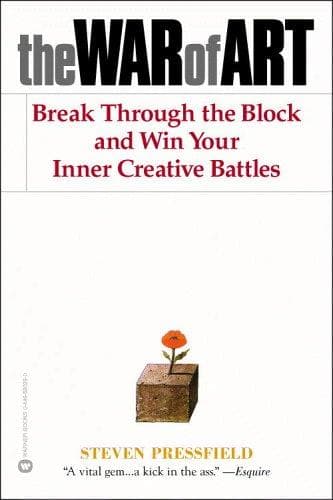
Core Idea
- Resistance is the book’s central enemy: an internal, self-sabotaging force that appears whenever we try to do something difficult, meaningful, or growth-producing.
- Pressfield treats creative work, moral courage, spiritual practice, fitness, and entrepreneurship as the same kind of war against Resistance.
- The answer is not waiting for inspiration or confidence, but acting like a professional: show up, do the work, and let the larger forces of creativity come after commitment.
Resistance: the Enemy Within
- Resistance is invisible, internal, insidious, implacable, impersonal, infallible, universal, never asleep, and strongest when we are close to completion.
- It attacks any movement from a lower sphere to a higher one, including art, education, service, commitment, and self-improvement.
- It often masquerades as procrastination, distraction, anxiety, “life,” or plausible circumstances, which makes it hard to recognize.
- The more important the calling, the more Resistance appears, so fear becomes a kind of compass pointing toward what matters most.
- Resistance recruits allies such as procrastination, sex, trouble, self-dramatization, self-medication, victimhood, criticism, self-doubt, and rationalization.
- Procrastination is especially dangerous because it can become a life pattern that postpones one’s real work indefinitely.
- Pressfield’s point is that Resistance is not personal and should not be negotiated with; it is a force of nature to confront.
Turning Pro: the Professional vs. the Amateur
- The amateur treats the work as optional, mood-dependent, identity-based, and vulnerable to outcome and audience approval.
- The professional shows up every day, no matter what, and commits for the long haul.
- A professional does not wait to feel ready; inspiration is something that arrives after the work begins, not before.
- The professional is motivated by love of the game and respect for the craft, not applause, money, or self-image.
- Fear is permanent, so professionalism means acting in the face of fear rather than trying to eliminate it first.
- The professional accepts no excuses, plays it as it lays, prepares for whatever the day brings, and does not take failure or success personally.
- Pressfield emphasizes self-validation: what matters is whether the work was done and whether the artist remained sovereign.
- Public failure is part of the test; Pressfield uses his own humiliation around King Kong Lives to show that real professionalism means enduring failure and continuing.
- A professional can also ask for help, recognize limits, and reinvent himself without clinging to one frozen identity.
Territory, Hierarchy, and the Higher Realm
- Pressfield contrasts hierarchical orientation with territorial orientation.
- Hierarchical orientation seeks rank, validation, status, and comparison.
- Territorial orientation seeks a private ground where the work itself is sustaining, such as the page, the studio, the gym, the piano, or the run.
- Art done for status or market prediction becomes hacking or prostitution because it second-guesses the audience instead of staying true to the work.
- The artist should not write what he thinks will sell, but what is true to his own heart.
- Pressfield frames the conflict as one between the Ego and the Self.
- The Ego believes in separateness, death, and self-preservation; the Self believes in unity, love, evolution, and God.
- Resistance lives in the Ego, while angels, muses, dreams, and the deeper Self stand on the side of creation and growth.
- The artist is not the source of the work but a vehicle or instrument for something larger, so humility is an accurate stance rather than a false one.
- Pressfield gives creativity a quasi-mystical frame through the Muse, angels, prayer, dreams, and Blake’s idea that “eternity is in love with the creations of time.”
- His practical ritual is to invoke the Muse before work as a way to acknowledge help beyond the conscious ego and reduce arrogance.
What To Take Away
- Do not wait to feel confident, healed, supported, or inspired, because those conditions can themselves be forms of Resistance.
- Treat fear and procrastination as signals that you may be near the work that matters most.
- Work territorially and professionally: focus on the next page, the next session, and the craft itself rather than rank or outcome.
- Give the work labor and humility, because Pressfield’s deepest claim is that this opens the door to the Muse, order, and a life one can actually inhabit.
Generated with GPT-5.4 Mini · prompt 2026-05-11-v6