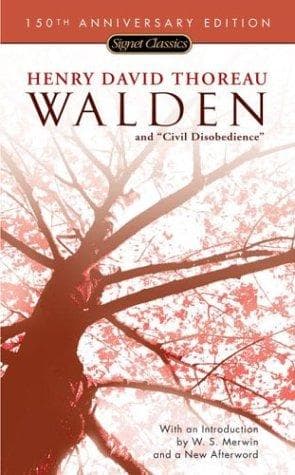
Core Idea
- Thoreau’s two linked projects are an experiment in simple living at Walden Pond and a moral argument for civil disobedience against unjust government.
- In both, his standard is the same: live by conscience and direct experience, not custom, property, convenience, or majority opinion.
- He treats modern life as cluttered by needless labor, false needs, and social conformity, while insisting that an individual can recover freedom by simplification, inward independence, and principled refusal.
Walden: Simplicity, Labor, and Self-Knowledge
- Thoreau builds and inhabits a small house near Walden Pond for over two years as a deliberate test of how little one needs to live well.
- He argues that most people are trapped by “factitious cares” and “superfluously coarse labors,” inheriting farms, houses, tools, and debts that make them “serfs of the soil.”
- His recurring diagnosis is that the mass of men live “lives of quiet desperation” and mistake resignation for freedom.
- He strips life down to the necessaries: Food, Shelter, Clothing, and Fuel, and argues that most luxuries are burdens rather than aids to human flourishing.
- The point of voluntary poverty is not asceticism for its own sake but the vantage point from which life can be seen clearly and honestly.
- He presents his own routine as an economic experiment: a little manual labor, a simple diet, minimal furniture, and enough leisure for observation, reading, and thought.
- His accounting of beans, bread, and household costs is meant to show that a person can meet needs without surrendering life to wage labor.
- He mocks the status-symbol logic of clothing, furniture, education, and housing, arguing that people too often serve possessions instead of using them.
- Railroads, commerce, newspapers, and “modern improvements” are criticized as faster means to old ends, not genuine progress.
- Even education is attacked when it becomes expensive, institutional, and abstract rather than practical and life-giving; he wants students to learn by doing.
- Thoreau’s prose repeatedly insists on simplicity, simplicity, simplicity as the cure for scattered attention and dependence.
Reading, Solitude, and the Uses of Nature
- Thoreau treats serious reading as a moral and intellectual discipline, not entertainment, and prizes the classics and scriptures as enduring “treasured wealth.”
- He contrasts high reading with “Little Reading,” cheap novels, and the shallow consumption of print that leaves readers dulled.
- Written language, for him, is a more mature and universal medium than speech; great books are a kind of inheritance across ages and cultures.
- Solitude at Walden is not loneliness but a state of mind, and he argues that one can be truly alone even in a crowd if one remains inwardly awake.
- Nature is his companion, teacher, and mirror: birds, pond, woods, weather, and seasonal change supply the deepest form of company.
- Walden Pond becomes the book’s central symbol: clear, deep, pure, and self-renewing, a mirror of both the world and the observer.
- He lingers over the pond’s color, transparency, ice, thaw, fish, and shoreline to show nature as living and exact rather than picturesque.
- Spring thaw especially matters to him because it reveals that the earth is not dead matter but a living earth, active, plastic, and generative.
- The railroad near Walden is both intrusion and emblem: it brings noise, commerce, and time-discipline, yet also shows the new power of modern civilization.
- Thoreau uses animal, plant, and landscape details to argue that wildness is not opposed to life but necessary to it.
Work, Wildness, and Moral Discipline
- His bean-field, fishing, walking, and woodcutting are not merely chores; they are occasions for moral and philosophical reflection.
- He admires ordinary labor when it is done consciously, but he rejects labor driven by greed, market pressure, or unnecessary consumption.
- He questions hunting and fishing as he practices them, moving from participation to self-reproach as he feels the pull of a higher law against killing.
- Food, drink, sensuality, and bodily discipline are treated as connected; he praises temperance and distrusts intoxication in all forms.
- He repeatedly frames wild creatures and marginal people as more truthful than respectable society, because they are less governed by performance.
- The former inhabitants of the Walden woods, the poor, and the socially marginal are memorialized as part of the place’s living history, not as sentimental decorations.
- His encounters with ants, loons, owls, mice, and birds become miniature dramas of struggle, intelligence, and indifference to human vanity.
- He treats hospitality, conversation, and village life as legitimate but limited goods; too much sociability dilutes the self.
Civil Disobedience: Conscience Against the State
- In On the Duty of Civil Disobedience, Thoreau argues that the best government is the one that governs least, and ideally not at all when people are ready for it.
- Government is merely an expedient; it becomes intolerable when it serves slavery, war, and injustice rather than justice.
- He rejects the idea that majority rule makes a law morally right, insisting that a person must be a man first and a subject afterward.
- Voting is not enough, because it is only a form of gaming; moral action requires direct refusal to cooperate with wrong.
- His central method is withdrawal of support: do not lend your person, money, or tax payment to an unjust state.
- The U.S. war with Mexico and the maintenance of slavery are his major examples of organized injustice demanding noncooperation.
- His own jail experience after refusing the poll tax becomes proof that prison may be the proper place for a just person under an unjust state.
- He treats tax resistance as a practical form of counter friction that exposes the state’s dependence on individual compliance.
- The state can punish bodies, but it cannot govern conscience unless the individual yields.
- He does not call for hatred of government, only for principled limits on allegiance and a refusal to let expediency override justice.
What To Take Away
- Thoreau’s lasting claim is that freedom begins when a person reduces external needs enough to hear conscience clearly.
- Walden shows how simplicity, labor, reading, and contact with nature can become a method for reclaiming inward independence.
- Civil Disobedience extends the same ethic into politics: if government requires complicity in injustice, the right response is noncooperation.
- Together, the works argue that a life worth living must be measured less by property, status, and speed than by truth, self-command, and fidelity to the higher law.
Generated with GPT-5.4 Mini · prompt 2026-05-11-v6