Core Idea
- Thoreau’s central experiment is to live deliberately and report the results plainly: after spending two years and two months in a self-built house near Walden Pond, he argues that most people live burdened by unnecessary labor, debt, fashion, and social expectation.
- He treats simplicity not as poverty for its own sake but as a way to recover freedom, attention, and spiritual depth; once the bare necessaries of life are secured, the real task is to “adventure on life.”
- The book is both a defense of self-reliance and a critique of modern civilization, which he says makes people into tools of their tools, servants of public opinion, and prisoners of property.
Life, Labor, and the Critique of “Civilized” Burdens
- Thoreau’s opening argument is that the “mass of men” live in quiet desperation, absorbed by factitious cares, mortgages, status, and “superfluously coarse labors” that consume their lives.
- He defines the human necessaries as Food, Shelter, Clothing, and Fuel, then argues that most comforts and luxuries are actually hindrances to elevation rather than aids.
- His discussion of clothing mocks fashion as social theater: people fear a patched knee more than a “broken conscience,” and he warns to “beware of all enterprises that require new clothes.”
- His discussion of shelter reduces the house to a warm covering and attacks the way modern houses become expensive burdens, often costing ten to fifteen years of labor and trapping their owners in rent, debt, and maintenance.
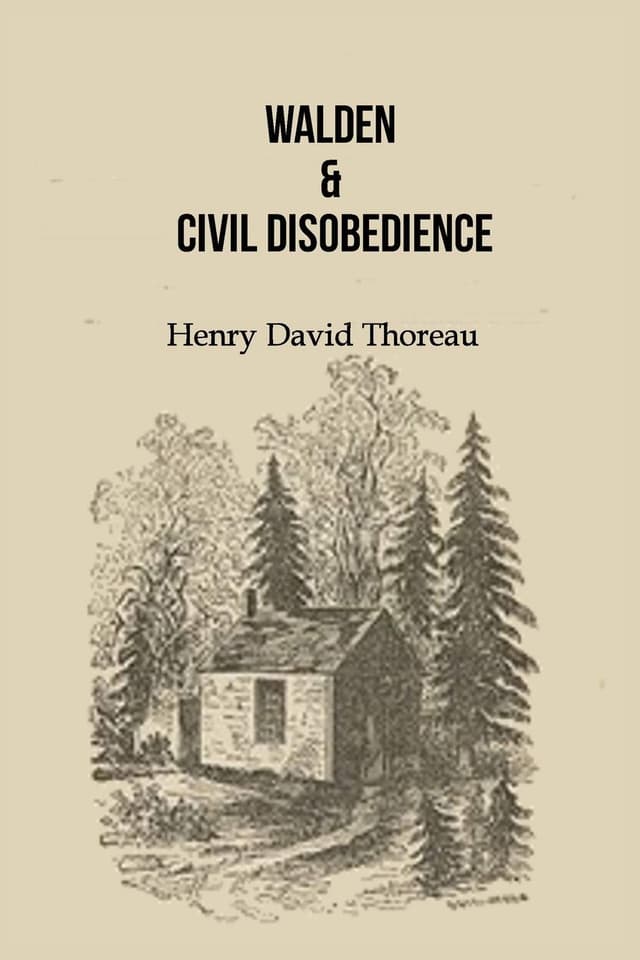
- He deliberately built a cheap house from reused materials near the pond in 1845, framing the project as a practical experiment in independence rather than frugality for its own sake.
- His own “business” is to observe nature, catch the “nick of time,” and write without tailoring his work to market demand, like the basket-seller who cannot make his wares worth buying.
Reading, Language, and the Higher Life
- Thoreau insists that all people could become students and observers if they chose, because truth is the one thing that makes a person “immortal” in contrast to property, family, fame, and state.
- He treats the best books as timeless and almost sacred: the classics are “the noblest recorded thoughts of man,” and true reading requires labor, restraint, and youthful effort.
- Easy reading, popular romances, and “Little Reading” produce dullness rather than wisdom; he wants readers to meet books as deliberately as they were written.
- He contrasts mother tongue speech, which is transient and almost brutish, with written language, which is mature, reserved, and demands that the reader be “born again.”
- Walden is, for him, a better study place than a university because it puts him beyond circulating libraries and nearer to the “books which circulate round the world.”
- He argues that education should not stop with school; towns should become true universities for adults, patronizing the best lectures, arts, newspapers, and serious thought rather than provincial gossip.
- Books alone are not enough, because nature speaks a language beyond print; the world itself offers a “language which all things and events speak.”
Walden as a Natural and Moral World
- Thoreau’s daily life at Walden is presented as a sustained encounter with the natural world: the pond, woods, birds, weather, plants, and animals form his real neighborhood.
- He is especially interested in the pond’s physical facts—its transparency, depth, color shifts, winter ice, and spring breakup—and uses careful observation to challenge local legends about its shape or origin.
- Walden is not merely scenery but a moral emblem: it is an “earth’s eye,” a mirror of the sky that remains pure despite roads, railroads, and human intrusion.
- He repeatedly contrasts Walden and nearby ponds with market value, arguing that the purest waters are too free and too lovely to be commodified.
- His descriptions of the seasons turn the pond into a calendar: winter freeze, ice harvesting, spring thaw, summer clarity, and autumn color all reveal nature’s order and renewal.
- He treats many plants, woods, and weather effects as shrines or revelations, including pine groves, cedar swamps, halos, rainbow light, and thawing sand shaped into living forms.
- The railroad is a recurring symbol of modern power: impressive, efficient, and morally suspect, it intrudes on the woods, regulates village life, and shows people becoming the tools of their tools.
Human Society, Wildness, and the Limits of Civilization
- Thoreau repeatedly contrasts the village’s gossip, labor, and commerce with the freedom of the woods, where solitude is not loneliness but a richer form of companionship.
- He values solitude as a condition of thought and self-possession, insisting that one can be crowded and lonely or alone and companioned by nature.
- His tax resistance and jail episode crystallize his political stance: he refuses a state that supports slavery and war, and he prefers integrity over compliance.
- The book’s many human portraits—the woodchopper, pauper, Irish family, farmers, philosophers, and village idlers—serve to distinguish mere livelihood from a fully awake life.
- Thoreau admires labor when it is simple, direct, and self-respecting, but he criticizes labor organized by convention, debt, or market dependency.
- He often treats hunting, fishing, meat-eating, and other bodily appetites as lower or transitional states, though he acknowledges their natural force and educational role in boyhood.
- He sees the body itself as morally expressive: a person’s habits of eating, work, restraint, and desire shape visible character.
What To Take Away
- Walden is a sustained argument that most modern “necessities” are optional burdens, and that freedom begins by stripping life down to what is truly needed.
- Thoreau’s method is not abstraction but example: he builds a house, farms beans, winters at the pond, and measures experience against careful observation.
- The book joins spiritual aspiration to physical concreteness: food, fire, ice, birds, and books all become tests of whether one is living deliberately.
- Its lasting challenge is simple but severe: stop accepting inherited habits as if they were proof, and ask what life becomes when reduced to truth, attention, and self-trust.
Generated with GPT-5.4 Mini · prompt 2026-05-11-v6