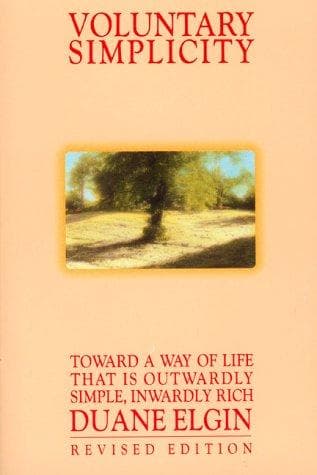
Core Idea
- Voluntary simplicity is a consciously chosen way of living that is outwardly simple and inwardly rich, not a retreat into deprivation, anti-technology romanticism, or mere “green” cosmetics.
- Elgin argues that humanity has reached an ecological and civilizational tipping point—energy depletion, climate change, overpopulation, water stress, and species loss make business as usual untenable.
- The book’s central claim is that simplicity is both a personal practice and a species-level response: it can deepen meaning and relationship while helping civilization move toward sustainability.
Why Simplicity Is Necessary
- The opening frame, reinforced by Edgar Mitchell and Ram Dass, is that Earth is a fragile “spacecraft” and that our lifestyles now have collective consequences.
- Elgin treats consumption as a civilizational problem because the planet is already in ecological overshoot, and waiting for unmistakable collapse could mean war, starvation, disease, and social breakdown.
- He rejects two weak versions of simplicity: crude/regressive simplicity that idealizes a return to the past, and cosmetic/superficial simplicity that preserves high consumption with minor efficiency tweaks.
- The preferred model is deep/sophisticated simplicity, a graceful transformation in work, housing, transport, food, clothes, and relationships that reduces harm and increases aliveness.
- The movement is framed as a “leaderless revolution” with many names—eco-living, green life-ways, earth-friendly living, soulful living, sustainable lifestyles—but the shared direction is a lighter touch on Earth.
What Voluntary Simplicity Includes
- Elgin organizes simplicity into eight “expressions”: uncluttered, ecological, family, compassionate, soulful, business, civic, and frugal simplicity.
- Uncluttered simplicity means reducing busyness, noise, and trivial distractions so attention can return to essentials.
- Ecological simplicity means “touching the Earth lightly” and honoring the wider community of life.
- Family simplicity places family well-being and the inheritance of a healthy planet above consumer status seeking.
- Compassionate simplicity draws on Gandhi’s “live simply so others may simply live,” linking moderation to justice, fairness, and global sharing.
- Soulful simplicity treats life as participation in a living universe rather than as a competition for possessions.
- Business simplicity points toward right livelihood and a greener economy that produces goods and services compatible with sustainability.
- Civic simplicity extends the ethic into governance, media, transportation, schools, workplaces, and city design.
- Frugal simplicity supports financial independence by eliminating needless spending, not by embracing deprivation.
- Common misunderstandings are explicitly rejected: simplicity is not poverty, not necessarily rural, not ugly, and not economic stagnation.
- The book emphasizes that many simpler-living people are urban or suburban, and that the consumer sector may shrink while unmet needs in education, healthcare, public works, repair, and renewal can expand.
Roots, Evidence, and the “Living Universe”
- Elgin situates simplicity in a long tradition: the golden rule and restraint in Christianity, moderation in Buddhism, Hinduism, Taoism, Greek philosophy, and American traditions like Puritanism, Quakerism, and Transcendentalism.
- He links Gandhi’s voluntary reduction of wants, Hindu aparigraha (non-possessiveness), and the Buddhist middle way to the idea that sufficiency supports spiritual and social life.
- American predecessors also matter: Puritan thrift, Quaker simplicity, and Emerson/Thoreau’s search for spirit through nature and inwardness.
- The book uses an early survey of voluntary simplifiers to show that the movement was not a fad: respondents were often educated, urban or suburban, and had usually been living this way for years.
- Their reasons clustered around inner growth, ecological responsibility, self-reliance, children, social justice, and freedom from consumerism.
- Lifestyle changes were usually gradual and practical—working fewer hours, gardening, composting, shopping secondhand, biking, eating less meat, using durable goods, and adopting passive solar or composting toilets.
- Inner practice mattered too, especially meditation, but also journaling, yoga, biofeedback, jogging, artistic work, science, and political engagement; there is no single inward path.
- A major philosophical turn in the book is the claim that science and spirituality are converging on a living universe rather than a dead, mechanical one.
- Elgin cites ideas such as non-locality, dark matter/energy, zero-point energy, continuous regeneration, consciousness at every scale, and quantum indeterminacy to support the image of a universe that is alive, emergent, and participatory.
- In that frame, consumerism makes sense only in a dead universe; in a living one, simplicity clears away clutter so people can feel the aliveness already present in relationships, nature, and self.
Humanity’s Larger Transformation
- Elgin says the deepest crisis is not only ecological but also one of collective vision: humanity lacks a shared story that can carry it into the future.
- He offers four archetypes for that story: humanity as a maturing species, heroic species, witnessing species, and cosmic species.
- As a maturing species, humanity must move from adolescent recklessness, status obsession, and instant gratification toward cooperation, stewardship, and adulthood.
- As a heroic species, the human journey becomes a collective rite of passage from separation and power-over-nature toward communion, invention, and sustainable community.
- As a witnessing species, humans can “know that we know,” which makes honest self-observation and cultural transparency transformative.
- Media therefore matter enormously: television and advertising are criticized for reinforcing consumer identity and cultural hypnosis, while the public airwaves should be reclaimed for ecological education, documentary, dialogue, and consensus-building.
- The book proposes Electronic Town Meetings (ETMs) as a way to surface shared priorities through televised dialogue and scientific sampling, not as a replacement for government but as support for democratic consensus.
- Elgin’s closing insistence is that no heroic leader or miraculous technology is required; enough people choosing a revitalizing future and working together can begin the shift.
What To Take Away
- Voluntary simplicity is not austerity but a conscious reordering of life around meaning, relationship, and ecological responsibility.
- The book’s argument depends on a stark diagnosis: ecological limits make high-consumption civilization unsustainable, so simplicity becomes a practical necessity as well as a moral choice.
- Elgin’s distinctive contribution is to connect personal lifestyle change, spiritual traditions, systems thinking, and media/political reform into one larger vision of civilizational change.
- The endpoint is not withdrawal from the world, but deeper participation in a living universe and in a more humane, sustainable civilization.
Generated with GPT-5.4 Mini · prompt 2026-05-11-v6