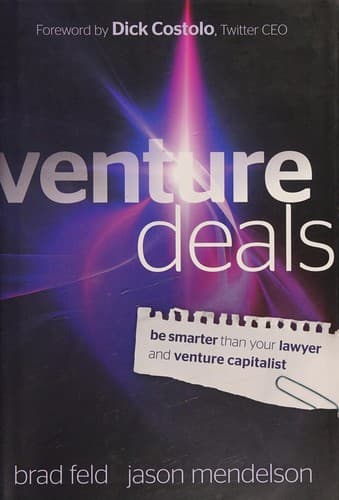
Core Idea
- Venture financing is a relationship-driven process where economics and control matter most, and entrepreneurs need to understand who actually has authority in the room.
- The book treats financing as a repeat game among founders, VCs, angels, lawyers, and future acquirers, so preserving leverage, trust, and clarity matters as much as getting a high price.
- Many terms that look technical at first—option pools, liquidation preferences, vesting, protective provisions, pay-to-play, and anti-dilution—are really about shaping incentives and power over time.
How Venture Deals Really Work
- Founders should stay at the center of fundraising and not outsource the deal to lawyers, because the financing documents define the long-term relationship and founders must understand them.
- VC firms have internal power structures: MDs/GPs make final decisions and sit on boards, while principals, associates, and analysts usually do research and support work.
- Entrepreneurs should diligence the firm and the person, ideally through other founders, and try to build a direct relationship with the actual decision-maker.
- Fundraising should start from a posture of confidence, not “testing the waters,” and founders should ask for a specific amount based on time to the next meaningful milestone rather than false precision.
- The authors strongly prefer short, substantive materials—email intro, executive summary, deck, and live demo/prototype—over long business plans or banker-driven PPM processes.
- Getting to multiple term sheets is the best leverage, because competition pushes peripheral terms toward market norms and makes a “slow no” effectively a no.
- The lead VC drives the round, but founders still need to communicate with every investor, and reverse-diligence the firm by talking to both successful and struggling portfolio companies.
- Negotiation is framed by three goals: a good/fair result, preserving the relationship, and understanding the deal; preparation, BATNA, and knowing the other side’s style are central.
- The authors warn against making the first offer, disclosing other term sheets or names, or relying on “it’s market” without understanding why it applies to this specific deal.
What the Term Sheet Is Really About
- The term sheet is not a letter of intent but the blueprint for the future relationship, and the two core issues are price/economics and control.
- Valuation can be premoney or postmoney, and founders should clarify which is meant; option pool size can silently lower the effective premoney because it is counted on a fully diluted basis.
- Liquidation preference sets how proceeds split on exit; the book favors simple 1× nonparticipating preferred in early-stage deals and strongly dislikes participating preferred, which gives investors extra downside protection.
- Pay-to-play is generally treated as healthy because it keeps investors committed in hard rounds, but it can become coercive if it enables a low-value recap that harms passive holders like friends-and-family angels.
- Vesting is usually four years with a one-year cliff, often with one year of credit at closing for existing founders; the goal is alignment, not just investor control, and double-trigger acceleration is the norm.
- Anti-dilution protects investors in down rounds; the book distinguishes full ratchet from weighted average, and broad-based formulas are less harsh than narrow-based ones.
- Control terms include board composition, protective provisions, drag-along rights, and conversion rights, which together can give investors effective control even without majority ownership.
- The authors prefer specificity over vague “material” qualifiers in protective provisions and prefer preferred classes to vote together rather than giving each series a separate veto.
- Conversion is treated as one of the few truly nonnegotiable investor rights: preferred can always convert to common, and automatic conversion on a qualified IPO is standard.
- Other terms matter more for signaling and downside than for most venture returns: dividends, redemption, registration rights, and IPO share-purchase rights are usually secondary in early-stage financings.
- Routine closing items still matter: information rights, right of first refusal, co-sale, founder activity covenants, indemnification, and assignment language all help define the company’s operating and transfer rules.
Cap Tables, Funds, and Hidden Economics
- A cap table is the real math of ownership, and founders need to understand it themselves because option pools, rounding, and fully diluted calculations can materially change outcomes.
- The book’s example shows how a $10M premoney, $5M VC check, and 20% employee pool can leave founders with only 46.67% of the company despite the same headline postmoney.
- The authors emphasize solving the cap table backward, using extra significant digits or fractional shares to avoid rounding errors, and having someone who actually understands VC cap tables do the math.
- VCs are themselves structured through management companies, GP entities, and fund LP vehicles, which matters because the legal entity on the term sheet may differ from the brand entrepreneurs know.
- LPs fund VC investments through capital calls, and if LPs cannot meet them, a fund can suffer serious stress that affects follow-on financing capacity.
- VC compensation comes mainly from management fees and carry; the book explains how fees accumulate across overlapping funds, why carry is firm-level rather than individual-level, and how clawbacks can arise if later losses erase earlier gains.
- Fund life affects behavior: commitment periods, fund extensions, reserves, “zombie VCs,” and key-man departures can all pressure firms toward or away from supporting companies.
- Reserve management is crucial because underreserving leads to favoritism and abandoned portfolio companies, while overreserving limits the fund’s ability to back new investments.
- VCs owe duties to multiple constituencies at once, creating a “fiduciary sandwich” that entrepreneurs should remember when reading investor behavior.
Special Situations, Legal Hygiene, and Exit Mechanics
- Convertible debt is treated as debt, not equity: it delays valuation, often converts at a discount, and can create insolvency and liability issues if used carelessly.
- Early deals can create long-tail problems later, especially when seed terms are too generous, investor veto rights are too broad, or separate preferred classes can block future rounds and IPOs.
- Acquisition LOIs are mostly nonbinding but economically important, because headline price is often reduced by escrows, working-capital adjustments, earn-outs, and retention pools.
- Sellers should pay close attention to the form of consideration: cash is straightforward, but private stock requires examining capital structure, liquidity, registration rights, and lockups.
- Stock option treatment in an acquisition can significantly alter who gets what, so vesting assumptions and exercise price basis matter.
- In M&A, confidentiality is usually bidirectional and NDAs are normal, unlike venture financings where the authors dislike NDA requests.
- Post-close administration is real work: the shareholder representative handles escrows, earn-outs, and disputes, so it should not be someone conflicted or inattentive.
- Basic legal hygiene matters throughout: clean IP assignment, proper employee documents, accredited-investor discipline, timely 83(b) filings, Delaware incorporation, and a current 409A valuation.
- The book repeatedly warns that small paperwork mistakes or ownership ambiguities—especially around IP, founders, contractors, or option grants—can stall or kill a financing.
What To Take Away
- Venture financing is less about a single “best price” than about structuring incentives, authority, and future optionality.
- The terms that look exotic—preferences, anti-dilution, vesting, board control, pay-to-play—are often the ones that determine who really wins or loses later.
- Founders who understand the cap table, the fund structure, and the negotiation dynamics can spot hidden dilution and control shifts before they become irreversible.
- The book’s practical standard is simple: know the deal, know the people, and never treat legal mechanics as someone else’s problem.
Generated with GPT-5.4 Mini · prompt 2026-05-11-v6