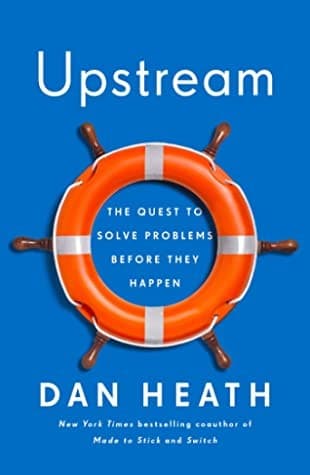
Core Idea
- Upstream argues that the best solution to many recurring harms is to prevent them, not merely respond after the damage is done.
- The book defines upstream thinking as reducing the chance of problems happening at all, or reducing harm systematically, even when the work is slower, messier, and harder to own than downstream response.
- Heath’s central claim is that societies and organizations are overbuilt for rescue and repair, and underbuilt for prevention.
Why We Keep Getting Stuck Downstream
- One root cause is problem blindness: people become so used to bad outcomes that they stop treating them as abnormal or fixable.
- Another barrier is lack of ownership: even when a problem is visible, teams often assume it belongs to someone else.
- A third barrier is tunneling: scarcity of time, money, and attention pushes people into short-term firefighting and away from root causes.
- Expedia illustrates the difference: instead of endlessly answering itinerary calls, the company reduced the need for calls by fixing email delivery, automating re-sends, and improving self-service.
- The book argues that focused organizations can still miss upstream opportunities because each unit optimizes its own task while nobody owns the whole customer problem.
The Main Mechanisms of Upstream Change
- Problem blindness is overcome when someone notices that “normal” is actually dysfunctional, as in the Patriots’ injury work, Chicago Public Schools’ graduation crisis, and Brazil’s overuse of C-sections.
- Chicago’s Freshman On-Track metric showed that ninth grade was the key leverage point; CPS improved results by giving freshmen stronger teachers, real-time data, and cross-disciplinary teams.
- Brazil’s childbirth reform shows that upstream change can come from redesigning the system, not shaming individuals: no elective C-sections before 40 weeks, shift-based coverage, continuity with obstetric nurses, and protected doctor income helped raise natural births.
- Lack of ownership is countered by asking, “Why not us?”—as Ray Anderson did at Interface when he committed the company to Mission Zero and made sustainability everyone’s job.
- Ownership can also be claimed at the personal level; Jeannie Forrest’s “move your chair” insight captures the habit of fixing what you can control instead of waiting for others.
- But the book is careful about limits: asking victims of harassment to own the problem would be blame-shifting, not upstream thinking.
- Tunneling explains why systems drift toward crisis response; nurses, poor families, and overworked managers may solve immediate problems while the underlying system never learns.
- The antidote is slack and structured time for problem-solving, such as safety huddles, collaborative meetings, or Freshman Success Teams.
What Upstream Work Looks Like in Practice
- Effective upstream work usually requires the right coalition, not just “more people,” as shown by Iceland’s anti-teen-drinking campaign.
- Iceland changed youth substance use by surrounding the problem with parents, schools, police, sports clubs, media, churches, and researchers, while increasing structured time and organized activities.
- The program relied on annual surveys, “outside hours” curfews, and making healthy participation socially binding; teen drinking, smoking, and cannabis use fell dramatically by 2018.
- Upstream work also means co-ownership across institutions, as in domestic-violence prevention teams that linked police, hospitals, advocates, prosecutors, probation, and batterer-intervention staff.
- The Danger Assessment and monthly high-risk reviews helped identify women in danger before homicide, and the coordinated response included concrete actions like emergency plans, drive-bys, and GPS fixes.
- Rockford’s homeless-services reform used the same logic: housing first, coordinated entry, by-name lists, and real-time case review helped the city reach functional zero for veterans and chronic homelessness.
- The book repeatedly shows that data for learning matters more than data for inspection; upstream teams need information fast enough to change what they are doing.
- Tony Iton’s work on health inequities reinforces the book’s systems view: life expectancy gaps by ZIP code are driven less by individual choices than by accumulated neighborhood conditions, stress, and policy.
- Heath stresses that systems change means making the right thing happen by default, not by constant heroics.
- In this framework, public health, housing, education, safety, and climate all become upstream problems because the causes are distributed and the harms are delayed.
Leverage, Measurement, and Unintended Consequences
- Chapter 7’s leverage theme is that the hardest part is finding the right point to intervene, especially early in a long effort.
- The Chicago Crime Lab shows this search in action: by reading homicide files closely, it found many killings were ordinary disputes that escalated through impulsivity, alcohol, and access to guns.
- BAM (Becoming a Man) worked by interrupting that escalation with small-group mentoring, check-ins, and cognitive reframing; arrests among participants fell, including violent-crime arrests.
- The book favors immersion and proximity over common sense, because close contact reveals leverage points that abstract thinking misses.
- Chapter 8 warns that early warning systems are only useful when the signal arrives in time to act, as with LinkedIn onboarding, EMS forecasting, CPR training, or school-shooting tip lines.
- The text also emphasizes the danger of alarm fatigue and bad screening, using thyroid-cancer overdiagnosis as a cautionary example.
- Chapter 9 warns against ghost victories: metrics can improve for the wrong reasons, misalign with the mission, or become the mission themselves.
- Chapter 10 adds that even successful interventions can create second-order effects, from Macquarie Island’s ecological cascade to cobra-bounty incentives and open-office backlash.
- The book’s answer is not paralysis but experimentation, feedback loops, and humility; upstream leaders should test whether a change is trial-able, reversible, and measurable in a way that actually reflects the mission.
- Chapter 11’s funding argument is that prevention fails politically because success is invisible and benefits are often in the wrong pocket; costs and savings are spread across different institutions.
- Programs like the Nurse-Family Partnership show why this matters: strong evidence exists, but financing is hard because one payer may spend while another captures the gains.
What To Take Away
- Upstream is a book about changing the conditions that produce harm, not just improving response after harm arrives.
- Its recurring lesson is that effective prevention requires ownership, proximity, leverage, feedback, and coalition-building.
- The book is optimistic but not naive: good intentions, simple metrics, and one-shot fixes are not enough, and prevention can backfire if systems are not carefully designed.
- The deepest ambition is to build a “world avoided”—a set of quieter successes where the bad thing never happens.
Generated with GPT-5.4 Mini · prompt 2026-05-11-v6